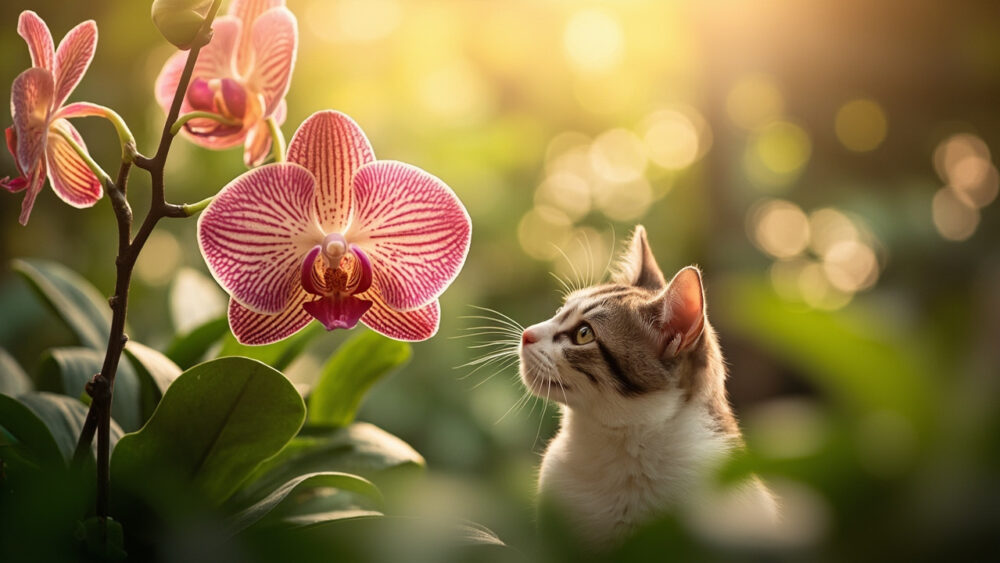
No, the common moth orchid (Phalaenopsis) and most other orchids sold as houseplants are not toxic to cats. They are on the ASPCA’s non-toxic list for cats and dogs. That is the short answer, and it is a genuine relief if you just watched your cat take a bite out of a leaf or knock a bloom spike off the windowsill.
But “orchid” covers a huge family, is orchid toxic to cats gets a slightly different answer depending on which plant you actually own, and a cat that eats any houseplant in bulk can still end up with an upset stomach even when the plant itself is not poisonous. There is also one common mix-up that sends worried owners searching in a panic over nothing, and a couple of look-alikes worth knowing so you never have to wonder again.
Keep reading and I will cover exactly which part of the plant to worry about, the signs that mean a vet call regardless of toxicity status, and what to grow instead if you want zero risk at all. Save the quick-reference card at the bottom for the next time this question comes up at 11pm.
The Plain Answer: Orchids and Cats
True orchids, the Orchidaceae family that includes Phalaenopsis, Cattleya, Dendrobium, and Oncidium, are considered non-toxic to cats. No calcium oxalate crystals, no cardiac glycosides, nothing in the tissue that is going to poison your cat.
If your cat chewed a leaf, batted a flower off the spike, or even nibbled the moss or bark mix out of the pot, the plant itself is not the danger. That last part matters more than people think, since a lot of the “orchid poisoning” scares are really reactions to what is in the potting medium, not the plant.
Here is where the answer gets more interesting than a flat yes or no.
The Mix-Up That Scares People Over Nothing
The confusion almost always comes from the name, not the plant. “Lily” shows up in a few orchid nicknames and in genuinely dangerous true lilies (Lilium and Hemerocallis species), and cat owners sometimes conflate the two after a quick panicked search.
True lilies are severely toxic to cats, capable of causing acute kidney failure from even a small amount of pollen or a lick of water from the vase. Orchids share none of that chemistry.
If there is any chance the plant in question is a true lily rather than an orchid, treat it as an emergency and skip straight to the vet, no observation period. That single naming mix-up is responsible for more midnight panic than almost anything else in this plant family.
Knowing which plant you actually have is half the battle, so let’s talk about what still matters even with a genuinely safe one.
What Still Matters Even Though Orchids Are Safe
Non-toxic does not mean risk-free in every scenario. A cat that eats a large quantity of any plant material, orchid included, can get vomiting or loose stool simply from the fiber and bulk, not from any toxin.
Fertilizer residue on the leaves or in the soil is a separate consideration, since some fertilizer products are irritating in concentrated form even when the plant itself is harmless. Follow the product label on any fertilizer and keep freshly fed plants out of paw’s reach for a day or two.
The bark, moss, or perlite mix many orchids grow in can also be a choking or blockage risk in bulk if a cat digs it out of the pot and eats it, which is a mechanical problem, not a toxicity one.
The plant passes the toxicity test, but the pot around it deserves its own look.
Signs Worth Watching For Anyway
Even with a non-toxic plant, watch for the general signs of a plant-related stomach upset: vomiting, drooling, loss of appetite, lethargy, or diarrhea in the hours after you catch them chewing.
- Vomiting or repeated retching
- Drooling more than usual
- Refusing food or water
- Unusual quietness or hiding
- Loose stool within a day of the incident
Most of the time with orchids specifically, you will see nothing at all, or a mild, short-lived stomach upset that resolves on its own. That is a genuinely different picture from a lily exposure, and it is worth knowing the difference so you are not treating every houseplant incident like an emergency.
Still, “probably fine” is not the same as “ignore it,” so here is what to actually do.
If Your Cat Ate Orchid: What To Actually Do
Call your veterinarian or an animal poison control line for any suspected ingestion, even one you believe is low risk. They know your cat’s history and can tell you whether this particular case needs a visit.
Before you call, take note of which plant it was, roughly how much is missing, and when you noticed it. A photo of the plant and the damage helps a vet or vet tech assess it fast if you cannot identify the species by name.
Do not give home remedies, induce vomiting, or administer anything without direction from a professional. That advice applies to every houseplant incident, toxic or not, since some home fixes cause more harm than the plant ever would.
If your cat seems fine now but you want zero repeat performances, the next section is for you.
Cat-Safe Look-Alikes and Alternatives
If you love the look of orchids but want extra peace of mind, several non-toxic houseplants deliver similar drama. Spider plant, Boston fern, and African violet are all safe for cats and easy to keep out of chewing range on a shelf.
If you specifically want to keep growing orchids but discourage the cat from investigating, a few plant pens or hanging arrangements out of jump range solve the access problem without giving up the plant. Bitter-tasting, pet-safe leaf sprays can also help redirect a determined chewer, used according to the product label.
Skip anything in the true lily family entirely if your cat has access to it, since that is the one common houseplant relative that genuinely earns the fear.
That is the whole picture, now here is the version you can screenshot.
Orchid: Quick Reference
- Toxic to cats: no, true orchids (Phalaenopsis, Cattleya, Dendrobium, Oncidium) are on the ASPCA non-toxic list
- Parts of concern: none are toxic, but bark or moss potting mix can cause mechanical upset if eaten in bulk
- Common confusion: true lilies, which are severely toxic to cats, sometimes get confused with orchids by name alone
- Signs to watch for: vomiting, drooling, appetite loss, lethargy, diarrhea, usually mild and short-lived with orchids specifically
- What to do if eaten: call your veterinarian or poison control for any suspected ingestion, note the plant and amount, never give home remedies
- Safer alternatives: spider plant, Boston fern, and African violet if you want a zero-risk houseplant lineup
Orchids are one of the rare houseplants you can grow without a second thought where your cat is concerned.
Keep the lilies out of the house instead, and you have solved the actual risk.