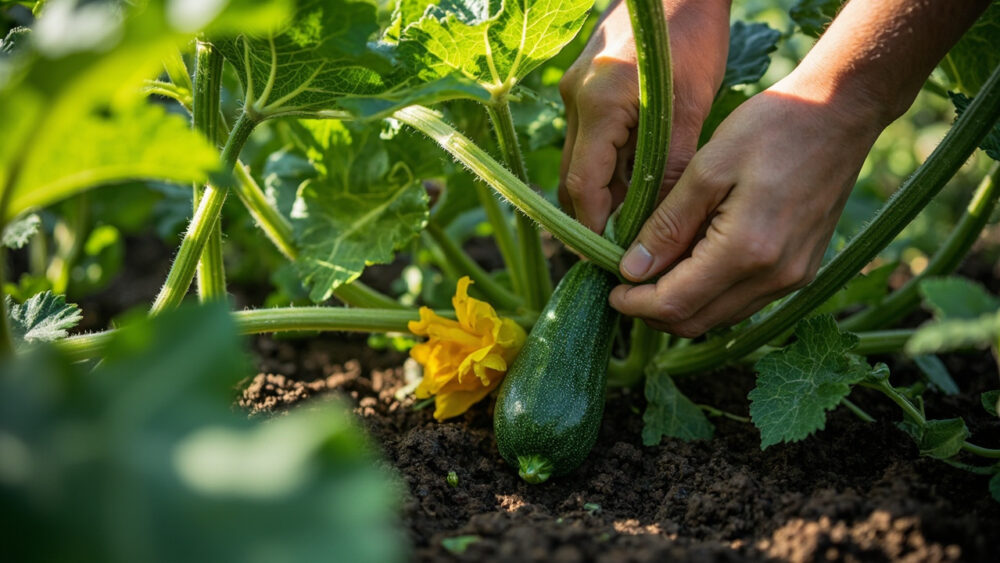
Caring for zucchini comes down to five things: full sun, consistently moist soil, room to sprawl, weekly feeding once it starts flowering, and hand-pollination backup if fruit keeps rotting on the vine. Get those right and one or two plants will bury you in squash by midsummer. Get them wrong and you will spend July staring at yellow blossoms that fall off without ever setting fruit.
That fruitless blossom problem is the one that ends most people’s zucchini season early, and the real cause is not what most gardeners assume. There is also a watering mistake that looks exactly like a fungal disease, and a pruning move almost nobody does that keeps a plant productive for an extra month.
Stick around for the full breakdown, and save the Zucchini at a Glance card at the bottom for the numbers you will actually need this weekend.
Sun, Placement, and Temperature Zucchini Actually Wants
Zucchini wants full sun, six to eight hours minimum, and warm soil. Plant it too early into cold ground and the seed just sits there or rots. Wait until soil temperature is reliably above 60°F, which is usually two to three weeks after your last spring frost.
Give each plant real room. Bush varieties need 24 to 36 inches between plants, with rows 3 to 4 feet apart, because the leaves get enormous and airflow matters more than it looks like it should. Cramped plants get mildew faster than anything else.
Direct-seed it if you can, an inch deep, two or three seeds per spot thinned to the strongest one. Zucchini transplants fine too, but it resents root disturbance, so start it in biodegradable pots if you’re starting indoors.
Get the spacing and timing right and the next question is almost always about water.
Watering: The Mistake That Mimics Disease
Zucchini needs about 1 to 1.5 inches of water a week, more during fruiting and hot stretches. Check the soil 2 inches down: if it’s dry there, water deeply at the base rather than a light daily sprinkle, which only wets the surface and encourages shallow roots.
Here’s the mistake that fools people. Overhead watering in the evening leaves the big leaves wet all night, and that alone triggers powdery mildew, the white dusty coating gardeners assume means their soil or fertilizer is off. It’s not a soil problem. It’s wet leaves at the wrong hour.
Water early morning, aim at the soil, and use a soaker hose or drip line if you have repeat mildew trouble. Mulch with 2 to 3 inches of straw or shredded leaves to hold moisture and keep splash off the foliage.
Get the water routine right and the soil underneath still has to hold up its end.
Soil and Feeding: Why Blossoms Fall Off Without Fruiting
Zucchini wants rich, well-drained soil with a pH around 6.0 to 6.8. Work in 2 to 3 inches of compost or aged manure before planting, because this plant is a heavy feeder and thin soil shows up fast as pale leaves and small fruit.
Once flowering starts, side-dress every 3 to 4 weeks with a balanced or slightly phosphorus-and-potassium-leaning fertilizer. Too much nitrogen gives you huge dark leaves and almost no squash, which is the opposite problem from what most people expect.
Now, the blossom drop everyone blames on bad soil or weather. Zucchini produces separate male and female flowers on the same plant, and the first flush is almost always all male. Those are supposed to fall off. It’s not a disease, not a nutrient problem, just the plant’s normal sequence before female flowers show up with a tiny swollen bulb at the base.
Once both flower types are open at the same time, pollination becomes the real bottleneck, and that’s worth watching closely.
Hand-Pollination: The Fix Nobody Mentions Until It’s Too Late
If female flowers open and the little fruit behind them shrivels and rots instead of growing, that’s a pollination failure, not disease, even though the rotting tip looks alarming. Poor bee activity, cool damp weather, or too few flowers open at once are the usual causes.
The fix is simple and takes thirty seconds. Pick a fresh male flower (no bulge at the base), strip the petals, and dab the pollen-covered center directly onto the center of an open female flower, early morning while both are open.
Do this every couple of days during a slow patch and you will keep fruit setting even in a rough pollinator year.
With pollination handled, the plant needs a bit of upkeep to stay productive all season.
Routine Tasks: Pruning, Harvesting, and Keeping It Clean
Zucchini doesn’t need much pruning, but removing a few of the oldest, lowest leaves once the plant is established improves airflow and slows mildew. This is the move almost nobody bothers with, and it genuinely extends the productive window by weeks.
Harvest young, at 6 to 8 inches long, when the skin is still glossy and easy to nick with a fingernail. Left too long, zucchini turns into a watery, seedy baseball bat and the plant slows production trying to mature that one giant fruit.
- Check plants every 1 to 2 days once fruiting starts, they grow fast
- Cut fruit with a sharp knife, leaving an inch of stem
- Remove any yellowing or mildew-spotted leaves promptly
- Clear fallen leaves and old fruit off the soil to reduce disease and pests
Stay ahead of harvest and cleanup, and most of the serious problems below never get a foothold.
The Problems Most Likely to Hit Your Zucchini
Powdery mildew (white dusty coating) comes from wet leaves and poor airflow, fix it with spacing, morning watering, and removing affected leaves; a labeled fungicide can help if you catch it early, following the product instructions exactly.
Squash vine borers are the plant’s most dangerous pest. Wilting that happens suddenly, on one otherwise healthy-looking stem, with a small hole and sawdust-like frass near the base, means a borer larva is inside. Once it’s in the stem, that vine usually cannot be saved.
Squash bugs and cucumber beetles show up as clusters of small bugs or bronze eggs on leaf undersides. Handpick early, check daily, and remove egg clusters before they hatch.
Blossom end rot on the fruit itself usually traces back to inconsistent watering rather than a calcium deficiency in the soil, so evening out your watering schedule fixes more of these than any additive does.
Catch these early and your plant sails into the stretch where it’s genuinely cranking out fruit.
Signs Your Zucchini Is Actually Thriving
A thriving plant has broad, deep green leaves, sturdy upright growth, and both male and female flowers opening steadily through the week. You’ll be harvesting every other day at peak, not scrambling to find one hidden fruit.
Healthy plants also shrug off a little mildew on old lower leaves late in the season, that’s normal aging, not failure, as long as new growth stays clean.
If you’re overwhelmed with squash by midsummer, that’s not a problem to solve, that’s the plant doing exactly what it’s built to do.
Zucchini at a Glance
- When to plant: two to three weeks after your last frost, once soil is reliably above 60°F.
- Spacing: 24 to 36 inches between plants, rows 3 to 4 feet apart, seeds 1 inch deep.
- Light: full sun, six to eight hours daily minimum.
- Water: 1 to 1.5 inches per week, deep and at the base, morning watering only.
- Feeding: compost at planting, then a balanced fertilizer every 3 to 4 weeks once flowering starts.
- Harvest: at 6 to 8 inches long, checking plants every 1 to 2 days during peak season.
- Watch for: powdery mildew from wet leaves, squash vine borer at the stem base, and blossom drop that is normal in the first flush of male flowers.
If you remember nothing else, remember this: water the soil, not the leaves, and let the first round of flowers fall without worrying about it.
Everything else about zucchini is forgiving as long as you give it room and don’t let it dry out.