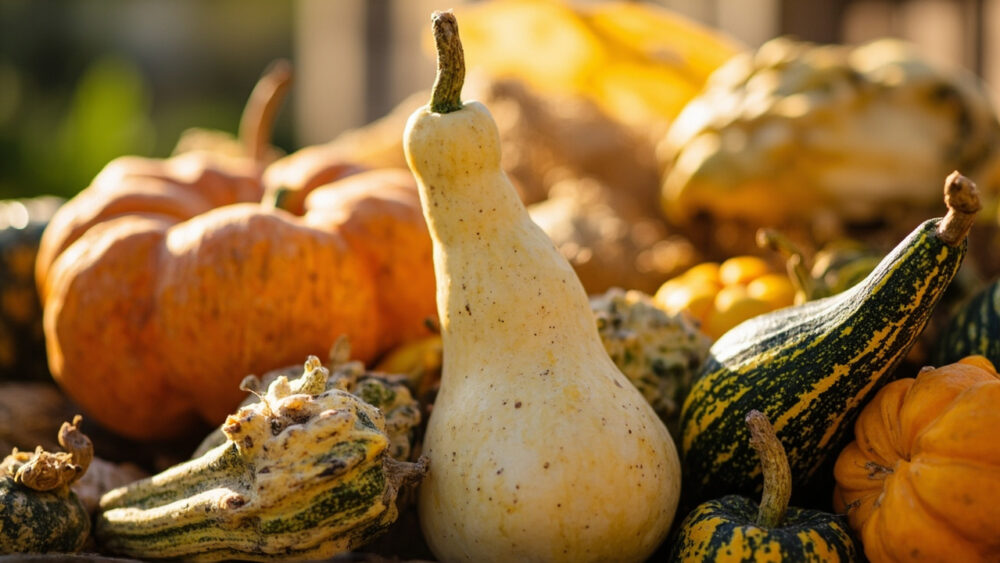
The fastest way to sort out types of gourds is to ask what you actually want from the vine: something to eat, something to carve and dry for winter, or something purely ornamental for a fall table. That single question eliminates most of the confusion, because edible squash-type gourds, hard-shelled bottle and dipper gourds, and decorative Cucurbita pepo gourds are grown almost completely differently and mature on different timelines.
Most beginners grab the little striped ornamental gourds at the garden center because they look charming in a photo, then wonder why the vine ate the entire fence and produced fifty gourds nobody wants. Meanwhile the gardeners who grow gourds year after year usually quietly favor one type most people overlook completely, a slow, unglamorous grower that turns into something genuinely useful once it dries.
Below are 15 types across four categories: ornamental gourds, hard-shell utility gourds, edible gourds, and a few oddball specialty types worth knowing. Number 13 is the one most people identify completely wrong at the farmers market, and the last few entries plus a straightforward method for choosing between all of them are waiting at the bottom, so keep scrolling.
Ornamental Gourds: Grown to Look Good, Not to Eat
These are Cucurbita pepo types, the same species as ornamental pumpkins, and none of them are worth eating even though they are not seriously toxic.
1. Warted Gourds
Bumpy, knobby skin is the giveaway here, and the bumps get more pronounced as the fruit cures after picking. They come in orange, green, and bicolor forms, vine aggressively (expect 10 to 15 feet of sprawl), and are grown strictly for fall decoration, not the table.
2. Turk’s Turban Gourds
A mushroom-cap shape with a round, striped top sitting on a paler bottom knob sets this one apart instantly. It holds its color well into winter if kept dry, and the vines need real space, figure 6 feet of trellis or ground room per plant.
3. Crown of Thorns Gourds
A ring of pointed spikes circling the widest part of the fruit makes this the spikiest thing in the ornamental gourd world. They are small, 3 to 4 inches, and dry to a hard, long-lasting shell that holds its shape for years on a shelf.
4. Spoon Gourds
A long curved neck ending in a rounded bowl is the shape, and it is exactly what it sounds like, an edible-looking but purely decorative gourd shaped like a ladle. Grow them on a trellis so the necks hang straight instead of curling on the ground.
5. Nest Egg Gourds
Smooth, white, egg-sized fruit that genuinely gets mistaken for real eggs from ten feet away, which is the entire point historically, they were once placed in henhouses to encourage laying. Compact vines make this one of the few gourds that behaves in a small garden.
Ornamental types are easy and forgiving, but the hard-shell gourds below ask for real patience.
Hard-Shell Utility Gourds: Grown to Dry, Cure, and Use
These are Lagenaria siceraria, bottle gourds, and they need a long season, 120 to 180 frost-free days, plus weeks of curing after harvest before they are usable.
6. Bottle Gourds
A rounded bottom with a narrower neck, roughly bottle-shaped, gives this one its name and its use, once dried it becomes a genuine water vessel or container. The skin starts fuzzy and pale green, turns hard and tan as it cures, and needs 2 to 6 months of dry storage before it is fully hollow and light.
7. Dipper Gourds
A long, slightly curved handle attached to a bulbous bottom is the tell. Grown on a trellis so the handle hangs straight and long instead of kinking on the ground, this is the type most often turned into actual kitchen dippers and birdhouses once cured.
8. Snake Gourds
Extreme length is the whole story, fruit routinely reaches 3 to 6 feet and can curl or coil as it hangs. Trellising is not optional here, the fruit needs to hang free or it grows into odd, unusable knots on the ground.
9. Kettle Gourds
A wide, rounded, squat body with almost no neck at all sets this apart from the bottle gourd. It cures into a thick-walled, genuinely sturdy shell, historically used as a bowl or container, and it is one of the slower gourds to dry fully because the walls are so thick.
If you actually want food from the vine, the next category is where to look.
Edible Gourds: The Ones You Cook
These are harvested young and soft, before the shell hardens, and they cook more like a mild summer squash than anything you would carve.
10. Bitter Gourd (Bitter Melon)
Warty, ridged, pale green skin on an oblong fruit, and a genuinely bitter flavor that is the entire point in the cuisines that use it most, particularly South and Southeast Asian and Caribbean cooking. Harvest young, while still firm and pale, since it turns orange, soft, and much more bitter as it ages on the vine.
11. Sponge Gourd (Luffa)
Ridged, cylindrical fruit that is edible young and turns into the fibrous bath sponge everyone recognizes if left to mature and dry fully. Pick some young for the pan and leave others on the vine into fall if you want the fibrous version, the plant genuinely gives you both options from the same vine.
12. Bottle Gourd, Young Harvest
The same vine as entry 6, harvested at a completely different stage, this is the young, tender, pale green bottle gourd sold and cooked as a vegetable throughout South Asian cuisine. Pick it when the skin still dents easily under a fingernail, once it resists pressure it is headed toward hard-shell territory instead of the dinner table.
13. Chayote
A single large seed inside pale, wrinkled, pear-shaped fruit is what actually separates chayote from summer squash, and this is the entry most people misidentify at the market, assuming it is a bland cucumber or unripe pear. It is a genuinely vigorous perennial vine in warm climates (zones 9 to 11 outdoors, an annual everywhere colder), needs a sturdy trellis, and produces mild, crisp fruit good raw or cooked.
A couple of true oddballs round out the list, and they deserve a category of their own.
Specialty and Novelty Gourds
These do not fit neatly into ornamental or edible and are worth growing specifically for the story they tell at harvest.
14. Apple Gourds
Small, round, apple-sized fruit in cream, green, or bicolor makes this the most versatile little ornamental gourd, compact enough for containers and prolific enough that a couple of plants fill a whole harvest display. It is genuinely one of the easier gourds for a first-time grower with limited space.
15. Tennessee Dancing Gourds
A long, skinny neck with a small round head gives this novelty gourd its odd human-like silhouette and its name, since dried ones rattle their seeds and are traditionally shaken like maracas. This is the quietly favored one among longtime growers, unglamorous on the vine, genuinely satisfying once dried and rattling in your hand.
How to Choose the Right One
Work through these in order and the right gourd for your space and goal becomes obvious fast.
- Space first: vining gourds need 6 to 15 feet of trellis or ground room, if you only have a small raised bed, pick compact ornamentals like apple gourds, not snake gourds or Turk’s turban.
- Climate next: hard-shell and long-season edible gourds like chayote and bottle gourds want a long, warm season, 120 days or more without frost, cooler short-season climates should lean toward faster ornamentals and young-harvest luffa or bitter gourd.
- Purpose third: decide if you want food, a dried craft or container piece, or fall decoration, since that single decision sorts all 15 types into the right category immediately.
- Curing tolerance: hard-shell gourds need weeks to months of dry curing after harvest before they are usable, skip these if you want a finished product the same season.
- Support structure: any gourd producing fruit longer than 12 inches needs a trellis, straight, usable shapes do not happen on fruit left to sprawl and curl on bare ground.
- Light and water: nearly all gourds want full sun, 6 or more hours daily, and consistent moisture while fruit is sizing, drought stress during that window is the most common cause of stunted or oddly shaped fruit.
Pick the category that matches your goal, then pick the shape you actually want to look at on the vine.
Either way, give the vine the room it is asking for, and it will give you more gourds than you know what to do with.