Here is how to grow acorn squash without wasting a season: wait until the soil is reliably above 65°F and all frost danger has passed, give each plant 3 to 4 feet of room to sprawl (or a sturdy trellis if space is tight), and keep the soil evenly moist until the fruit’s skin turns matte and hard, usually 80 to 100 days after planting. That is the short version. The long version is where most gardeners lose their crop without realizing why.
Three things trip people up almost every time. The first is planting too early in soil that looks warm but isn’t, which stalls germination for weeks and lets the seed rot before it sprouts. The second is misreading a healthy squash plant’s midday wilt as a watering emergency, when it’s often just the plant protecting itself from heat. The third is the harvest question nobody asks until it’s too late: does acorn squash actually stop ripening once you cut it, and how do you know it’s really done on the vine?
All three get answered below, in order, along with the pests that actually threaten this crop and the ones you can ignore. Stick around to the end and you’ll find a save-able Acorn Squash at a Glance card with every number in one place.
When to Plant Acorn Squash
Acorn squash is a warm-season crop through and through. Wait until soil temperature sits at 65 to 70°F at a 2-inch depth, which usually lands 1 to 2 weeks after your last spring frost date. Cold, wet soil is where seeds rot instead of sprout.
In most of zones 3 to 6, that means late May into early June. In zones 7 to 9 you can plant as early as mid to late April, and warm-winter zones 9b to 11 can often get away with a second planting in mid to late summer for a fall harvest.
If you want a head start, start seeds indoors 2 to 3 weeks before your last frost in biodegradable pots, since squash roots hate disturbance. Direct-sowing after the soil warms is simpler and usually catches up within a few weeks anyway.
Get the timing right and the rest of the season gets a lot easier.
Choosing the Spot and Prepping the Soil
Acorn squash wants full sun, 6 to 8 hours minimum, and room to run unless you’re trellising. Vining varieties can stretch 6 to 10 feet, so give them space or a fence line to climb.
Soil matters more than most people expect. Squash is a heavy feeder that wants loose, well-drained ground rich in organic matter. Work 2 to 3 inches of compost into the top 8 to 10 inches of soil before planting, and aim for a pH between 6.0 and 6.8.
Raised mounds, sometimes called hills, help in areas with heavy clay or slow drainage. Build them 12 inches wide and a few inches tall, since warmer, faster-draining soil gets seedlings off to a stronger start.
The bed is ready. Now the actual planting technique decides whether those seeds turn into strong vines or a patchy mess.
Planting Step by Step
- Depth: sow seeds 1 inch deep in warm soil, slightly shallower in heavier clay.
- Spacing: plant 2 to 3 seeds per hill, hills spaced 3 to 4 feet apart in rows 4 to 6 feet apart.
- Thinning: once seedlings have 2 true leaves, snip all but the strongest one at soil level per hill.
- Transplants: if starting indoors, harden off over 4 to 5 days before setting out, planting at the same depth they were growing in the pot.
- Mulch: apply 2 to 3 inches of straw or shredded leaves once seedlings are up, to hold moisture and keep fruit off bare soil later.
Seeds and transplants in the ground is the easy part, keeping them alive through July heat is where the real work starts.
Watering and Feeding Through the Season
Acorn squash needs about 1 to 1.5 inches of water per week, more during fruit set in hot, dry stretches. Water deeply at the base rather than overhead, since wet leaves invite powdery mildew.
If you assumed a droopy, wilted-looking plant at 2 p.m. means it’s thirsty, that guess sends a lot of gardeners out with a hose they didn’t need. Squash leaves are broad and often go slack in full afternoon sun purely to reduce water loss, then perk back up by evening. Check soil moisture 2 inches down before you water. If it’s still damp, leave it alone.
Feed at planting with a balanced fertilizer or compost, then side-dress with a phosphorus-and-potassium-leaning feed once vines start running and again when flowers appear. Too much nitrogen late in the season gives you huge leaves and disappointing fruit.
Water and feeding keep the plant alive, but it’s the pests and diseases that decide whether it survives to harvest.
Problems That Actually Threaten This Crop
Three pests cause most acorn squash failures: squash bugs, cucumber beetles, and squash vine borers. Squash bugs cluster on stems and leaf undersides and cause wilting that looks like drought stress but doesn’t respond to water, which is the real answer to that midday wilt question if watering deeply hasn’t fixed it in a day or two.
Squash vine borers are the serious one. Look for a small hole near the base of the stem with sawdust-like frass around it, and a vine that wilts suddenly despite moist soil. Once the larva is inside, there is no reliable fix, only slitting the stem to remove it, which the plant may or may not survive.
Powdery mildew shows up as white, flour-like patches on leaves in humid weather. It rarely kills the plant outright but weakens it and shortens the harvest window.
Prevention beats treatment for all three. Rotate where you plant squash family crops each year, remove and destroy vines after harvest so borers and beetles don’t overwinter nearby, and use floating row covers early in the season, removed once flowers appear so pollinators can reach them. If an infestation takes hold, an insecticide or fungicide labeled for the specific pest is the next step, applied exactly as the label directs.
Manage the pests and the mildew, and the plant will usually reward you with a full harvest right on schedule.
When and How to Harvest
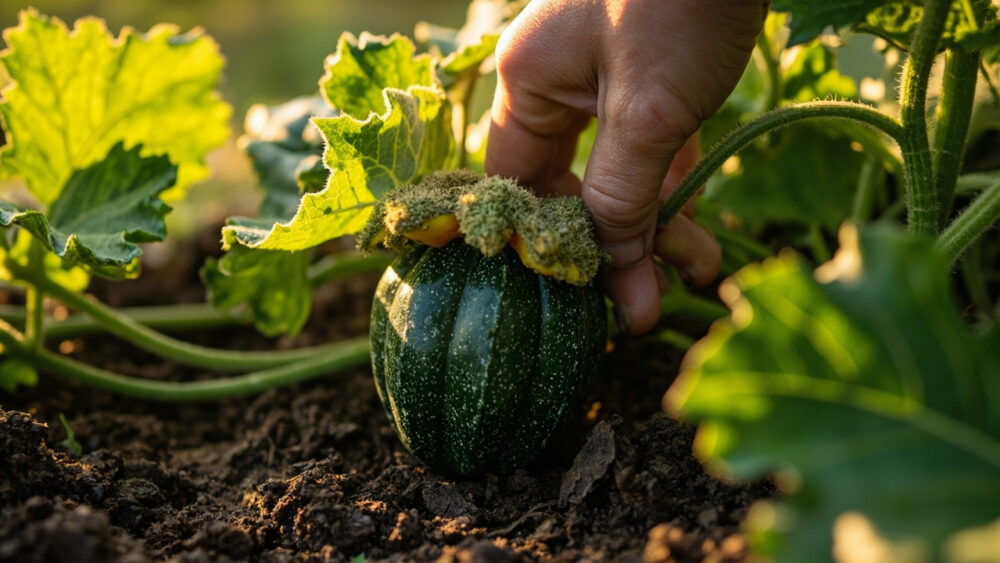
Acorn squash is ready 80 to 100 days after planting, when the skin turns deep green (or the mature color for your variety) with a dull, matte finish instead of a glossy shine. Press a thumbnail into the rind: if it resists and doesn’t puncture easily, it’s mature.
Here’s the honest answer to the question everyone eventually asks: unlike tomatoes, acorn squash does not keep ripening much after it’s cut. What’s on the vine at harvest is close to what you’ll get, so don’t rush it off the plant early expecting a windowsill to finish the job.
Cut with 1 to 2 inches of stem attached rather than snapping it off, since a torn stem invites rot in storage. Harvest before the first hard frost, as even light frost damage on the fruit shortens its storage life significantly.
Cure harvested squash in a warm, dry spot around 80°F for about a week, then store in a cool space between 50 and 55°F, where it will typically keep for 1 to 3 months.
Everything above works together, and here’s the whole season boiled down to one list you can pull up from your phone in the garden.
Acorn Squash at a Glance
- When to plant: after soil hits 65 to 70°F, about 1 to 2 weeks past your last frost date.
- Spacing: hills 3 to 4 feet apart, one strong seedling per hill, rows 4 to 6 feet apart.
- Depth: sow seeds 1 inch deep, transplant at the same depth as the seedling pot.
- Water: 1 to 1.5 inches per week, deep and at the base, checked at 2 inches down before watering again.
- Feeding: compost or balanced fertilizer at planting, phosphorus and potassium feed at flowering.
- Watch for: squash bugs, cucumber beetles, squash vine borers, and powdery mildew in humid weather.
- Harvest: 80 to 100 days after planting, when skin is dull and matte and resists a thumbnail, cut with 1 to 2 inches of stem attached.
Get the timing and the pest watch right, and this is a genuinely forgiving crop. Everything else on this list is just backup for the week something inevitably tries to go wrong.