The best companion plants for celery are leeks, onions, bush beans, cabbage-family crops, and tomatoes, because celery’s shallow roots and heavy appetite for water and nitrogen pair well with plants that either fix nitrogen, shade the soil, or repel the pests celery draws in. Skip carrots and parsnips nearby, since they compete for the same root zone and can stunt both crops. Skip corn too, it just outcompetes celery for water celery cannot live without.
Most people planting celery this year make one mistake that has nothing to do with companions: they crowd it into dry soil and wonder why it bolts and turns bitter. Companion planting can fix a lot, but it cannot fix underwatered celery.
There is also a sign almost everyone misreads when celery struggles next to a “good” companion, and a myth about tomatoes and celery that gardeners repeat without ever testing it themselves. Stick around, the full breakdown plus a save-able Celery at a Glance card is at the bottom of this page.
Why Celery Is Picky About Neighbors
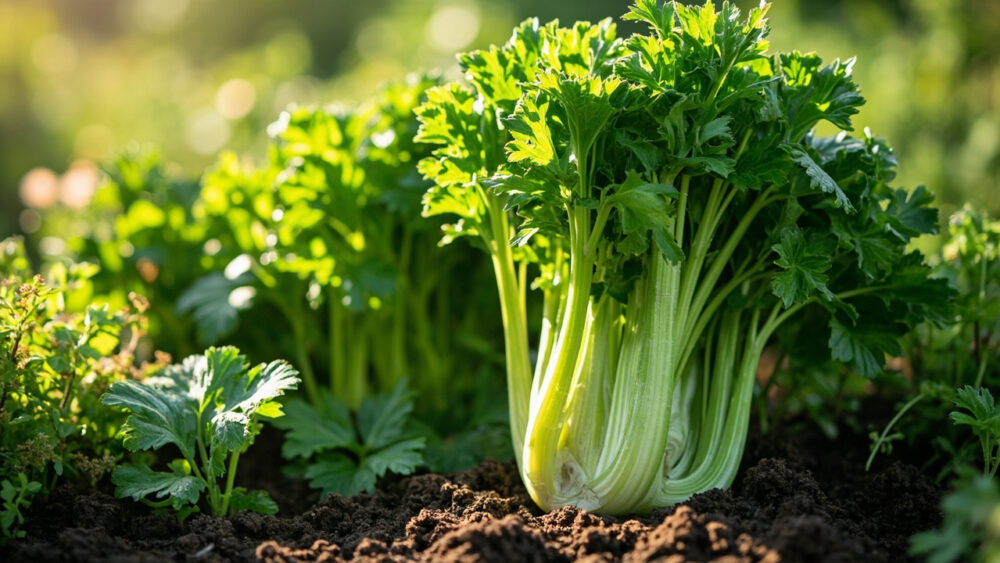
Celery has a shallow, fibrous root system that sits in the top 6 to 8 inches of soil, and it wants consistent moisture, roughly 1 to 1.5 inches of water a week, the entire 85 to 120 days it takes to mature. That makes it sensitive to anything that steals water or shades it wrong.
It is also a magnet for aphids, celery leaftier, and carrot rust fly, which is exactly why some companions matter more for pest confusion than for soil chemistry.
Once you understand what celery actually needs, the companion list stops looking random.
The Best Companions and Why Each One Earns Its Spot
Leeks and Onions
Alliums mask the scent celery gives off that attracts carrot rust fly and aphids. Their upright, narrow growth also does not compete for canopy space, so celery still gets full sun.
Plant them in alternating rows about 12 inches apart and they barely notice each other.
Bush Beans
Beans fix nitrogen in the soil through root nodules, feeding celery’s heavy nitrogen appetite without you having to side-dress as often. They also stay low enough to avoid shading celery’s crown.
This is one of the few pairings that genuinely improves soil, not just pest pressure.
Cabbage, Broccoli, and Cauliflower
These brassicas benefit from celery’s strong scent, which confuses cabbage moths and cabbage loopers hunting by smell. In exchange, celery gets a bit of afternoon shade from taller brassica leaves during hot spells, which helps prevent bolting.
It is a genuine two-way trade, which is rarer in companion planting than most articles admit.
Tomatoes
Tomatoes and celery share water needs and neither minds the other’s root depth, since tomato roots run deeper. Tomato foliage also gives celery light afternoon shade in zones where summer heat pushes past 85°F.
This pairing works, but only under one condition you will want to know before you plant.
The Tomato Myth Nobody Checks
If you have read that tomatoes make celery taste better or grow faster, that is the part to drop. There is no real mechanism for tomatoes improving celery’s flavor or size, and no reliable garden evidence backs it up.
What tomatoes actually do is provide shade and use a different root depth, which is a spacing benefit, not a flavor benefit.
The honest version: plant tomatoes near celery for the shade and the space efficiency, not because of some plant-to-plant magic.
Knowing what a companion actually does for you matters more than the folklore, and the next section shows what happens when you ignore that.
What to Never Plant Near Celery
Carrots and Parsnips
Both share celery’s shallow root zone and both belong to crops that draw carrot rust fly, so planting them together concentrates the pest instead of confusing it. Root competition also stunts whichever crop is slightly behind.
Keep celery at least 18 to 24 inches from any carrot family root crop.
Corn
Corn is a heavy water and nitrogen feeder with deep, aggressive roots that will out-compete celery every time. Celery planted in corn’s root zone often bolts early from drought stress even when you are watering on schedule.
If your soil an inch down feels dry despite regular watering, corn roots nearby are often the real cause, not your watering can.
Parsley (in Large Blocks)
Parsley is in the same family as celery, so it shares pests and diseases, including the same fungal leaf spot issues. A few plants scattered around is fine, but a solid block next to celery just doubles the pest and disease pressure in one spot.
Layout matters just as much as which plants you choose, so let’s get the bed arrangement right.
How to Lay Out the Bed
Give celery rows 18 to 24 inches apart with plants spaced 6 to 10 inches within the row, since crowding restricts airflow and invites fungal problems in humid weeks. Plant companions like beans or onions in the next row over, not interplanted stem to stem.
Put taller companions like tomatoes or staked beans on the south or west side of celery in hot climates, so they cast afternoon shade without blocking morning sun.
In cooler zones (roughly zone 6 and colder), skip the shade strategy entirely and give celery full sun all day, since heat stress is not the risk there.
Get the layout right and even a plain bed of celery and onions will outperform a cluttered mix of “good” companions planted badly.
The Sign Everyone Misreads
When celery next to a good companion still looks pale and stringy, most people assume the companion pairing failed. It usually has not.
Pale, hollow-feeling stalks are almost always a moisture or nitrogen problem, not a companion problem. Celery pulls water and nitrogen hard and fast, and even the best neighbor cannot fix soil that dries out between waterings.
Check the soil 2 inches down. If it is dry there, the fix is water and mulch, not a new companion plant.
With the pairings, the layout, and the myths sorted, here is the whole thing condensed into one card worth saving.
Celery at a Glance
- When to plant: transplant celery 2 to 3 weeks after your last frost, once soil temperature holds at 55 to 65°F.
- Spacing: 6 to 10 inches between plants, 18 to 24 inches between rows.
- Best companions: leeks, onions, bush beans, cabbage family crops, and tomatoes for shade.
- Avoid planting near: carrots, parsnips, corn, and large blocks of parsley.
- Water needs: 1 to 1.5 inches per week, consistent, never letting the top 2 inches of soil dry out.
- Days to maturity: 85 to 120 days depending on variety and climate.
- Bolting trigger: drought stress or prolonged heat above 85°F without shade.
Celery rewards good water and the right neighbors, not clever tricks.
Get the moisture consistent and the layout sensible, and the companions do the rest of the work on their own.