Iceberg lettuce moves through five distinct growing stages from seed to harvest: germination, seedling, rosette leaf growth, head formation, and maturity, usually spanning 70 to 85 days depending on your temperatures. In cool spring or fall weather it stays close to that range. In heat it stalls, bolts, or turns bitter before it ever forms a real head.
Most people lose their iceberg lettuce crop at one specific stage, and it is not the one they worry about. There is also a sign at the head-forming stage that looks like disaster but usually is not, and a totally different sign that actually means trouble and gets ignored because it looks harmless.
Stick with this and you will know exactly what your lettuce should look like at every point between sowing and slicing, including how to tell a plant that is just taking its time from one that has genuinely quit. The full Iceberg Lettuce at a Glance card is waiting at the bottom, saveable in ten seconds.
Germination: Days 1 to 10
Seeds sown a quarter inch deep in soil between 45 and 75 degrees F sprout in 7 to 10 days. Below 40 degrees or above 80, germination slows badly or quits entirely, iceberg is genuinely fussy about this.
Keep the top inch of soil consistently moist, never soggy, during this window. Seeds that dry out even once during sprouting simply die rather than pause.
You are looking for a small pale loop pushing through the surface, then two tiny seed leaves called cotyledons.
That first true leaf is where the real growing starts.
Seedling Stage: Weeks 2 to 3
Once the true leaves appear, growth is slow and unglamorous. The plant is building roots more than leaves right now, even though roots are the part you cannot see.
This is the stage where the timing mistake happens. Gardeners start seed indoors, then transplant too late, weeks after the soil has already warmed past iceberg’s comfort zone, and the plant never fully forgives it.
Transplant seedlings out 2 to 3 weeks before your last spring frost, when they have 3 to 4 true leaves, hardened off over 5 to 7 days of increasing outdoor exposure. Space them 12 to 16 inches apart, iceberg needs the room more than looser-leaf lettuces do.
Crowded seedlings look fine right up until they suddenly do not.
Rosette Stage: Weeks 3 to 6
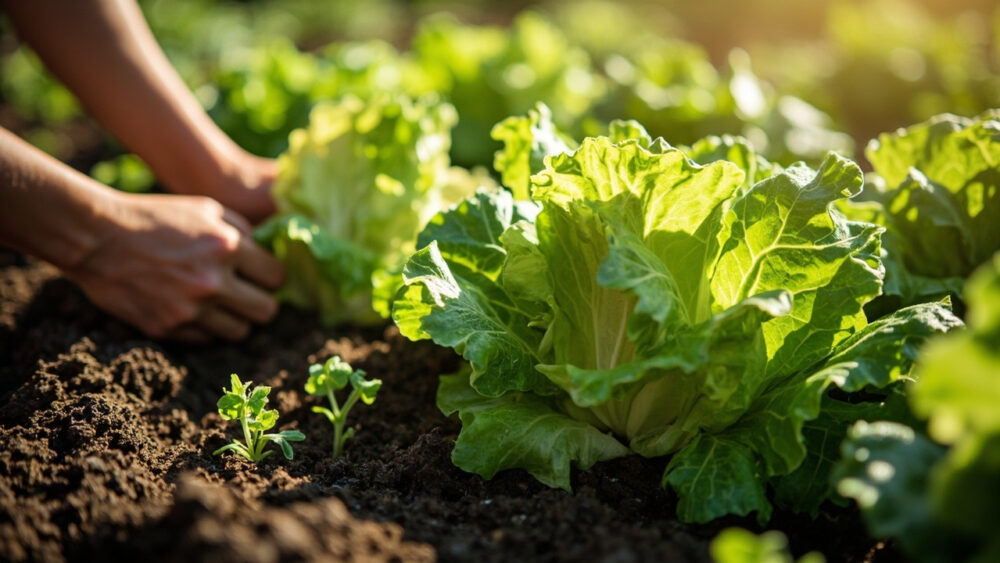
This is the stage everyone enjoys because it finally looks like something. The plant sends out a low, wide rosette of loose outer leaves, flat to the ground, expanding fast in cool weather.
If you assumed this leafy stage means the head is forming, that guess is early. This is still just outer leaf production, the actual head has not started yet.
Feed lightly with a balanced or nitrogen-leaning fertilizer once during this stage, and keep soil evenly moist, about an inch of water a week between rain and irrigation. Uneven watering here is what causes tip burn later.
Watch the center of the rosette closely, because that is where the next stage quietly begins.
Head Formation: Weeks 5 to 9
Inner leaves start cupping inward instead of spreading flat, and the center begins to firm up. This is the stage most people mess up, because the fixes for two very different problems look identical from a distance.
Sudden hot weather during this stage is the single biggest reason iceberg fails to head up at all. Above roughly 80 degrees F consistently, the plant often skips heading and bolts straight to a seed stalk instead, or just stays loose and leafy forever. There is no fixing a bolted lettuce, that plant is done for the season.
Here is the part that looks alarming but usually is not: outer leaves that yellow and drop as the head fills out. That is normal energy reallocation, not disease, as long as the developing head itself stays firm and pale green at the base.
The sign that actually deserves attention is a soft, mushy, or foul-smelling patch at the base near the soil line. That is bottom rot from excess moisture sitting against the crown, not something to wait out.
Firmness is your best clue that this stage is going well, so learn to check for it.
How to Tell Real Progress From a Stall
Squeeze the developing head gently, the way you would check a cabbage. A head that is progressing normally feels a little firmer week over week, even if it is small.
A true stall feels the same firmness for two weeks straight, with leaves that look dull rather than glossy, and often coincides with a dry stretch or a heat spike. Deep watering and afternoon shade can sometimes restart it if caught early.
A plant that has bolted, by contrast, will show a stretched, elongated center stem pushing upward, sometimes with a bitter smell to the outer leaves. That plant will not recover into a usable head.
Knowing which one you are looking at saves you from either giving up too early or wasting three more weeks on a lettuce that already quit.
Maturity and Harvest: Weeks 9 to 12
A mature iceberg head feels dense and solid when squeezed, roughly softball to volleyball sized, with the outer leaves still a bit loose and the wrapper leaves pale green. That firmness is the real signal, not the calendar.
Harvest by cutting at the base with a sharp knife, leaving a couple of outer leaves attached for protection. Waiting too long past firm maturity risks the head splitting or bolting, especially if a heat spell hits right after it matures.
Once you have harvested, the timing card below is what you will actually want open on your phone next season.
Iceberg Lettuce at a Glance
- When to plant: direct sow or transplant seedlings 2 to 3 weeks before your last spring frost, or 8 to 10 weeks before your first fall frost for a second crop.
- Ideal soil temperature: 45 to 75 degrees F for germination, with growth slowing hard above 80 degrees F at any stage.
- Spacing: 12 to 16 inches between plants, rows 18 to 24 inches apart, iceberg needs more room than loose-leaf types.
- Time to maturity: 70 to 85 days from seed, depending on temperature and variety.
- Water needs: about 1 inch per week, kept consistent, since irregular watering causes tip burn and bottom rot.
- Signs of a healthy head: firm to the squeeze, pale green wrapper leaves, gradual outer leaf yellowing as the center fills in.
- Signs of trouble: an elongated central stem means bolting with no recovery, while a soft or foul-smelling base means bottom rot and should be pulled.
If you remember one thing, remember to check firmness, not the date on the calendar.
Heat is the enemy at every single stage, so time your planting around cool weather first and everything else second.