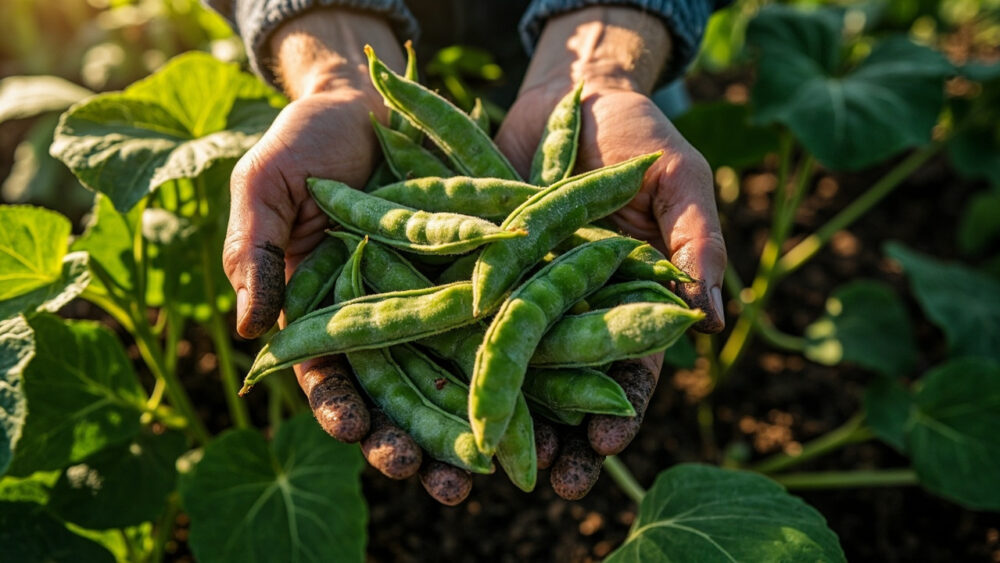
Harvest edamame when the pods are plump, bright green, and feel tightly packed with beans, usually 75 to 100 days after planting and about 3 to 4 weeks after flowering. This is a narrow window compared to most beans. Wait too long and the pods turn yellow and starchy overnight, it seems, even though the plant has been building toward that moment for weeks.
Most people ruin their first crop the same way: they treat edamame like green beans and let the pods hang on “just a little longer” for extra size. That single habit is the most common reason edamame comes out mealy and bland instead of sweet and snappy.
Below I will walk through the exact signs to check with your hands, not just your eyes, what early and late harvesting actually do to flavor and texture, how to pick without stripping the whole plant bare too fast, and what to do in the first hour after harvest so the sweetness does not disappear. There is also a save-able Edamame at a Glance card at the bottom with every number in one place.
The Real Ready Signs, Not Just Green Pods
Color alone will fool you. Edamame pods stay green well past the point where they are actually good, and they also stay green for a while after they have gone starchy. You need the feel test, not just the look test.
The squeeze test
Pinch a pod between your thumb and finger. A ready pod feels full and firm, like there is barely any give between the beans inside and the pod wall. If it feels flat, thin, or the beans move around loosely inside, it needs more time.
The bulge test
Look along the length of the pod for distinct bumps where each bean is pushing against the skin. Two to three visible bulges per pod is the sweet spot. Pods that are still smooth and flat sided are not there yet.
Once you can feel that fullness across most of the plant, the clock starts running.
The Timing Window, and Why a Few Days Matters
Edamame is harvested green and immature on purpose, that is the entire point of the crop. It typically hits peak harvest 3 to 4 weeks after the plant flowers, and stays at peak for roughly 7 to 10 days before quality drops fast.
Go too early and the beans are small, watery, and barely worth shelling. Go too late and something more frustrating happens: the pods keep looking green on the outside while the sugars inside convert to starch, the same thing that happens to sweet corn left on the stalk too long. The beans get firm, dense, and take on a dry, chalky bite instead of a sweet, buttery one.
If you have ever wondered why store-bought edamame is so much sweeter than a home-grown batch that “looked the same,” this timing gap is almost always the answer. It is not the variety, it is the day you picked it.
Leave it a few days too long and no amount of cooking brings that sweetness back.
How to Pick Edamame Without Wrecking the Plant
Edamame plants are bushier and more brittle at the root than people expect, and yanking pods can pull the whole plant out of the ground, especially in loose or recently watered soil.
- Hold the stem first: use one hand to steady the branch just above the pod cluster.
- Snip, do not pull: use scissors or pruning snips to cut the pod cluster free, or twist gently with a firm pinch if you are picking by hand.
- Work bottom to top: lower pods on the plant mature first, so check there before moving up.
- Pick in the cool part of the day: early morning pods hold sugar and moisture better than pods picked in afternoon heat.
You can harvest pod by pod as they ripen, or cut whole branches once most of the plant is ready, both work, the difference is just how many trips you make to the garden.
Once the pods are in your hand, the next hour matters almost as much as the day you picked them.
What to Do in the First Hour After Harvest
Edamame starts losing sweetness the moment it is cut from the plant, the same way sweet corn and peas do. Get it out of the sun and into the fridge or a pot of water as fast as you reasonably can.
If you are not cooking immediately, rinse the pods and refrigerate them in a loosely sealed bag. They hold decent quality for 2 to 3 days this way, but flavor is best within 24 hours.
The classic prep is boiling the pods whole in salted water for 4 to 5 minutes, then shocking them in ice water to stop the cooking and lock in color. Squeeze the beans directly out of the pod to eat.
Beyond fresh eating, there is a way to stretch this harvest well past the day you picked it.
Keeping the Harvest Coming, and Storing the Extra
Edamame plants generally produce one main flush of pods rather than a steady trickle like green beans, so do not expect weeks of continuous picking from a single planting. If you want a longer harvest window, stagger your plantings every 2 to 3 weeks through early summer instead of putting everything in the ground at once.
For extra pods you cannot eat fresh, blanch them for 3 to 4 minutes, cool them in ice water, then freeze in a single layer before bagging. Frozen this way, quality holds well for 8 to 10 months.
Do not try to save seed from pods you let go starchy on the plant for eating purposes, that stage is actually closer to what you want if you are deliberately drying pods for next year’s seed, which is a different goal than harvesting for the table.
Everything above comes down to a handful of numbers, and here they are in one place.
Edamame at a Glance
- When to plant: after your last frost, once soil has warmed to at least 55 to 60°F.
- Days to harvest: roughly 75 to 100 days from planting, or 3 to 4 weeks after flowering.
- Ready signs: pods feel full and firm with visible bean bulges, not flat or thin.
- Peak window: about 7 to 10 days once pods hit peak fullness, quality drops fast after.
- Harvest method: snip pod clusters with scissors or twist gently, avoid pulling on the whole plant.
- After picking: refrigerate or cook within 24 hours for best sweetness, use within 2 to 3 days at most.
- Storage: blanch and freeze for 8 to 10 months of good quality.
If you remember one thing, remember the squeeze, not the color. A firm, full pod is ready no matter how green it still looks, and a few days of hesitation is the difference between sweet edamame and starchy edamame.