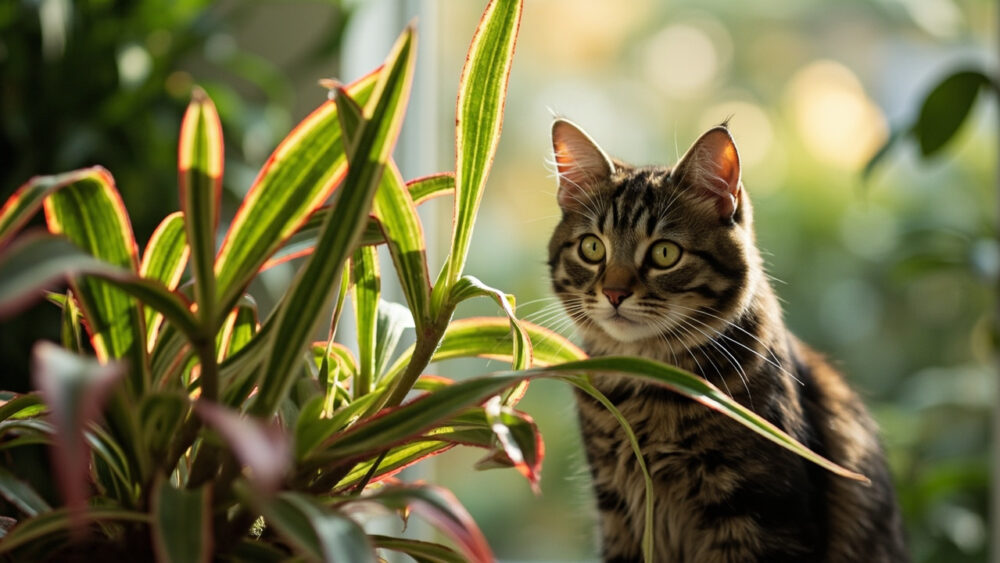
Yes, dracaena is toxic to cats. Every common variety sold as a houseplant, including corn plant, dragon tree, and the ribbon-leafed dracaena you probably have on your windowsill, contains compounds that irritate a cat’s mouth and gut. So if you clicked here already owning one, is dracaena toxic to cats is the right question to ask before you do anything else, and the short answer is don’t panic but don’t ignore it either.
The severity depends on how much your cat actually ate, not just whether it took a curious nibble. A single bite off a leaf tip is a very different situation than a chewed-up stem or a plant knocked over and shredded.
Stick around for the part most owners get wrong: the symptom that looks like nothing, the exact move to make in the first ten minutes after you catch your cat mid-bite, and a short list of cat-safe look-alikes that give you the same jungly look with zero trip to the emergency vet. There’s also a save-able quick-reference card at the bottom of this page, worth screenshotting before you put the plant back on a high shelf.
The Plain Answer: Dracaena Is Toxic to Cats
Dracaena contains saponins, plant compounds that act as a natural pesticide and taste genuinely awful.
Every dracaena species sold as a houseplant carries this risk, including Dracaena fragrans (corn plant), Dracaena marginata (dragon tree), Dracaena trifasciata (often still sold under its old name, Sansevieria, the snake plant), and Dracaena reflexa (song of India). If the tag says dracaena in any form, treat it as toxic.
The good news, if there is good news here, is that dracaena is not on the level of true emergencies like lilies for cats. It causes real illness, not organ failure.
That distinction matters for how worried to be, but it does not change what you do next.
Which Part, and How Much, Actually Matters
Every part of the plant contains saponins, but the leaves are what cats actually chew, since the stem and roots usually stay buried in soil or out of reach.
A single small nibble, the kind where your cat mouths a leaf tip and spits it back out, often causes mild drooling and little else. Cats that actually swallow a meaningful amount of leaf material get hit much harder.
Cats who chew a lot, not just a lick, get the fuller symptom picture below. Kittens and small cats are at higher risk simply because a given amount of plant material is a bigger dose relative to their body weight.
How much your cat ate changes everything that follows, so look at the plant before you look at the cat.
Signs Your Cat Ate Dracaena
If you assumed vomiting is the first sign, you’re right, but it’s usually not the first thing owners notice. Excess drooling often shows up before vomiting starts, because the saponins hit the mouth and throat first.
Watch for:
- Drooling or foaming at the mouth
- Vomiting, sometimes with visible plant material in it
- Loss of appetite
- Lethargy or hiding more than usual
- Dilated pupils, seen mainly in cats (less common but reported)
- Wobbly or uncoordinated walking in more severe cases
Mild cases often resolve with drooling and one or two bouts of vomiting and nothing more. But you cannot tell from the outside how much your cat swallowed, so any of these signs deserves a phone call, not a wait-and-see approach.
Here’s exactly what that phone call and the next hour should look like.
What to Do If Your Cat Ate Dracaena
Call your veterinarian or an animal poison control line right away, even if your cat seems fine. Symptoms sometimes take a few hours to show up fully, and a vet can tell you whether your specific situation needs an in-person visit based on how much was eaten and your cat’s size and health history.
Before you call, do a few things that make the call faster and more useful:
- Look at the plant and note how much leaf material is missing or shredded
- Take the plant tag or a photo of the plant if you’re not sure of the exact species
- Note the time you noticed the chewing or the first symptom
- Do not give your cat food, water, milk, or anything else to induce or stop vomiting on your own
Do not attempt any home remedy, including inducing vomiting yourself. Some substances make things worse coming back up, and this is exactly the judgment call a vet needs to make, not a guess made at home.
Once that call is made and you know what to watch for, it’s worth asking whether this plant belongs in a cat household at all.
Safer Look-Alikes If You Want the Same Look
You do not have to give up the tall, architectural, jungle-corner look that dracaena gives a room. A few genuinely cat-safe plants scratch the same itch.
Areca palm gives you the same upright, fountain-like foliage at a similar scale and is non-toxic to cats. Parlor palm (Chamaedorea elegans) is smaller, tolerates low light better than dracaena ever will, and is also considered pet-safe.
For something with bolder leaves, calathea and most peperomia varieties are non-toxic options with real visual presence, though calathea is fussier about humidity and water quality.
None of these need to go on a high shelf, which honestly makes them easier houseplants to live with regardless of pets.
If you’d rather keep the dracaena you already have, the next section is your permanent cheat sheet.
Dracaena: Quick Reference
- Toxic to cats: yes, all common dracaena species including corn plant, dragon tree, and snake plant
- Toxic compound: saponins, found throughout the plant, concentrated in the leaves
- Severity: mild to moderate for most cases, not typically life-threatening, but always worth a vet call
- Common signs: drooling, vomiting (sometimes with plant material), loss of appetite, lethargy, dilated pupils, wobbly walking in severe cases
- What to do: call your veterinarian or animal poison control immediately, do not induce vomiting or give home remedies
- Safer alternatives: areca palm, parlor palm, calathea, peperomia
Keep dracaena up high, out of chewing range, or skip it for one of the safer look-alikes above.
Either way, save this card, and call your vet first, ask questions second.