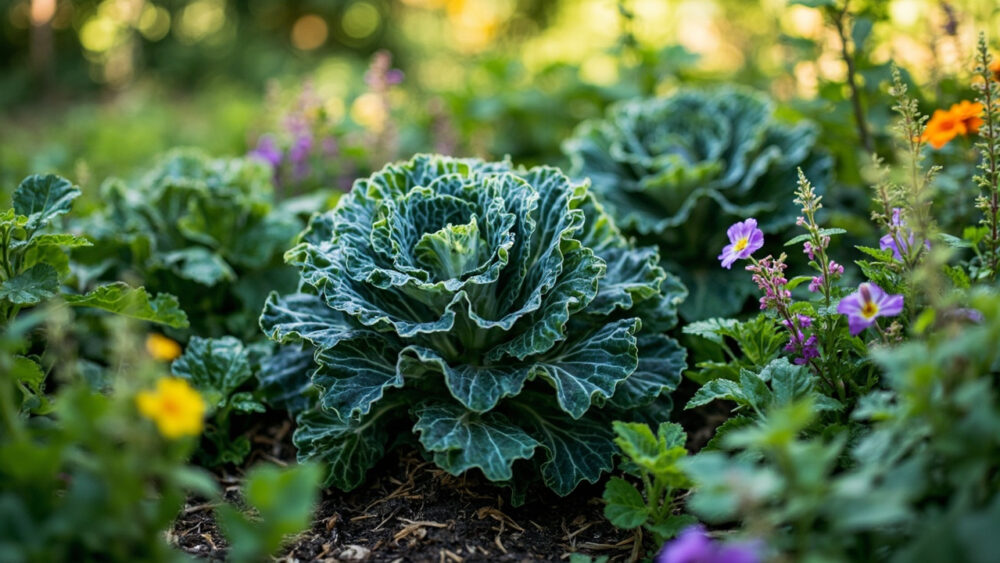
The best companion plants for kale are aromatic herbs like dill and thyme, alliums like onions and garlic, and flowers like nasturtium and marigold, because they confuse or repel the cabbage moths and aphids that go straight for kale’s leaves. The plants to keep away are strawberries, other brassicas planted too thick, and anything in the same family that shares its pests and drains the same nutrients from the same depth of soil.
That much you could probably guess. What most people get wrong is assuming any strong-smelling herb works as a decoy, when only a specific few actually pull cabbage moths off kale before they lay eggs.
There is also a spacing mistake that quietly wrecks half of these pairings before they even get a chance to help, and a popular “helper” plant that does the opposite of what everyone assumes. Stick with me through the layout section and the myth-busting near the end, because the full Kale at a Glance card is waiting at the bottom with everything worth saving to your phone before you head out to the bed.
Why Companion Planting Actually Matters for Kale
Kale’s biggest enemies are not soil problems, they are bugs. Cabbage worms, aphids, and flea beetles find kale by smell and by sight, homing in on the shape and scent of brassica leaves from several feet away.
Good companions work by breaking up that visual and chemical signal, or by attracting the predators that eat the pests before they do damage. That is the whole game. It is not magic, it is disruption.
Once you understand that logic, the “best” and “worst” lists stop feeling arbitrary.
The Companions Worth Planting
Dill and Cilantro
Both bolt to flower quickly, and those tiny umbrella-shaped blooms are a magnet for hoverflies and parasitic wasps. Those insects lay eggs in aphids and cabbage worm larvae, which does the pest control for you.
Let a few plants flower on purpose instead of pinching them back, since the flowers are the actual payoff, not the leaves.
This one only works if you let it go to seed, which is the part most people skip.
Onions, Garlic, and Chives
Alliums release a sulfur scent that masks the smell of kale’s leaves, making it harder for cabbage moths to find their target plant by scent alone. They also take up minimal above-ground space, so they slot into gaps without stealing light.
Plant them 4 to 6 inches from kale stems, close enough to blend scents but far enough to avoid root competition.
Next up is the pairing that gets recommended constantly and deserves the hype, for a different reason than most people think.
Nasturtium
Nasturtium is a sacrifice plant, and that is exactly why it works. Aphids and cabbage worms prefer its softer leaves over kale’s tougher ones, so they colonize the nasturtium first and leave your kale alone longer.
Plant it a foot or two away, not right against the stem, so it draws pests toward itself instead of straight into your kale row.
Check the underside of nasturtium leaves weekly. If you see clusters of aphids there, you are winning, not losing.
Marigold
Marigold roots release compounds that suppress certain soil nematodes, and the strong-scented foliage throws off flea beetles hunting by smell. French marigold, the compact type with the strongest scent, works better for this than the taller African varieties.
Tuck it along the bed edge every 12 to 18 inches rather than scattering single plants, since a solid scent line confuses pests more than isolated pots do.
Herbs and flowers cover the pest side, but kale also needs help from the ground up, and that means thinking about roots.
Beets and Celery
These root deep while kale roots stay relatively shallow, so they are not competing for the same slice of soil moisture and nutrients. Beets in particular tolerate the partial shade kale’s broad leaves throw once it matures.
Space beets 3 to 4 inches from kale’s outer leaf spread, giving both room to bulk up without one smothering the other.
Now for the plants that look like natural neighbors but actually work against kale.
What to Never Plant Near Kale
Other Brassicas Packed Too Tight
Broccoli, cabbage, Brussels sprouts, and kale all share the same pest list and the same nutrient draw from the soil. Planting them shoulder to shoulder does not spread risk, it concentrates it.
A cabbage moth that finds one brassica in a dense block finds all of them within days. The fix is spacing, not avoidance: give each brassica family member 18 to 24 inches minimum, and break up blocks with a row of alliums or herbs between them.
Strawberries deserve their own warning, because the reason surprises people.
Strawberries
Strawberries and kale both draw heavily on potassium and calcium from the same shallow soil band, which means one crop’s roots are constantly out-competing the other’s. Strawberries also attract slugs, and slugs do not discriminate once they arrive in a bed.
The result is usually smaller kale leaves and slug damage on both crops by midsummer.
Grapevine and fennel cause a different kind of trouble worth knowing before you plant either.
Fennel
Fennel releases root compounds that suppress the growth of many neighboring vegetables, kale included. It is one of the few plants in the garden that genuinely does not play well with almost anything nearby.
Give fennel its own bed entirely, at least 3 feet from any other vegetable, kale or otherwise.
Layout matters just as much as plant choice, so let’s get the bed itself right.
How to Lay Out the Bed
Plant kale 18 to 24 inches apart, in rows spaced the same distance, since mature kale spreads wider than the small transplant suggests. Tuck fast growers like dill, cilantro, or lettuce into the gaps while kale is still small, they will finish and clear out before kale needs that space.
Run a border of alliums or marigold along the bed’s outer edge instead of scattering them randomly. A perimeter creates a scent barrier pests have to cross to reach the kale in the middle.
Keep nasturtium as a separate patch a foot or two off, functioning as its own pest magnet rather than a mixed-in plant.
Here is the mistake that undoes all of this even when every plant choice is correct.
The Spacing Mistake That Cancels Every Good Pairing
Cramming companions in tight against kale’s stem, thinking more density means more protection, backfires badly. Poor airflow between crowded plants raises humidity right where kale’s lower leaves sit, and that is exactly the environment that breeds downy mildew and black rot.
If you assumed tighter spacing means stronger companion effects, that guess causes more disease than the pests it was meant to prevent.
Leave real air gaps. A companion 6 inches away still masks scent and attracts predators just fine, and your kale’s leaves stay dry enough to resist fungal problems.
That leads straight into the myths people repeat without checking.
Companion Planting Myths That Do Not Hold Up
- Myth: any herb repels pests. Basil and mint are wonderful herbs but do very little for kale’s specific pest list. Stick to dill, cilantro, and alliums for actual results.
- Myth: marigold fixes soil problems fast. Its nematode suppression builds over a full season or more of roots being in the ground, not within weeks of planting.
- Myth: companion planting replaces row covers. If cabbage moths are already established in your area, floating row cover over young kale still outperforms any companion plant alone.
With the guesswork cleared up, here is everything worth keeping on hand.
Kale at a Glance
- When to plant: two to three weeks before last frost in spring, or six to eight weeks before first fall frost for a fall crop, once soil hits at least 45°F.
- Spacing: 18 to 24 inches between kale plants, same distance between rows.
- Planting depth: transplants set at the same depth they sat in the pot, seeds sown 1/4 to 1/2 inch deep.
- Best companions: dill and cilantro left to flower, onions and garlic and chives, nasturtium as a sacrifice plant, French marigold along the border, beets and celery for the deeper root layer.
- Never plant nearby: other brassicas packed tighter than 18 inches, strawberries, fennel.
- Watch for: aphid clusters on nasturtium leaves as an early warning sign, and small holes with green droppings on kale leaves signaling cabbage worm.
- Biggest layout mistake to avoid: crowding companions tight against the stem, which traps humidity and invites mildew and black rot.
Get the spacing right and the pest pressure drops on its own, no extra spraying required.
Everything else on this list just works better once that foundation is in place.