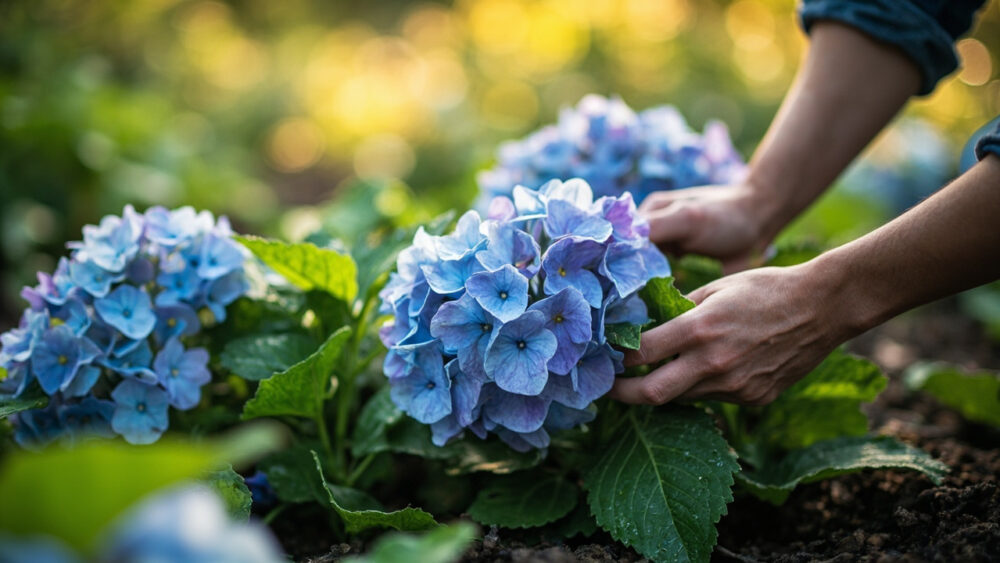
Caring for hydrangeas comes down to four things: morning sun with afternoon shade, soil that stays evenly moist but never soggy, a spring feeding with compost or a balanced fertilizer, and pruning at the right time for your specific variety, since pruning the wrong type at the wrong time is the single most common way people lose a season of blooms. Get those four right and hydrangeas are forgiving, fast-growing shrubs that reward you for years.
Most of the trouble people run into is not mysterious. It is usually one of three things: they pruned off next year’s flower buds without realizing it, they planted in full sun and the plant wilts every afternoon no matter how much they water, or they are staring at green blooms wondering if the plant is dying when it is actually just fine.
There is also the soil color question everyone asks eventually, and the honest answer surprises people. Stick with me through the sections below and I will hand you a save-able Hydrangeas at a Glance card at the bottom with the numbers you actually need on hand.
Light, Placement, and Temperature
Morning sun, afternoon shade is the placement that works almost everywhere. Four to six hours of direct sun in the morning, followed by dappled or full shade once the afternoon heat sets in, keeps the big leaves from wilting while still giving you strong bloom production.
In hot climates, zone 7 and up, more shade is better. In cooler zones, 4 through 6, hydrangeas can handle considerably more sun, even most of the day, because the heat stress that punishes them in the South just is not a factor.
Hydrangeas are hardy roughly in zones 3 through 9 depending on species, but late spring frosts after the plant has leafed out can kill emerging flower buds on old-wood types. That is a real risk, not a scare tactic, and it is one reason gardeners in colder zones lean toward reblooming or new-wood varieties.
Get the light right and watering gets a lot more forgiving.
Watering: How Much, How Often, and How to Tell
Hydrangeas want soil that is consistently moist, roughly like a wrung-out sponge, never bone dry and never waterlogged. In the ground, that usually means a deep watering once or twice a week, more often during summer heat or in sandy soil, less in clay or during cool, rainy stretches.
Check the top two to three inches of soil with your finger before watering. If it is dry there, water deeply until it runs from the base of the pot or soaks a foot down in the garden bed. Shallow, frequent sprinkling grows shallow, weak roots.
Afternoon wilting is the classic hydrangea moment that panics new growers. If the leaves droop hard in the heat of the day but bounce back by evening, the plant is fine and just doing what big-leafed hydrangeas do in strong sun. If they are still limp the next morning, that is your real signal to water.
Wilting that recovers overnight is not thirst, it is just the plant’s way of coping with heat.
Soil, Potting Mix, and Feeding
Hydrangeas like rich, well-draining soil with a good amount of organic matter, moisture-retentive but not swampy. Working a few inches of compost into the planting hole at installation solves most soil problems before they start.
For containers, use a quality potting mix with added compost rather than garden soil, which compacts and drains poorly in pots.
Feed once in early spring as new growth appears, using a balanced fertilizer or a layer of compost worked into the top few inches of soil. A second light feeding in early summer is fine for heavy bloomers, but stop feeding by mid to late summer so the plant can harden off before winter.
Now, the soil color question everyone eventually asks: for bigleaf hydrangeas (Hydrangea macrophylla), soil pH controls whether blooms go blue or pink, not fertilizer color or luck. Acidic soil, below pH 6, pulls blooms toward blue. Alkaline soil, above pH 7, pushes them toward pink. This trick does not work on white varieties, and it does not work at all on panicle or oakleaf hydrangeas, whose color is fixed by genetics.
Get the soil chemistry right and the bigger seasonal jobs, pruning especially, are where most people actually go wrong.
Pruning, Repotting, and the Timing Mistake That Costs You a Season
Here is the mistake that ruins more hydrangea seasons than anything else: pruning old-wood varieties, like most bigleaf and oakleaf hydrangeas, in fall or early spring. Those types set next year’s flower buds on the current season’s growth by late summer, so cutting them back after that removes the very buds you are waiting for.
Prune old-wood types right after they finish floweringin mid to late summer, removing spent blooms and shaping lightly. Prune new-wood types, like most panicle (Hydrangea paniculata) and smooth (Hydrangea arborescens) hydrangeas, in late winter or early spring before growth starts, since they bloom on wood grown that same year and can take a harder cut.
If you genuinely do not know which type you have, prune lightly and only right after bloom, that is the safest default until you can identify the variety.
Repot container hydrangeas every two to three years, or when roots are circling the pot, doing it in early spring before new growth takes off. Clean up dead or damaged wood any time you see it; that job never has bad timing.
Prune at the wrong time and you will not kill the plant, you will just be staring at a healthy shrub with no flowers.
Problems That Actually Show Up, and What to Do About Them
Most hydrangea problems trace back to water, sun, or a fungal issue, rarely anything exotic.
- Scorched, browning leaf edges: too much direct afternoon sun or underwatering in heat; move the pot or add afternoon shade, and increase watering frequency.
- Powdery white coating or dark leaf spots: fungal issues from poor air circulation and wet foliage. Space plants for airflow, water at the soil line instead of overhead, and remove badly affected leaves. A fungicide labeled for ornamental shrubs can help if it is spreading. Follow the product label exactly.
- No blooms at all: almost always wrong-time pruning, too much shade, or a hard late freeze that killed the buds. Not overwatering, which people blame constantly and rarely correctly.
- Yellowing leaves with green veins: often an iron deficiency tied to overly alkaline soil. Working in a little sulfur or an acidifying soil amendment usually corrects it over a season.
- Wilting despite moist soil: check for root rot from soggy, poorly draining soil. Ease off watering and improve drainage before it spreads.
Hydrangeas are mildly toxic to dogs, cats, and horses if leaves, flowers, or buds are eaten, with signs including vomiting, diarrhea, or lethargy. If you suspect a pet has eaten a meaningful amount, call your veterinarian rather than waiting to see what happens.
Most of these fixes take a week or two to show results, so patience matters as much as the fix itself.
How to Tell It Is Actually Thriving
A thriving hydrangea has firm, deep green leaves that hold their shape through the morning and only soften slightly in peak afternoon heat, springing back fully by evening. New stems should feel firm, not woody and brittle, and you should see fresh growth pushing from the base or tips each spring.
Bud count is the real tell. A healthy old-wood hydrangea going into fall should be carrying visible, swelling buds along last summer’s stems, not just green leaves. That is your proof pruning timing and winter protection worked.
Flower color that is vivid and consistent, rather than patchy or washed out, usually means the soil pH and feeding schedule are dialed in.
Everything above gets easier once you have the numbers in front of you instead of in your head.
Hydrangeas at a Glance
- Light: morning sun, afternoon shade, four to six hours direct sun ideally, more shade in hot climates.
- Watering: deep watering once or twice weekly, soil moist like a wrung sponge, check the top two to three inches before watering.
- Soil and pH: rich, well-draining soil with compost worked in, pH below 6 for bluer blooms on macrophylla, above 7 for pinker blooms.
- Feeding: balanced fertilizer or compost in early spring, optional light feed in early summer, stop by mid to late summer.
- Pruning: old-wood types right after flowering in mid to late summer, new-wood types in late winter or early spring before growth starts.
- Hardiness: zones 3 through 9 depending on species, watch for late spring frosts on old-wood types after leaf-out.
- Repotting: every two to three years in early spring, or when roots circle the pot.
If you remember one thing, remember to identify your hydrangea’s bloom type before you ever pick up pruning shears.
Everything else on this list is easy to fix. A wrong cut at the wrong time is the one mistake you cannot prune your way back from until next year.