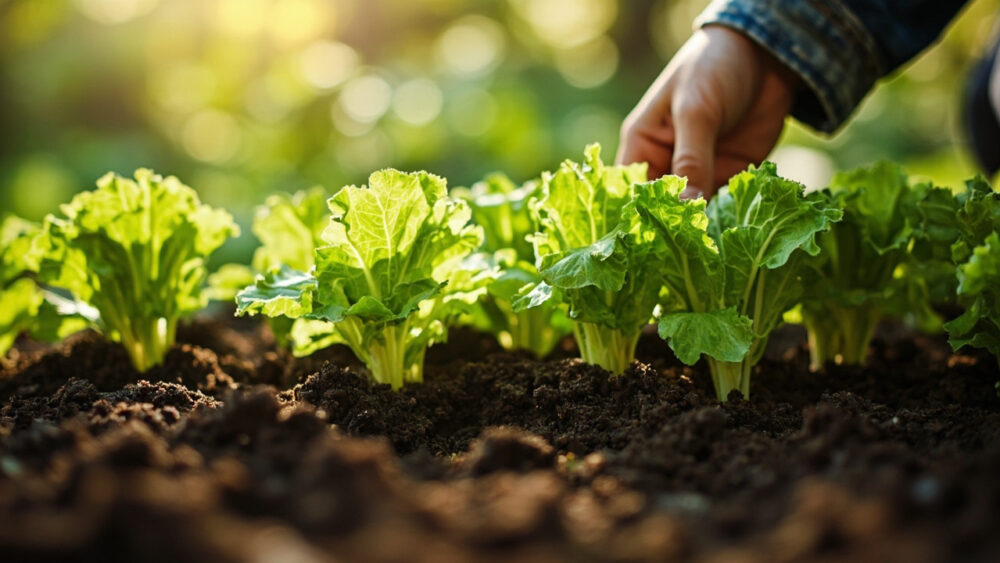
Loose-leaf lettuce wants 4 to 6 inches between plants, and head lettuce like romaine or butterhead wants 8 to 12 inches. Seeds go in barely covered, about a quarter inch deep, because lettuce seed needs light to germinate well and buried seed just sits there sulking. Get those two numbers right and most of what goes wrong with lettuce never happens in the first place.
But the numbers are the easy part. The mistake that wrecks most home lettuce patches is not spacing at all, it is what you do (or don’t do) three weeks after planting, when the seedlings you spaced perfectly have already grown into each other. There is also a sign of overcrowding that looks nothing like overcrowding, and most people misread it completely.
Stick with me and I will walk through row layout, container spacing, what too-tight and too-loose actually cost you in the ground, and how to rescue a bed you already planted too thick. The exact-numbers card you can save to your phone is waiting at the very bottom.
The Real Spacing and Depth Numbers
Lettuce splits into two spacing camps depending on what you’re growing. Loose-leaf types like oakleaf, salad bowl, or mesclun mixes can go in at 4 to 6 inches apart, because you’re harvesting outer leaves continuously and never letting the plant reach full size before you cut it back.
Head-forming types like romaine, butterhead, and crisphead need 8 to 12 inches. They’re building a dense rosette or a tight head, and that takes real root space and airflow to pull off without rotting in the middle.
Depth is the same for both: a quarter inch, no more than half an inch in heavier soil. Lettuce seed is tiny and needs light plus consistent moisture to sprout, usually in 5 to 10 days when soil sits between 60 and 70 F.
Get the spacing right at planting and you’ve solved half your future problems before they start.
Rows, Blocks, or Broadcasting: Pick Your Layout
Traditional rows work fine: space rows 12 to 18 inches apart, then thin plants within the row to the spacing above. It’s the easiest layout to weed with a hoe.
Block or bed planting is more efficient in small spaces. Instead of rows, you space plants evenly in every direction, like a grid, 6 inches apart for leaf types or 10 inches for heads. You fit more plants into less bed and the leaves eventually shade the soil, which cuts down on weeding later.
Broadcasting seed and thinning afterward is the common shortcut, and it’s honestly fine for loose-leaf lettuce you’re going to cut young anyway. Scatter thinly, rake in lightly, then thin ruthlessly once seedlings show their first true leaves.
Whichever layout you choose, the thinning step is where most people quietly skip a step that matters more than the layout itself.
What Actually Goes Wrong When Lettuce Is Too Close
Here’s the sign everyone misreads: lettuce planted too close doesn’t necessarily look stunted right away. It looks lush. A solid green carpet of seedlings feels like success.
That density is exactly the problem. Crowded lettuce competes for water and light and responds by stretching upward and thinning out, a stress response called etiolation. The plants get tall, pale at the base, and floppy instead of compact and dense.
Crowding also traps moisture at soil level with no airflow, which is the single biggest driver of bottom rot and gray mold in a home lettuce patch. If you’ve ever had lettuce collapse into slime right at the crown for no obvious reason, tight spacing and poor air movement is almost always the actual cause, not a mystery disease.
Head lettuce suffers worse than leaf types here, because a head that never gets room to bulk out just stays small and bitter no matter how long you wait.
If crowding causes rot, you might assume more room always fixes it, but spacing too wide creates its own quieter failure.
What Goes Wrong When It’s Too Far Apart
Wide spacing doesn’t rot your lettuce, but it wastes your bed and your season. Lettuce left with too much elbow room doesn’t grow proportionally bigger to fill the gap. It just grows to its normal size and leaves bare soil around it.
Bare soil between lettuce plants is an invitation, mostly for weeds, which then compete for the same water and nutrients you were trying to give the lettuce in the first place. In hot weather that exposed soil also heats up faster, and lettuce roots are shallow and heat-sensitive, so warmer soil pushes plants toward bolting sooner than they should.
Wide spacing is the safer mistake compared to crowding. It costs you yield and invites weeds, but it rarely costs you the whole planting to rot.
That’s not an excuse to eyeball it loosely though, especially once you move lettuce into a pot.
Container Spacing: The Numbers Change a Little
Containers concentrate root competition faster than open ground, so tighten your numbers slightly. In a pot at least 6 to 8 inches deep, space loose-leaf lettuce 4 inches apart and treat that as a firm minimum, not a suggestion.
For head lettuce in containers, give each plant its own 8 to 10 inch pot, or space them 10 inches apart in a larger container or trough. Crowded roots in a container hit their ceiling fast, and you’ll see it as slow growth and early bolting rather than lush green cover.
Windowsill and balcony growers often do best with cut-and-come-again mixes seeded thickly on purpose, then harvested with scissors at 3 to 4 inches tall before real crowding ever becomes an issue. That’s the one legitimate exception to strict spacing rules, because you’re never letting the plants mature into competition with each other.
Containers forgive almost nothing, which makes them the fastest way to learn what correct spacing actually looks like.
How to Fix a Bed You Already Planted Too Thick
If your seedlings are already touching, don’t wait it out hoping they’ll sort themselves out. They won’t, and every week you wait costs you size and quality on the plants you keep.
Thin decisively once true leaves appear, snipping unwanted seedlings at the soil line rather than pulling them, since pulling disturbs the roots of the ones you’re keeping. Eat the thinnings, they’re just baby lettuce.
If plants are more established and touching, transplant every other one to a new spot rather than discarding it. Lettuce transplants reasonably well up to about the four or five true leaf stage, watered in immediately and shaded for a day or two if it’s warm out.
Once you’ve corrected spacing, top-dress with a light layer of compost and water evenly. The remaining plants will bulk up noticeably within a week or two once they’re not fighting neighbors for root space.
Fix it once at this stage and you won’t be fighting rot or bolt-outs later in the season.
Lettuce at a Glance
- When to plant: 2 to 3 weeks before your last frost for a spring crop, and again 6 to 8 weeks before first fall frost, once soil is workable and sits around 40 to 70 F.
- Seed depth: a quarter inch, no deeper than half an inch, pressed in lightly rather than buried.
- Loose-leaf spacing: 4 to 6 inches between plants, rows 12 to 18 inches apart.
- Head lettuce spacing: 8 to 12 inches between plants, rows 12 to 18 inches apart.
- Container spacing: 4 inches for leaf types, 8 to 10 inches per plant for head types, in pots at least 6 to 8 inches deep.
- Germination window: 5 to 10 days at 60 to 70 F soil temperature, slower and less reliable above 80 F.
- Overcrowding sign: tall, pale, floppy growth and soft rot at the crown, not obvious wilting.
Spacing is the one lettuce decision you don’t get a second chance at without pulling something out. Get it right at planting, thin without mercy, and the rest of the crop mostly takes care of itself.