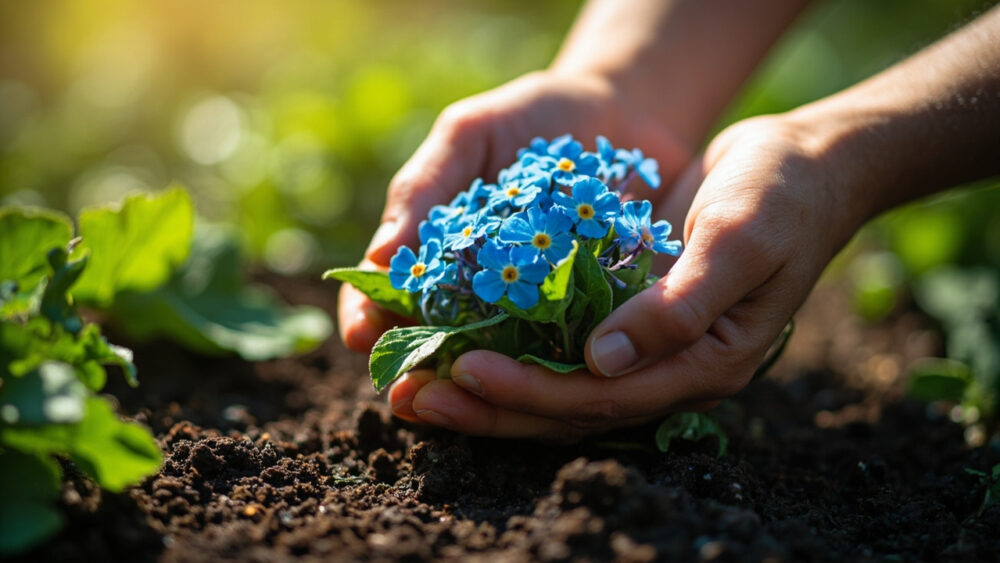
How to grow forget me nots comes down to three things: cool, moist, part-shade conditions, seeds or starts going in a few weeks before your last frost or in late summer for the following spring, and patience while they germinate slowly in their own time. They are not fussy about soil richness, but they are fussy about drying out. Get the moisture and timing right and they will reseed themselves so reliably you will be giving clumps away by year two.
Here is what trips people up. Most gardeners assume a spring-blooming flower wants a full sun spot, plant it in blazing afternoon exposure, and watch it fry by July. That guess is backwards for this plant, and I will get into why in a minute.
There is also a timing question almost nobody asks until it is too late: should you plant now, or is this actually a fall job in disguise. And a lot of readers are about to wonder how forget me nots even reproduce, since the seed pods are tiny and easy to miss entirely. Stick with me through the growing details and the save-able Forget Me Nots at a Glance card at the bottom will give you every number in one place.
When to Plant Forget Me Nots
You have two honest windows, and which one you use depends on whether you are starting from seed or from nursery starts.
For seed started outdoors, sow in early spring as soon as the soil can be worked, roughly four to six weeks before your last expected frost, when soil temperature sits between 55 and 65 F. Forget me nots tolerate light frost fine once up, so you do not need to wait for warm ground the way you would for tomatoes.
The second window, and honestly the better one in many climates, is late summer to early fall, about eight to ten weeks before your first hard frost. Fall-sown plants overwinter as small rosettes and explode into bloom the following April or May. This is how they naturalize in woodland gardens, and it is the closer-to-nature method.
In zones 3 to 7, forget me nots usually behave as biennials or short-lived perennials that self-seed. In zones 8 and warmer, they often act as cool-season annuals, blooming in winter and spring before summer heat ends them.
Timing gets you in the door, but the spot you pick decides whether the plant thrives or sulks.
Choosing the Spot and Prepping the Soil
Here is the sun mistake. Forget me nots are woodland-edge natives, and full, hot sun is the fastest way to stunt them and trigger early powdery mildew. What they actually want is part shade, morning sun with afternoon shade, or the dappled light under deciduous trees. In cooler northern climates they will tolerate more sun, but in anything zone 6 and warmer, afternoon shade is not optional if you want a full season of bloom rather than a two-week flash.
Soil matters less for fertility and more for moisture retention. They want soil that is consistently moist but not waterlogged, slightly acidic to neutral, and enriched with compost or leaf mold if your ground drains fast. Sandy soil that dries out by noon is the other common failure point, right alongside too much sun.
Work an inch or two of compost into the top 6 inches before planting. That is really all the soil prep this plant asks for.
Once the bed is ready, the actual planting takes only a few minutes.
Planting Forget Me Nots Step by Step
- Sow seed shallow. Scatter seed on the soil surface and press it in, covering with no more than 1/8 inch of fine soil. These seeds need some light to germinate well, so do not bury them deep.
- Water gently right after sowing and keep the top inch of soil damp. Germination is slow and uneven, often taking 2 to 4 weeks, sometimes longer in cool soil, so do not give up and assume the seed failed.
- Thin or space seedlings to 6 to 8 inches apart once they have a couple of true leaves. They fill in fast, so tighter spacing just means earlier thinning.
- For nursery starts, dig a hole the same depth as the root ball, set the plant so the crown sits level with the soil surface, backfill, and firm gently.
- Water in well after transplanting to settle soil around the roots and remove air pockets.
Getting them in the ground is the easy part, keeping them alive through their first month is where attention pays off.
Watering and Feeding Through the Season
Forget me nots are shallow-rooted, which means they dry out fast and show it fast. Check soil an inch down; if it is dry, water. In cool spring weather that might mean twice a week, in a warm dry spell it can mean every other day.
Mulch is doing more work here than fertilizer ever will. A 1 to 2 inch layer of shredded leaves or fine bark keeps roots cool and moisture even, which is the single biggest thing you can do for this plant beyond picking the right spot.
Feeding needs are light. A balanced, diluted liquid fertilizer once in early spring as growth resumes is plenty. Heavy feeding pushes soft, floppy growth and more mildew, not more flowers.
Water and mulch right, and the next thing you will be managing is pests, not thirst.
Problems That Actually Show Up
The big one is powdery mildew, a gray-white coating on leaves that shows up when plants are stressed by heat, dry soil, or crowded, still air. It is common enough on forget me nots that seeing a little in midsummer is not a crisis. Improve airflow by thinning crowded clumps, water at the soil line instead of overhead, and remove badly affected leaves. If it is severe, a fungicide labeled for powdery mildew on ornamentals can help; follow the product label exactly.
Slugs and snails go after young seedlings and low foliage, especially in the damp conditions this plant loves. Look for irregular holes and slime trails at dusk. Hand-picking, beer traps, or an iron phosphate slug bait used per label are the standard, low-drama fixes.
Aphids cluster on new growth and stem tips. A strong water spray or insecticidal soap knocks them back without much fuss.
Forget me nots (Myosotis) are not listed among the seriously toxic garden plants, but as with any plant, keep an eye on pets and small children who like to sample things, and call a veterinarian or poison control if you suspect a significant ingestion.
Handle those three problems and the plant mostly takes care of itself the rest of the way to bloom.
When Forget Me Nots Bloom, and the Seed Question
Spring-sown plants typically flower by early to mid summer of the same year in cooler climates, though in warmer zones spring sowing often only gets you foliage before heat shuts things down. Fall-sown or overwintered plants bloom far more reliably, opening in April or May and often continuing 4 to 6 weeks.
There is no harvest step in the vegetable-garden sense, but there is a seed step, and this is the part almost nobody notices happening. After petals drop, tiny curved seed pods form along the stem, easy to mistake for nothing at all.
Let some of those pods dry and brown on the plant if you want self-seeding, which is how forget me nots naturalize into drifts with almost no effort from you. If you want to collect seed intentionally, snip stems once pods are dry and papery, shake them into a paper bag, and store the seed somewhere cool and dry until your next sowing window.
Once bloom fades, cutting plants back by half tidies them up and can trigger a second, lighter flush before the heat of summer ends the show.
Everything you need to keep straight season to season is in the card below.
Forget Me Nots at a Glance
- When to plant: sow seed 4 to 6 weeks before last frost in spring, or 8 to 10 weeks before first frost in late summer for the strongest bloom the following year.
- Where to plant: part shade, morning sun with afternoon shade in zones 6 and warmer, more sun tolerated in cooler zones.
- Soil and moisture: compost-enriched, slightly acidic to neutral, kept consistently moist, never allowed to dry out for long.
- Planting depth and spacing: seed just barely covered, about 1/8 inch deep, plants thinned or spaced 6 to 8 inches apart.
- Watering and feeding: check soil an inch down and water when dry, mulch 1 to 2 inches, one light balanced feeding in early spring.
- Common problems: powdery mildew from heat and crowding, slugs on seedlings, occasional aphids.
- Bloom time: April to May from fall-sown plants, lasting 4 to 6 weeks, with self-seeding pods forming right after.
Get the shade and the moisture right and forget me nots basically grow themselves from there.
Leave a few seed pods on the plant each year and you will likely never have to plant this flower again.