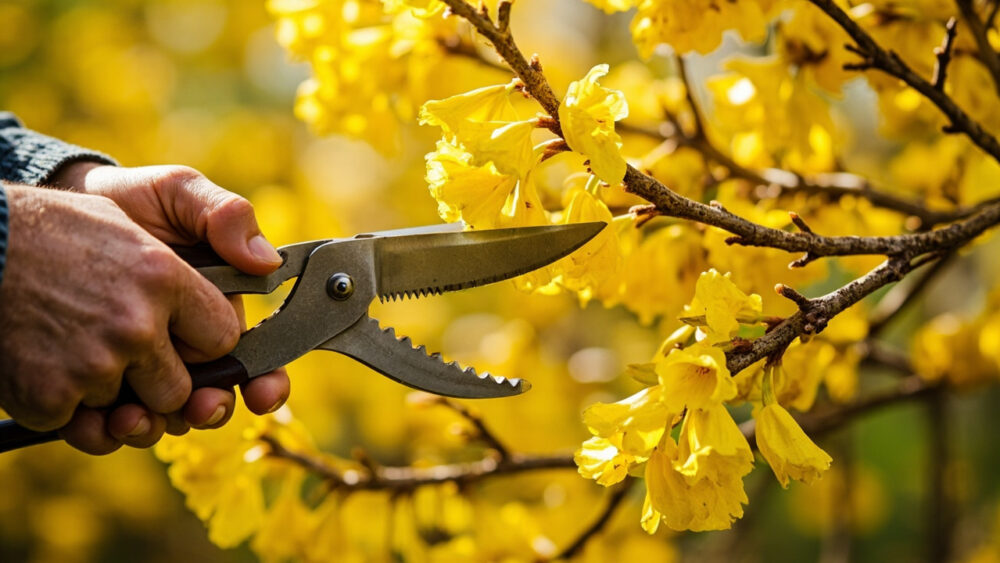
The answer to how to prune forsythia comes down to timing more than technique: cut it right after it finishes blooming in spring, not in fall or winter, and remove no more than a third of the oldest wood at ground level each year. Wait too long or cut at the wrong time of year and you will not kill the shrub, but you will cut off next year’s flowers before they even had a chance to form. That single timing mistake is the reason so many forsythias turn into bare green blobs by midsummer.
There is more to get right than just the calendar. The mistake almost everyone makes is shearing forsythia into a tidy ball, which looks fine for about two weeks and then ruins the natural arching shape for years. There is also a sign on the shrub right now that tells you exactly how urgent this job is, and a follow-up question almost nobody asks until it is too late: what happens if you missed the window and it already set next year’s buds.
Stick with me through the how-to and the mistakes, because the save-able Forsythia at a Glance card at the bottom has every number you need on your phone the next time you are standing in front of the shrub with loppers in hand.
When to Prune Forsythia (and When to Leave It Alone)
Prune forsythia within two to three weeks after the flowers fade in spring. That is usually a window measured in weeks, not a fixed date, and it depends entirely on your climate. Depending on zone, that can land anywhere from March to early May.
The reason for the rush matters: forsythia blooms on old wood, meaning the flower buds for next spring form during the summer right after this year’s bloom. Prune in fall, winter, or even midsummer and you are cutting off buds that are already set, which is why a forsythia pruned at the wrong time still leafs out fine but barely flowers the following year.
Never prune forsythia in fall or winter just because the shrub is bare and easy to see into.
Tools and the One Prep Step That Actually Matters
You need bypass hand pruners for anything pencil-thick or smaller, loppers for branches up to about an inch and a half, and a pruning saw for anything thicker at the base. Clean, sharp blades matter here because forsythia stems are pithy and tear rather than cut cleanly with dull tools.
The prep step everyone skips is simply standing back and looking at the shrub for a full minute before you cut anything. Identify the oldest, thickest, grayest canes at the base first, since those are your priority removals, not the young whippy green growth on the outside.
Wipe your blades with rubbing alcohol between plants if you are working on more than one shrub, especially if any showed dieback or unusual spotting last season.
Once you know which canes are oldest, the actual cutting takes less time than the looking did.
Step 1: Remove the Oldest Canes at the Base
Cut one third of the oldest, thickest stems all the way down to a few inches above ground level. These older canes bloom less each year and crowd the center of the plant.
Removing them at the base, not partway up, is what keeps a forsythia renewing itself instead of getting woodier and more tangled every season.
Step 2: Thin Out Crossing and Inward-Growing Branches
Look inside the canopy for branches that cross, rub, or grow back toward the center of the shrub. Cut these back to where they originate, either at the base or at a healthy junction.
This step opens up airflow and light, which reduces fungal leaf spot later in the season.
Step 3: Shape the Remaining Growth, Sparingly
Tip back any wildly long shoots that ruin the arching form, cutting just above a healthy bud. Do not round the whole shrub into a hedge shape.
Forsythia’s natural form is a loose fountain of arching branches, and that shape is exactly what shearing destroys.
How Much Is Too Much
As a hard ceiling, never remove more than a third of the shrub’s total wood in one year. Overgrown, neglected forsythia can be renewal pruned by cutting the entire plant back to 6 to 12 inches from the ground, but only do this right after bloom and understand you will sacrifice most of next year’s flowers to reset the plant.
That tradeoff, one lost bloom season for years of better shape, is the honest deal with a severe rejuvenation cut.
What Forsythia Does After a Proper Pruning
Expect a burst of new green shoots from the base and from cut points within two to four weeks. This new growth is where next year’s flower buds will form over the summer, so do not judge the shrub’s flowering by what happens this year.
If you assumed a hard prune means fewer flowers forever, that guess is backward. A shrub thinned correctly right after bloom typically flowers just as heavily, or more heavily, the following spring because the plant is putting energy into fewer, stronger canes instead of a tangle of old wood.
The shrub also tends to hold its arching shape better through summer instead of flopping under its own weight, since you removed the heaviest old growth at the base.
None of that new growth means much if you made one of the timing mistakes below.
The Mistakes That Cost You Next Year’s Flowers
Here is the honest answer to the question you were about to ask: if you missed the post-bloom window and it is now midsummer or later, do not prune this year. Wait until right after next spring’s bloom instead. Pruning now will not hurt the shrub’s health, but it will cut off buds already forming for next spring.
Shearing into a ball or hedge shape is the second big mistake, and it is almost always done with hedge trimmers instead of hand tools. Sheared forsythia produces a flush of dense outer growth that shades out the interior, so flowering concentrates only on the surface and the center goes bare and woody.
A few more mistakes worth naming plainly:
- Pruning in fall to tidy up: removes next spring’s flower buds outright.
- Never removing old wood: leads to a dense, twiggy shrub that blooms less every year.
- Fertilizing heavily after a hard prune: pushes leafy growth at the expense of flower bud formation, so skip heavy nitrogen the same season.
- Cutting all canes to the same height: creates an unnatural flat-topped look instead of the arching form forsythia is grown for.
Get the timing and the amount right and forsythia forgives almost everything else, which is exactly what the quick-reference card below is for.
Forsythia at a Glance
- When to prune: within two to three weeks right after the spring flowers fade, never in fall or winter.
- How much to remove: up to one third of the oldest canes at ground level per year, as a hard yearly limit.
- Where to cut: oldest, thickest, grayest canes cut at the base, crossing branches cut back to their point of origin.
- Renewal pruning: overgrown shrubs can be cut back to 6 to 12 inches after bloom, at the cost of most flowers the following spring.
- Tools needed: bypass hand pruners, loppers for branches up to about 1.5 inches, a pruning saw for thicker old wood.
- Shape to aim for: a loose arching fountain, never a sheared ball or hedge.
- Blooms on: old wood, meaning flower buds form during summer for the following spring.
If you remember one thing, remember this: forsythia’s whole flowering cycle depends on cutting right after bloom, not before, and not months later out of habit.
Get that timing right and everything else about pruning this shrub is genuinely hard to mess up.