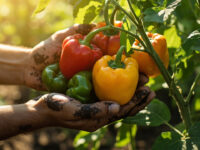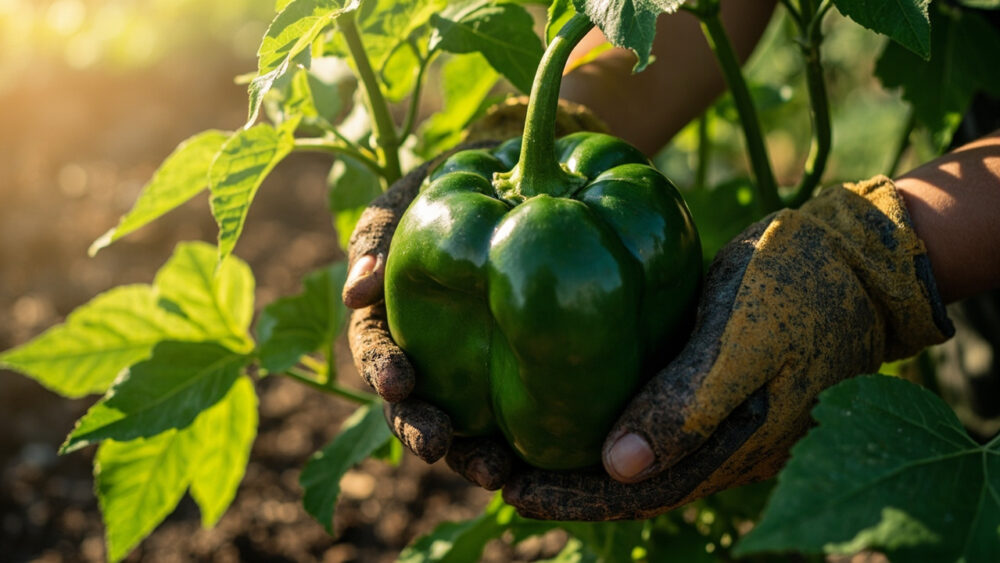
The honest answer to when to harvest poblano peppers is that you get to pick twice, at two different colors, and both are correct. Most gardeners cut them at 60 to 75 days from transplant when they’re still glossy dark green and about 4 to 5 inches long. Leave them another 2 to 3 weeks and they’ll blush to a deep brownish red or almost black, which is when they’re fully ripe, sweeter, and technically ready to become ancho peppers if you dry them.
Here’s what trips people up: the color change everyone waits for isn’t a sign of rot or something gone wrong, it’s the plant doing exactly what it should. But going by color alone without checking the other two signals is the mistake that costs people a whole harvest window, because a poblano can look ready and still be weeks off, or look fine and be about to split open.
There’s also a timing decision buried in this that nobody warns you about until it’s too late, the choice between picking green for volume or waiting for red for flavor really does force a tradeoff on the plant. Stick with me and I’ll walk through the exact signs, the harvest technique that keeps the plant producing, and what to do with peppers the moment they’re off the stem. Save the “Poblano Peppers at a Glance” card at the very bottom, it’s the part you’ll want pulled up on your phone next time you’re standing in front of the plant.
The Ready Signs: What to Actually Look and Feel For
A ready poblano gives you three signals at once, not just one. Skip any of them and you’re guessing.
Size and shape
Poblanos should be 4 to 6 inches long and wide-shouldered, almost heart-shaped, tapering to a blunt point. If it’s still slim and small at 2 to 3 inches, give it more time regardless of color.
Skin feel
The skin should be firm and taut, not soft or wrinkled. Run a thumb over it. If it dents easily or feels papery, it’s past its best or was stressed by drought.
Color and sheen
Green-stage poblanos are glossy, almost waxy, dark green with no yellowing patches. That gloss is a real tell, a dull or matte green usually means the pepper stalled out from heat stress or inconsistent water, not that it needs more time.
Once you can check all three boxes, the clock is yours to work with.
The Timing Window, and What Green Versus Red Actually Costs You
Poblanos take roughly 60 to 75 days from transplant to reach full green size, then another 2 to 3 weeks on the plant to ripen to red or near-black if you leave them. That second stretch is where most of the guesswork lives.
Pick too early and you get thin-walled, bitter peppers that shrivel fast in the fridge. Pick too late, past full ripening, and the pods can split at the shoulder, especially after a heavy watering or rain, and split pods invite rot within a day or two.
Here’s the tradeoff nobody mentions upfront: every poblano you let ripen to red is a pepper the plant spent extra weeks of energy on instead of putting out new flowers. Ripen a few for anchos and pick the rest green, and you’ll get both flavor variety and a longer-producing plant. Ripen everything and total yield drops noticeably by season’s end.
First frost matters here too. Poblanos are frost-tender, so once nighttime temperatures are forecast to dip near 32°F, pick everything on the plant, ripe or not, green pods included, because a single hard frost turns the whole plant to mush overnight.
Knowing when is only half the job, the cut itself decides whether the plant keeps producing or sulks for weeks.
How to Harvest Without Setting the Plant Back
Poblano stems are surprisingly tough and the branches are brittle, which is a bad combination if you just yank the fruit off.
Use scissors or pruning snips, not your fingers, and cut the stem about a half inch above the pepper’s cap, not flush against the branch. Pulling instead of cutting is the step almost everyone gets wrong, and it’s how you end up snapping a branch loaded with three more peppers along with it.
Hold the branch steady with one hand while you cut with the other, especially on plants loaded with fruit, since the weight alone can tear at the joint. Harvest in the morning when the pods are firmest and the plant is least stressed by heat.
If a stem does snap, don’t panic and don’t try to tape or splice it. Just remove the broken piece cleanly and let the plant redirect energy elsewhere.
Once the pepper’s in your hand, what you do in the next hour matters almost as much as the cut.
Right After the Cut: Handling Fresh Poblanos
Fresh poblanos bruise more easily than their thick skin suggests. Set them in a single layer, not piled in a bucket, on the walk back from the garden.
Rinse and dry them before storage, and skip the crisper drawer’s high humidity setting if your fridge has one, poblanos do better in a slightly drier environment, around 45 to 55°F, loosely bagged with a little airflow. Handled that way, green poblanos hold well for 1 to 2 weeks.
Don’t wash them until you’re ready to use or process them if you’re storing longer, since trapped moisture on the skin is what starts soft spots. A quick rinse right before cooking is fine.
That storage window is short, though, which is exactly why harvest pace matters as much as harvest timing.
Keeping the Harvest Coming
Poblano plants are indeterminate producers, meaning they keep flowering and fruiting as long as you keep picking. Consistent harvesting, every 3 to 5 days once pods start sizing up, is what pushes the plant to set new flowers instead of pouring everything into the fruit already hanging.
Leave a plant unpicked for two or three weeks and it slows down noticeably, sometimes for the rest of the season.
If you’re aiming for dried anchos, let a portion ripen fully to deep red, then either string them to air-dry in a warm, well-ventilated spot or use a dehydrator on a low setting until they’re leathery and pliable, not brittle. Fully dried anchos, sealed and kept dark and cool, last a year or more.
Green poblanos also freeze well, roasted and peeled first, if you’re picking faster than you can eat or cook them, which happens to almost everyone by midsummer.
All of that comes down to a handful of numbers worth keeping close, so here’s the short version.
Poblano Peppers at a Glance
- When to plant: set transplants out 2 to 3 weeks after your last frost, once soil has warmed to at least 65°F.
- Spacing and depth: space plants 18 to 24 inches apart, transplant at the same depth they were growing in the pot.
- Days to green harvest: 60 to 75 days from transplant, pods at 4 to 6 inches, glossy dark green, firm skin.
- Days to red, fully ripe: add another 2 to 3 weeks on the plant for deep red to near-black color, sweeter flavor, ready for drying.
- How to cut: snip the stem a half inch above the cap with scissors or snips, never pull by hand.
- Storage: fresh at 45 to 55°F holds 1 to 2 weeks unwashed, dried anchos keep a year or more sealed in a cool, dark spot.
- Keep it producing: harvest every 3 to 5 days, and strip every pod off before the first frost near 32°F.
Pick by size, feel, and sheen together, never color alone, and cut instead of pulling.
That combination is what keeps both the harvest and the plant going strong through the end of the season.