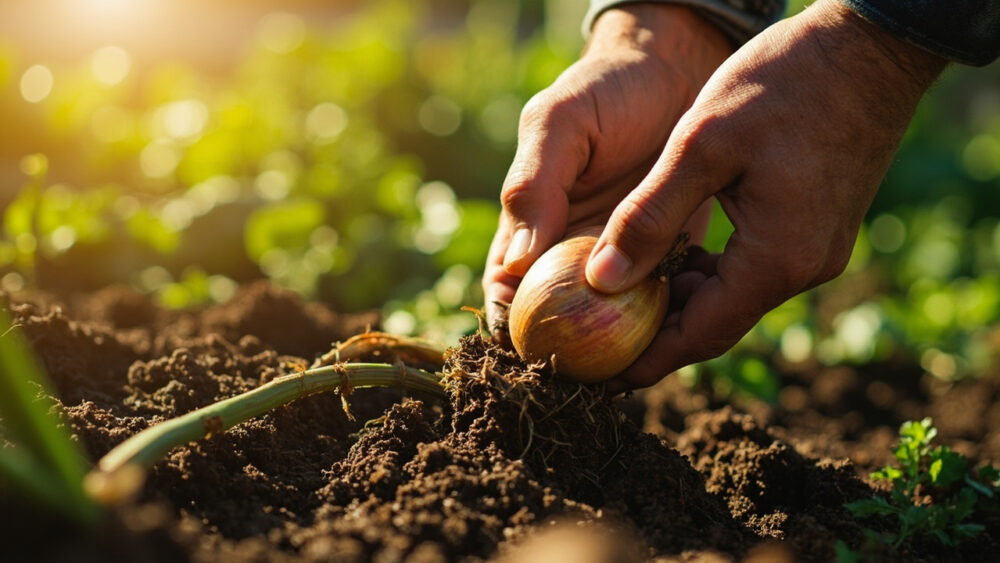
The moment to harvest onions is when the tops start falling over on their own and turning yellow or brown at the base, which usually happens 100 to 175 days after planting depending on variety. You do not cut them down or bend them yourself. You wait for the plant to make that decision, then pull within a week or two of it happening.
That part is simple. What trips people up is everything around it: the mistake of forcing the tops over early because a gardening neighbor told them to, the way a perfectly ready onion can look identical to one that needs another three weeks, and the honest truth about what happens if a big storm flops your whole bed over in one night and you cannot tell if it was ready or just wind-damaged.
Stick with me through the signs, the timing window, and the actual pulling and curing process, and by the end you will have the “Onions at a Glance” card saved to your phone for every season after this one.
The Real Ready Signs, Not the Guessed Ones
Most people assume bigger is better and keep waiting for the bulb to swell more. That guess costs you storage life, not size.
Tops falling over
The papery neck just above the bulb weakens and the whole top flops sideways. This happens naturally when the bulb has finished sizing up and the plant is shifting energy out of the leaves. Falling tops are the single most reliable signal you have. Not yellowing alone, not size alone, the actual flop.
Yellowing and thinning necks
Once tops fall, they usually yellow within a few days. The neck, which was firm and green, goes soft and papery. Grab one gently between two fingers. If it feels thin and floppy rather than thick and juicy, that onion is done growing.
Once 30 to 50 percent of the tops in the bed have fallen over, the whole planting is entering harvest week.
The Timing Window, and What Early or Late Actually Costs You
Onions are day-length driven, not calendar driven. Long-day types (common in the northern half of the country) and short-day types (common in the South) both bulb up in response to hours of daylight, then mature over roughly 3 to 5 months from planting depending on variety and how they were started, sets, transplants, or seed.
Pull too early and you get a small, thin-skinned onion that will not cure properly and rots fast in storage. The neck is still thick and full of moisture, which is exactly what invites mold once you try to store it.
Wait too long past the point where most tops have fallen, and the neck can rot right where the plant meets the soil, especially after rain. The bulb can also split its outer skin or resprout if warm, wet weather hits after the tops go down. Onions do not hold in the ground the way carrots or potatoes do once they signal they are finished.
The honest window is about 5 to 10 days after most of the tops have fallen over, before the next rain if you can help it.
So what do you do if a windstorm flattens the whole bed before any of that happens naturally.
When Wind or Storms Knock the Tops Down First
This is the follow-up question almost everyone has right after they learn the falling-tops rule, and it deserves a straight answer. Wind-flattened tops that are still thick, green, and firm-necked are not a ready signal. They are storm damage.
Check the neck, not the angle of the leaf. A truly mature onion has a thin, weak, papery neck that gives way on its own. A storm-flattened onion still has a plump green neck holding moisture. If most of your necks are still thick, prop nothing back up, just wait. The plant will tell you again once it is actually ready, usually within another one to three weeks.
Next comes the part where a lot of good onions get bruised or torn right at the finish line.
How to Pull Onions Without Wrecking Them
Never yank a bulb straight up by the neck. The skin tears, the neck bruises, and a bruised onion is a rotted onion within a few weeks in storage.
- Loosen the soil first. Slide a garden fork or trowel down 3 to 4 inches next to the bulb, a few inches out from the base, and lever gently upward.
- Lift by hand. Once the soil gives, grasp the bulb itself, not the leaves, and lift straight out.
- Brush off loose soil with your hand or a soft glove. Do not scrub, rinse, or knock it against a hard surface.
- Set aside any bulb with a soft spot, split skin, or bruise. Those go in the kitchen pile for immediate use, not the storage pile.
Pick a dry day if you have any choice in the matter, wet soil clinging to bulbs is where storage rot starts.
The First 48 Hours Matter More Than People Realize
Fresh-pulled onions still have wet outer layers and soft necks. What you do in the next couple of days decides whether they store for months or mush out in weeks.
Get them off the ground and into airflow immediately. Lay them in a single layer, tops and all, somewhere dry, shaded, and breezy: a covered porch, a garage with the door cracked, a shed with a fan. Direct sun for more than a few hours can scald the bulbs.
Leave the tops attached during this stage. Do not trim them yet, and do not wash the bulbs. Water is the enemy right now, not dirt.
This first stretch is really the start of curing, and curing is where most of the real payoff happens.
Curing and Storage: Turning a Harvest Into Months of Onions
Curing is what converts a wet, fresh-pulled bulb into something that keeps. It takes 2 to 4 weeks in warm, dry, well-ventilated conditions, ideally 75 to 90°F with good airflow and out of direct sun.
You will know curing is finished when the outer skins turn papery and rustle, and the neck at the top has dried down tight and thin, almost like twine.
- Trim the tops to about an inch once fully cured, or braid them if you plan to hang the bunch.
- Trim roots close to the base at the same time.
- Store cured onions in mesh bags, old pantyhose, or a slatted crate somewhere cool, dry, and dark, ideally 35 to 45°F with low humidity.
- Sort by thickness of neck. Thin-necked, hard bulbs store longest, sometimes 4 to 8 months. Thick-necked or soft bulbs should be used first, within a few weeks.
Skip curing and even a perfectly harvested onion will start going soft in the pantry within days.
All of that comes down to a handful of numbers and cues worth keeping on hand every single season.
Onions at a Glance
- Ready sign: tops fall over on their own and the neck goes thin and papery, not thick and green.
- Timing window: pull within 5 to 10 days after most tops have fallen, ideally before the next rain.
- Days to maturity: roughly 100 to 175 days from planting, depending on variety and start method.
- How to pull: loosen soil with a fork first, lift by the bulb, never yank by the leaves.
- After harvest: cure 2 to 4 weeks in a warm, dry, shaded, well-ventilated spot before trimming tops or roots.
- Storage: cool, dry, dark, around 35 to 45°F, thin-necked bulbs keep longest.
- Storm-flattened tops: not a ready sign by itself, check the neck for thinness before pulling.
Let the plant tell you when it is finished, then move fast on the pulling and slow on the curing.
Get that order right and a single bed of onions can feed you well past the season it grew in.