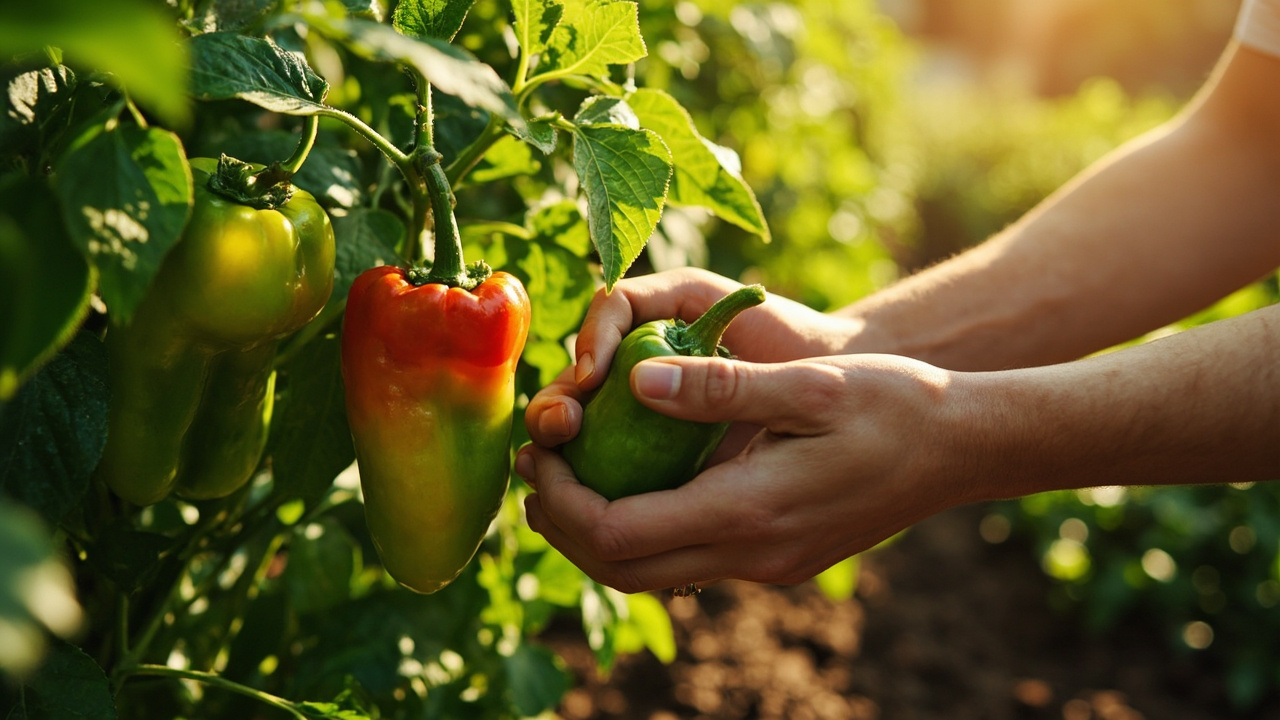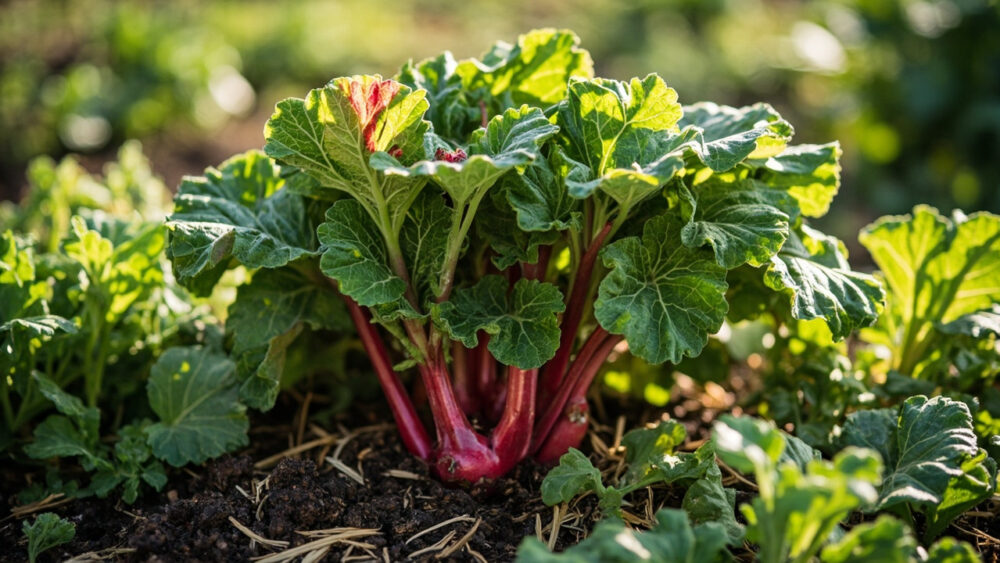
Good companion plants for rhubarb are the ones that either use the space that giant leaf canopy leaves bare, help chase off the bugs that go after brassicas and beans, or simply stay out of the way of those aggressive, water-hungry roots. Onions, brassicas like cabbage and broccoli, beans, and strawberries all pair well. What ruins the pairing almost every time is planting something shallow and thirsty right at the drip line, where rhubarb’s roots will out-compete it before midsummer.
There is a mistake nearly every new rhubarb grower makes with companions, and it has nothing to do with which plant you pick. It is where you put it.
Before you get to the planting layout, there is also one popular “companion” pairing that garden lore repeats constantly and that just does not hold up in practice, plus the plant family you should never tuck in close no matter how tempting the empty ground looks. Stick with me through the layout section and the myth-busting, because the save-able Rhubarb at a Glance card at the bottom has the spacing, timing, and soil numbers you will want pulled up on your phone next time you are standing at the bed.
Why Companion Choice Matters More Than People Think for Rhubarb
Rhubarb is a perennial that claims its ground for a decade or more once it is happy. That changes the companion planting game.
You are not rotating this bed every year like you would with tomatoes or squash. Whatever you plant near it needs to tolerate permanent, deep shade from a leaf canopy that can reach 2 to 3 feet across by early summer, and roots that spread wide and pull hard on soil moisture and nutrients.
The right neighbors fill gaps, repel pests, or take advantage of the shade. The wrong ones either get shaded out, starved out, or start a fight over root space that neither plant wins cleanly.
Get the pairing logic straight first, and the plant list actually makes sense instead of feeling like a random chart.
The Best Companion Plants for Rhubarb
Alliums: Onions, Garlic, and Chives
Alliums are the classic rhubarb companion for good reason. Their sulfur compounds help mask the plant from aphids and some borers, and their narrow, upright growth habit means they are not fighting rhubarb’s broad leaves for light.
Plant them 8 to 10 inches out from the rhubarb crown, in a ring or a row along the sunny edge of the bed.
That ring of alliums does its best work when the plant next to it actually needs the protection.
Brassicas: Cabbage, Broccoli, Kale
Rhubarb’s big leaves cast useful afternoon shade that brassicas appreciate once the weather turns warm, and brassicas in turn do not compete much for the same root depth. There is also a long-standing garden claim that rhubarb repels cabbage worms and cabbage loopers outright.
That is overstated. What rhubarb actually offers is shade and a slightly different scent profile that can make brassicas a little less obvious to egg-laying moths, not a guarantee of a worm-free crop.
Give brassicas at least 18 inches from the rhubarb crown so their roots are not fighting for the same nutrient band.
Realistic expectations here matter, because the next companion actually earns its keep in a different way entirely.
Bush Beans
Bush beans fix nitrogen in the soil through their root nodules, and rhubarb is a heavy nitrogen feeder that will happily take advantage of that boost. Beans also stay low and compact, so they are not shading out the rhubarb crown or competing above ground.
Keep beans 12 to 18 inches from the crown and let them run their season out; when you pull the spent plants in fall, leave the roots in the ground to break down and release that nitrogen right where the rhubarb needs it.
Strawberries take a different approach to the same problem, and it is worth knowing where their limits are.
Strawberries
Strawberries are shallow-rooted, low-growing, and tolerate the light shade rhubarb throws off in the afternoon. They make decent living mulch along the sunnier edges of a rhubarb bed, suppressing weeds in ground that would otherwise sit bare.
The catch is that strawberries still want reasonably consistent moisture, and if you plant them right against a mature rhubarb crown, they will lose that moisture fight by August most years.
Give them 12 inches of breathing room and treat them as an edge planting, not an underplanting.
Marigolds and nasturtiums round out the list, and they solve a problem the vegetables above cannot.
Marigolds and Nasturtiums
Both are classic pest-trap and pest-deterrent flowers. Marigolds’ root exudates discourage some nematodes, and nasturtiums draw aphids away from nearby crops by being more attractive to them than almost anything else in the bed.
Tuck them into any gap around the rhubarb’s edge, 6 to 12 inches out, where they get enough sun to bloom.
Now for the part that costs people an entire rhubarb crown if they get it wrong.
What to Never Plant Near Rhubarb
Other Members of the Nightshade-Adjacent Deep-Root Crowd: Skip Tomatoes and Potatoes
If you guessed rhubarb’s danger plants would be something exotic, the real answer is more mundane and more common in home gardens: tomatoes and potatoes.
Both compete hard for the same nutrient-rich, moisture-retentive soil rhubarb wants, and potatoes in particular can attract soil-borne fungal issues that spread to rhubarb’s root system. Tomatoes planted too close will also get progressively shadier and stunted as the rhubarb canopy fills in through June.
Keep both at least 3 feet from any rhubarb crown, and honestly, a separate bed is simpler than trying to manage that overlap all season.
There is a second plant to avoid that has nothing to do with competition and everything to do with what happens if a leaf ends up in the wrong place.
Skip Anything You Will Harvest Leaf-by-Leaf Right Next to It
Rhubarb leaves contain oxalic acid and are toxic if eaten, to people and to pets. This is well established, and it is the reason you eat the stalks and discard the leaves.
The practical risk with companions is not the rhubarb itself spreading toxicity through soil. It is a dropped or wind-blown leaf landing in a bed of lettuce, spinach, or other leafy greens you are harvesting by hand without a close look every time.
Keep leafy greens harvested for fresh eating on the far side of the garden, not tangled in with rhubarb, so a stray leaf never ends up in a salad by accident. If a child, dog, or cat is ever seen eating rhubarb leaves, call a veterinarian or poison control promptly rather than waiting to see what happens.
Layout solves most of these problems before they start, so let’s get the bed geometry right.
How to Lay Out a Rhubarb Bed With Companions
Rhubarb crowns need real room: space plants 3 to 4 feet apart, and plan for a mature spread of 2 to 3 feet per plant in both directions.
Think of the bed in rings. The crown and its root zone claim the center. A foot out, you have your allium ring or bean row. Past that, at the 18 to 24 inch mark, brassicas or flowers can go in without root competition.
- Zone 1 (0 to 10 inches from crown): alliums only, or leave bare and mulched.
- Zone 2 (10 to 18 inches): bush beans, nasturtiums, marigolds.
- Zone 3 (18 inches and beyond): brassicas, strawberries along the sunny edge.
Mulch the whole bed 2 to 3 inches deep with straw or shredded leaves, keeping mulch pulled back an inch or two from the crown itself so it does not trap moisture against the buds and invite rot.
With the layout sorted, it is worth killing off the last few myths before you plant anything.
Companion Planting Myths That Do Not Hold Up
Myth one: rhubarb repels all garden pests nearby. It does not. It has a mild deterrent effect on a narrow set of pests through scent and shade, nothing close to a blanket shield.
Myth two: asparagus and rhubarb are a natural pair because they are both early perennials. In reality they have different soil pH preferences and different root structures, and there is no documented benefit to planting them together beyond convenience.
Myth three: rhubarb needs no companions at all because it is tough enough to grow alone. True that it will survive alone, but a bare root zone around a widely spaced perennial is wasted growing space and an open invitation to weeds.
All of this is easier to act on with the numbers in one place, so here they are.
Rhubarb at a Glance
- When to plant: early spring as soon as the soil can be worked, about 2 to 4 weeks before your last frost, or in fall in mild-winter areas.
- Spacing: 3 to 4 feet between crowns, planted 2 to 3 inches deep with the buds just at or slightly below soil level.
- Soil and site: rich, well-drained soil with a pH around 6.0 to 6.8, in full sun to light afternoon shade.
- Best companions: onions, garlic, chives, bush beans, brassicas, strawberries at the edge, marigolds, nasturtiums.
- Never plant close: tomatoes and potatoes within 3 feet, and avoid mixing in leafy greens you harvest by hand.
- Toxicity note: leaves are toxic to people and pets due to oxalic acid; only the stalks are edible, and any suspected ingestion of leaves should go straight to a veterinarian or poison control.
- Maintenance: mulch 2 to 3 inches deep, keep mulch off the crown, and top-dress with compost each spring since rhubarb is a heavy feeder.
Rhubarb rewards good neighbors and punishes crowding, so give the crown its own ring and let the companions work the space around it.
Get the spacing right once, and this bed keeps producing with almost no drama for years.