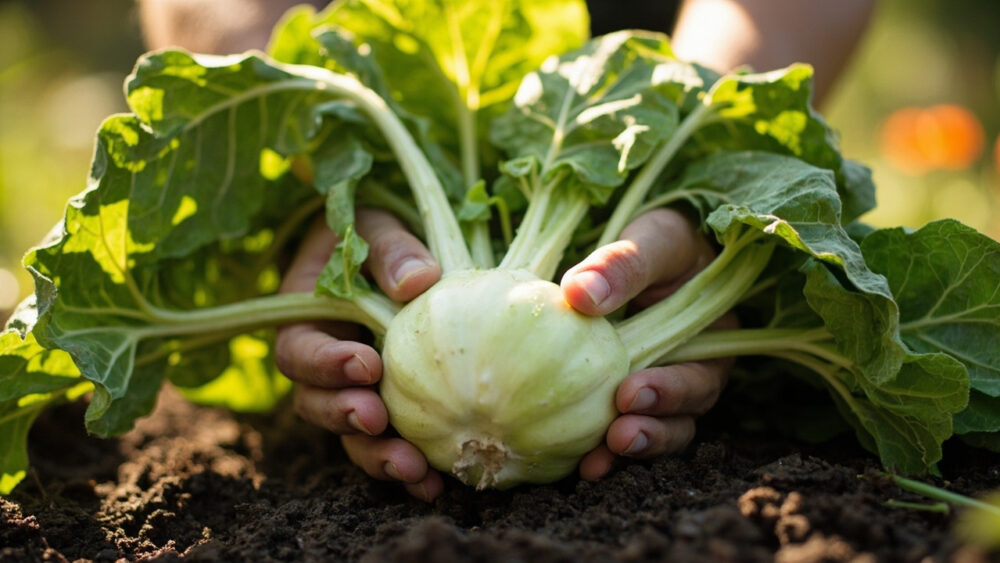
Kohlrabi is ready when the bulb reaches about 2 to 3 inches across for the sweetest texture, or up to 3 to 4 inches for most varieties before it turns woody. That usually lands 45 to 60 days after transplanting, or 55 to 70 days from direct seeding, depending on the variety and how warm the weather has been. Skip the ruler entirely if you want, because your eyes and a light squeeze will tell you almost as much.
Here is where most people go wrong, though, and it is not the part you’d expect. Most gardeners assume bigger is always better with kohlrabi, the same way they’d think about a cabbage or a winter squash, and that assumption is exactly what turns a crisp, mild bulb into something fit only for the compost pile.
There is also a sign growers misread constantly, one that looks like trouble but usually means the opposite. And there is a real, honest answer to the question you are probably about to ask next: what happens if you already let it go too long. Stick around, because the save-able Kohlrabi at a Glance card at the bottom covers the exact sizes, timing, and storage numbers so you don’t have to remember any of this later.
The Real Ready Signs
Forget days-to-maturity as your only guide. That number on the seed packet is a starting estimate, not a deadline, since heat and water swing it by a week or more in either direction.
Size and shape
Look for a bulb that has swelled to golf-ball size at minimum and softball size at most, roughly 2 to 4 inches in diameter depending on variety. Purple varieties and white or green ones mature at similar sizes, so color is not your cue here.
The feel test
Firmness matters more than size. Press the bulb gently. It should feel dense and solid all the way through, not spongy, and definitely not hollow-sounding if you tap it.
Now here’s the sign everyone misreads: if the lower leaves start yellowing slightly while the bulb is still small, most people panic and assume disease or nutrient trouble. Nine times out of ten it just means the plant is shifting energy into bulb formation, which is a good thing, not a warning.
Once you know what “ready” actually feels like, the trickier question is when that window opens and closes.
The Timing Window: Early, Late, and the Sweet Middle
Kohlrabi is a cool-season crop, and it wants to mature in mild weather, ideally 60 to 75 degrees F. Spring crops go in the ground 2 to 3 weeks before your last frost date, and fall crops go in about 6 to 8 weeks before your first fall frost, since the bulb sizes up fastest in that cooling autumn stretch.
Harvest early and you lose almost nothing. A 1.5 to 2 inch bulb is still perfectly usable, just smaller and slightly less filling for a meal. That is a minor disappointment, not a mistake.
Harvest late, though, and the damage is real and mostly permanent. Past 4 inches or so, especially in warm weather, the flesh turns woody and fibrous, with a bitter edge that no amount of cooking fixes. This is the honest answer to the follow-up question: no, you cannot cure an overgrown kohlrabi back to tender by leaving it longer or cooking it softer. Once the fiber sets in, it’s done, and that bulb is headed for the compost or, at best, a long slow braise that only partly rescues it.
Hot weather speeds up that decline. A kohlrabi that would take 10 days to go from perfect to woody in cool spring weather might do it in 4 or 5 days once summer heat sets in.
Checking bulbs every 2 to 3 days once they hit golf-ball size is the only real insurance against missing the window.
How to Harvest Without Wrecking the Plant
Kohlrabi harvest is simple, but there is a wrong way to do it that damages the bulb or the surrounding soil for anything you plan to plant next.
- Check the soil first. If it’s dry and hard, water lightly the day before so the bulb pulls without tearing roots or compacting the bed.
- Grip low on the stem, right where it meets the bulb, not the leaves, which can tear away and leave you fighting a bulb still anchored underground.
- Pull straight up with steady pressure. Most kohlrabi releases easily once the taproot loosens. If it resists hard, work a hand trowel around the base first rather than yanking harder.
- Trim the leaves to about 1 inch above the bulb using a clean knife or shears, unless you’re using the greens right away, in which case leave more stem for handling.
Twisting instead of pulling straight is the number one way people crack the bulb, and a cracked bulb won’t store past a few days.
Once it’s out of the ground, what you do in the next hour matters almost as much as the harvest itself.
Right After You Pull It
Get it out of the sun fast. Kohlrabi left sitting in a warm garden bed softens quickly and starts losing that crisp bite within a couple of hours.
Rinse off garden soil with cool water, but don’t scrub hard enough to bruise the skin. A light brush or your hand is enough.
If you trimmed the leaves off, use those greens within a day or two. They cook similarly to collards or kale and most gardeners let them go to waste, which is a shame since they’re genuinely good.
Now the real work: making sure this isn’t your only harvest of the season.
Keeping the Harvest Coming, and Storing What You Pick
Kohlrabi doesn’t regrow from the same plant once you pull the bulb, so continuous harvest means staggered planting, not regrowth. Sow a new round every 2 to 3 weeks through your cool season for a steady supply instead of one glut.
For storage, fresh kohlrabi keeps 1 to 2 weeks in the refrigerator crisper drawer, unwashed and with leaves removed, wrapped loosely in a plastic bag to hold humidity without trapping excess moisture.
For longer storage, root-cellar conditions around 32 to 40 degrees F and high humidity can hold kohlrabi for 2 to 3 months, similar to how you’d store turnips or beets.
That long storage window is exactly why most gardeners plant more kohlrabi than they think they need, and it’s the last thing worth knowing before you go check your own bed.
Kohlrabi at a Glance
- When to plant: spring crops 2 to 3 weeks before last frost, fall crops 6 to 8 weeks before first fall frost.
- Days to harvest: 45 to 60 days from transplant, 55 to 70 days from direct seed, depending on variety and warmth.
- Ideal harvest size: 2 to 3 inches across for the sweetest texture, up to 3 to 4 inches at the outside before it turns woody.
- Ready check: firm and dense when pressed, never spongy, with bulb clearly swollen above the soil line.
- How to pull: grip the stem near the bulb and lift straight up, never twist.
- Fresh storage: 1 to 2 weeks refrigerated, leaves removed, loosely bagged.
- Long storage: 2 to 3 months in root-cellar conditions around 32 to 40 degrees F with high humidity.
Size is the tiebreaker, but firmness is the truth. When in doubt, pull it a little early rather than a little late.