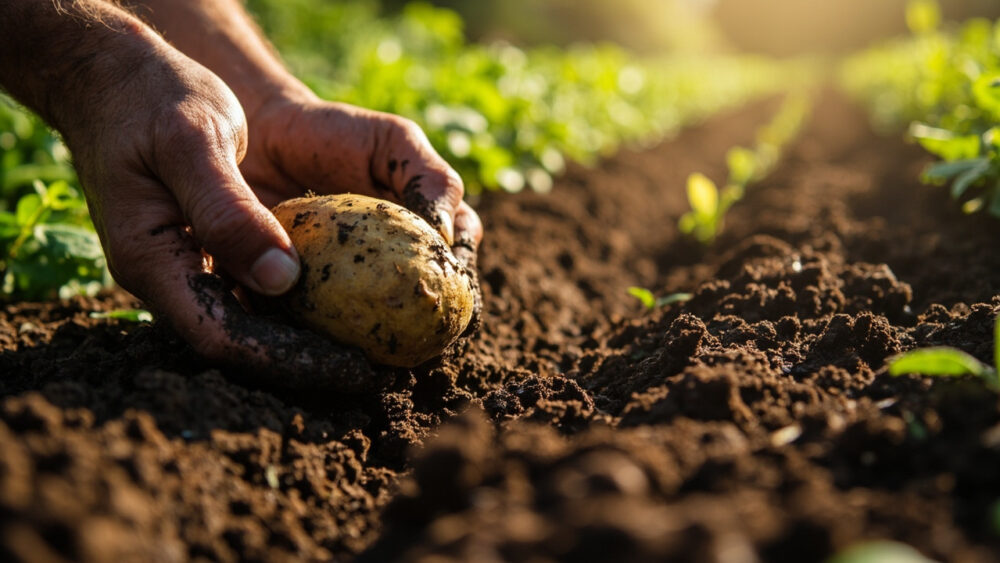
Plant seed potatoes 12 inches apart within the row, with rows spaced 30 to 36 inches apart, and set them 3 to 4 inches deep before hilling more soil over them as they grow. That spacing gives each plant enough room to bulk up a real harvest instead of a handful of golf-ball tubers. Get how far apart to plant potatoes wrong and you will not find out until you dig, which is exactly the problem.
Most people plant potatoes too close because the seed pieces look small and the bed looks big. That mistake does not show up for months, and by the time it does, you cannot fix it without sacrificing part of the row.
There is also a hilling mistake almost everyone makes in their first year or two, and it has nothing to do with spacing at all. Stick around, because the save-able Potatoes at a Glance card at the bottom has every number in one place for your phone.
The Real Spacing and Depth Numbers
Twelve inches between seed pieces down the row is the number to plant by for most varieties, whether you are growing a fingerling type or a big russet-style baking potato. Some gardeners tighten this to 9 inches for smaller varieties meant for new potatoes, and open it to 14 to 15 inches for large late-season types that sprawl.
Depth matters just as much as spacing. Plant the seed piece 3 to 4 inches deep in loosened soil, eye or sprout facing up if you can tell which way is up.
Potatoes form on stolons that grow off the buried stem, above the seed piece, not below it. That is the whole reason hilling exists, and it is also why shallow planting shortcuts cost you tubers later.
The depth number is simple, but the layout around it is where most gardens actually go wrong.
Row and Bed Layout Options
In a traditional row garden, keep rows 30 to 36 inches apart. That gap is not wasted space, it is where you pull soil from to hill the plants twice during the season.
In raised beds you can tighten things slightly, planting in a grid roughly 12 by 12 inches, since you are not walking between rows to hill. You hill from the bed’s own soil or add compost and straw instead.
Trench planting works well too: dig a trench 6 to 8 inches deep, set seed pieces 12 inches apart along the bottom, and fill in gradually as shoots emerge, which naturally builds your hills as you go.
Whichever layout you choose, the spacing number inside the row does not change, only how you access it to hill later does.
What Actually Happens When Plants Are Too Close
If you assumed tight spacing just means smaller potatoes, that guess undersells the damage. Crowded plants compete for light and shade each other’s lower leaves, which cuts photosynthesis right when the plant should be sending sugars down to the tubers.
The bigger issue is airflow. Dense foliage stays wet longer after rain or dew, and that damp, still air is exactly what late blight and other foliar diseases want. A crowded potato patch is often the first one in the neighborhood to show blighted leaves in a wet summer.
Crowding also makes hilling nearly impossible. You need room to mound soil up around each stem without burying the neighboring plant, and at 6 or 8 inches apart there simply is not enough soil to go around.
The plants that lose this competition do not die outright, they just quietly produce less, which is its own kind of costly mistake.
What Happens When You Plant Too Far Apart
Spacing too wide is the less common mistake, but it is not free either. Plants set 18 to 24 inches apart do not fail, they just waste garden space you probably wanted for something else.
Wide spacing can also invite weeds into the bare soil between plants before the potato canopy fills in, and weeds compete for the same water and nitrogen your tubers need.
There is no yield bonus for extra-wide spacing on standard varieties. Twelve inches is already enough room for a healthy plant to size up a full set of tubers, so anything wider is just unused real estate.
Efficient spacing matters just as much in a five-gallon bucket as it does in a forty-foot row.
Container and Grow Bag Equivalents
In containers, think in terms of soil volume per plant rather than a ruler measurement. One seed potato per 10-gallon grow bag or container is the safe baseline, and two per a true half-barrel size container around 20 to 25 gallons.
Cramming three or four seed pieces into a 15-gallon bag is the container version of the same overcrowding mistake gardeners make in rows, just faster and harder to fix, since there is no extra soil to spread them into.
Depth still matters: start with 4 inches of soil in the bottom, plant the seed piece, then add soil gradually as the plant grows, the same hilling logic as the ground, just in a bag with handles.
Containers forgive a lot of mistakes, but they do not forgive skipping the hilling step, which is where the next honest answer comes in.
The Hilling Mistake Nobody Warns You About
Here is the follow-up problem spacing alone will not solve: even at perfect 12-inch spacing, plants that never get hilled will underperform. Hilling means mounding soil, straw, or compost up around the base of the stem two or three times over the season, eventually building a mound 6 to 8 inches tall.
Skip hilling and exposed tubers near the surface turn green from sunlight, which means they are producing solanine, a compound that tastes bitter and is toxic in enough quantity. Green potatoes should be discarded, not just peeled and eaten.
Hilling also protects developing tubers from frost damage early in the season and from the tuber moth and other surface pests later on.
Get spacing and hilling right together, and even a crowded-looking bed can still turn out a solid harvest.
How to Fix a Planting That Is Already Too Crowded
If your potatoes are already up and you can see they are too tight, you have two honest options, and neither involves a miracle fix. First, thin now: once plants are 4 to 6 inches tall, you can carefully dig and transplant every other plant to open space elsewhere, though transplant shock will cost you a little yield on the moved plants.
Second, and often better, leave everything in place and lean hard on hilling and feeding. Extra hilling gives crowded plants more soil volume to form tubers in even without more horizontal space, and a light side-dressing of balanced fertilizer helps offset the competition.
What you cannot do is un-crowd a planting that is already flowering and expect a rescue to double your yield. The honest prognosis is a smaller harvest than you hoped, not a lost one.
Next season, the fix is free: just give them the 12 inches from the start.
Potatoes at a Glance
- When to plant: 2 to 3 weeks before your last spring frost, once soil hits about 45 to 50°F, or as soon as soil is workable.
- Spacing in the row: 12 inches apart for most varieties, 9 inches for small new-potato types, 14 to 15 inches for large late-season varieties.
- Row spacing: 30 to 36 inches between rows to leave room for hilling.
- Planting depth: 3 to 4 inches deep, eye or sprout facing up.
- Hilling schedule: mound soil up around stems twice, once at 6 to 8 inches of growth and again a few weeks later, building a mound 6 to 8 inches tall.
- Containers: one seed potato per 10-gallon container, two per 20 to 25-gallon half-barrel size, starting with 4 inches of soil and adding more as plants grow.
- Warning sign to watch: any tuber showing green skin should be discarded, not eaten.
Twelve inches apart, 3 to 4 inches deep, hilled twice: that is the whole system.
Get those three numbers right and the harvest takes care of itself.