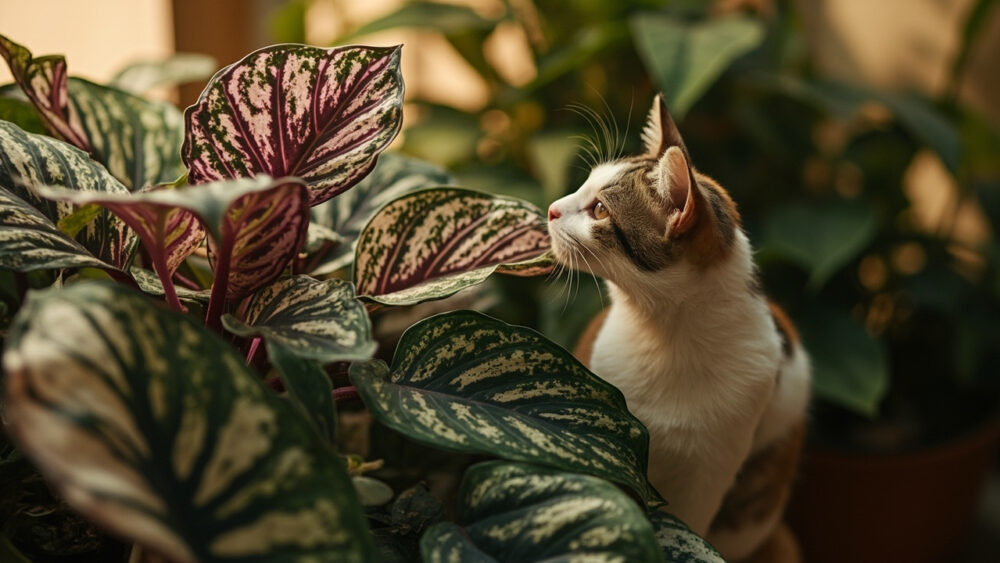
No, calathea is not toxic to cats. It is one of the genuinely safe houseplants, listed as non-toxic by the ASPCA for cats, dogs, and horses. That answer covers the whole plant, not just the leaves, and it holds true across the different calathea varieties sold as houseplants.
That said, “not toxic” is not the same as “no problem ever,” and that is where most of the useful information actually is. There is a very common mix-up that sends worried owners searching for the wrong plant entirely. There is also a real reason your cat might still get sick after chewing calathea, even though the plant itself is not the cause.
Stick with me through the next few sections and I will cover exactly what to watch for, what actually happens if a cat eats calathea leaves, and which look-alike plants deserve a second look. Save-able quick-reference card is waiting at the bottom.
The Plain Answer: Calathea Is Cat-Safe
Calathea, in all its common forms, prayer plant, rattlesnake plant (Calathea lancifolia), peacock plant (Calathea makoyana), zebra plant (Calathea zebrina), contains no compounds known to be toxic to cats. That includes the leaves, stems, and roots. Veterinary toxicology lists treat calathea as a safe plant for households with cats.
If you have been avoiding calathea because a friend warned you off it, you were probably thinking of a different plant with a similar common name or a similar striped leaf. That mix-up is common enough that it deserves its own section.
There is one situation, though, where an otherwise safe plant still causes a vet visit.
The Mix-Up That Confuses Most Owners
Calathea is frequently confused with two genuinely toxic plants: dieffenbachia (dumb cane) and some varieties of caladium. Both have bold, patterned leaves and get sold under similar nursery tags, and both contain calcium oxalate crystals that are irritating and unsafe for cats.
If your plant tag says “calathea” and the botanical name on it starts with Calathea or the newer genus Goeppertia, you are in safe territory. If the tag says Dieffenbachia or Caladium, treat it as toxic and keep it out of reach.
When in doubt, a photo of the leaf shape and the nursery tag sent to your vet or a local garden center takes two minutes and settles it for good.
Even a fully non-toxic plant can still upset a cat’s stomach, and here is why.
Why a “Safe” Plant Can Still Cause Symptoms
Cats are not built to digest large amounts of plant fiber. Chewing through calathea leaves, even though there is no toxin involved, can cause mechanical irritation and mild digestive upset simply from the volume of plant matter and the physical texture of the leaf.
General signs to watch for after a cat chews or eats a significant amount of any houseplant, calathea included, are:
- Drooling or lip licking right after chewing
- Mild vomiting
- Soft stool or diarrhea
- Reduced appetite for a meal or two
- Lethargy that is out of character for your cat
These are non-specific signs, meaning they can show up with almost any stomach upset, plant-related or not.
Knowing what is normal helps, but knowing what to actually do matters more.
What to Do If Your Cat Ate Calathea
Because calathea itself carries no known toxin, a small nibble is rarely an emergency on its own. But you should still watch your cat closely for the next several hours.
Call your veterinarian if you see vomiting that repeats, diarrhea, obvious discomfort, or if your cat stops eating or seems off. This applies to any suspected plant ingestion, since it is genuinely hard to be certain from a distance that the plant your cat chewed is calathea and not a look-alike.
When you call, have ready: the plant’s name if you know it (or a photo), roughly how much was eaten, and when you noticed it. Your vet will tell you whether an in-person visit is needed based on your cat’s specific symptoms.
Do not give home remedies, induce vomiting, or attempt any treatment on your own. Let the vet direct that decision.
If you would rather sidestep the guesswork entirely, there is a longer list of plants worth knowing about.
Safe Look-Alikes and Companions for a Cat-Friendly Shelf
If you like calathea’s bold, patterned foliage but want to fill out a cat-safe plant shelf, a few others fit the same look and the same non-toxic status:
- Parlor palm (Chamaedorea elegans): non-toxic, feathery texture, tolerates low light
- Calathea’s cousin, ctenanthe (never-never plant): similar patterned leaves, same safety profile
- Peperomia varieties: non-toxic, compact, easy on a shelf cats can reach
- Friendship plant (Pilea involucrata): non-toxic, textured leaves, good humidity lover like calathea
Plants to keep well away from cats if you are shopping the same aisle include dieffenbachia, caladium, philodendron, pothos, and any true lily (Lilium species), the last of which is severely toxic to cats even in small amounts.
Here is the whole answer condensed so you can save it or send it to whoever else waters your plants.
Calathea: Quick Reference
- Toxicity: calathea is non-toxic to cats, dogs, and horses, according to ASPCA plant listings
- Parts affected: none specifically, the whole plant is considered safe, leaves, stems, and roots
- Common confusion: often mistaken for dieffenbachia or caladium, both of which are genuinely toxic
- Possible symptoms anyway: mild vomiting, drooling, or soft stool from plant fiber irritation, not from toxin
- What to do: call your veterinarian for any suspected ingestion with symptoms, and confirm the plant’s identity with a photo or tag
- Safer alternatives with a similar look: parlor palm, ctenanthe, peperomia, and friendship plant
Calathea earns its reputation as one of the better choices for a home shared with cats.
Just double check that tag before you bring one home, because the plant beside it on the shelf might not be so forgiving.