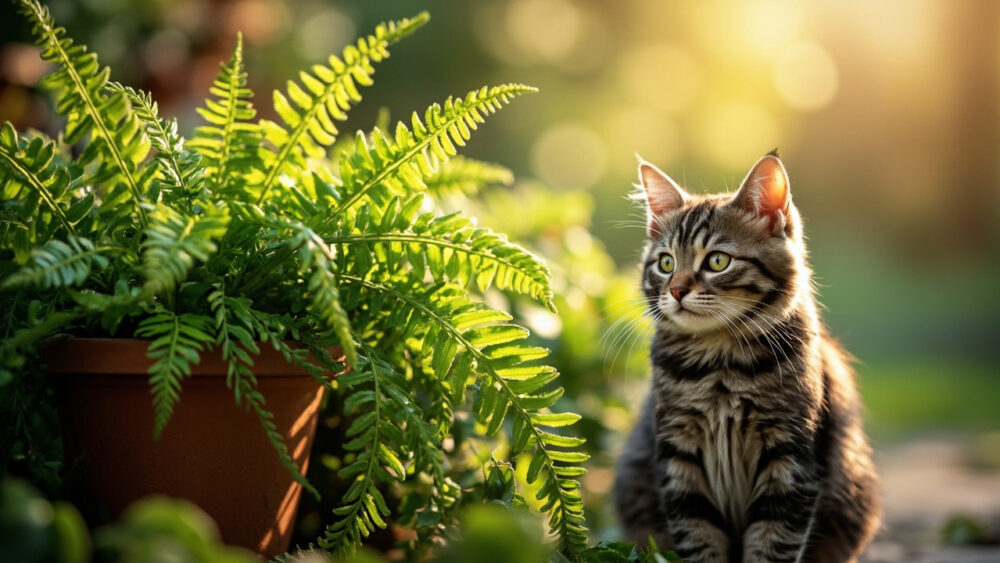
No, Boston fern is not toxic to cats. It’s one of the few genuinely pet-safe houseplants on the market, listed as non-toxic to both cats and dogs. So if your cat just took a bite out of that frilly frond, the honest answer to “is Boston fern toxic to cats” is that you’re probably dealing with a mess, not a poisoning.
That said, “non-toxic” and “no consequences” are not the same thing. There’s a nibbling scenario that still lands cats in an upset-stomach situation, a lookalike plant that gets confused with Boston fern and is NOT safe, and a specific way to tell your own plant apart from the impostor before you relax completely.
Stick around, because down at the bottom there’s a save-able quick-reference card with the core answer plus every qualifier that matters, the kind of thing worth screenshotting before you put your phone down.
The Plain Answer: Boston Fern Is Safe
Boston fern (Nephrolepis exaltata) contains no compounds known to be toxic to cats or dogs. This is confirmed by the ASPCA’s plant toxicity guidance, which is the standard reference vets themselves use.
Your cat can chew on a frond and the worst realistic outcome is a scratchy throat or a hairball-style upset stomach from the fibrous texture, not organ damage or poisoning.
This puts Boston fern in the same safe category as spider plants and areca palms, plants you can actually let a curious cat get near without panic.
But “safe plant” doesn’t mean “safe forever,” and there’s one mix-up that trips up a lot of well-meaning pet owners.
The Mix-Up That Changes Everything: Asparagus Fern
Here’s the loop worth closing right now. Asparagus fern (Asparagus densiflorus) is sold right next to Boston fern in nursery displays, gets called “fern” by nearly everyone, and is genuinely toxic to cats. It’s not even a true fern botanically, it’s a member of the lily family, and its berries and sap can cause vomiting, diarrhea, and skin irritation on contact.
If you assumed all the feathery, frilly plants in the fern aisle carry the same safety rating, that assumption is exactly what gets cats into trouble.
Boston fern has broad, flat, sword-shaped fronds with tightly packed leaflets and no berries. Asparagus fern has wiry, needle-thin stems, a much lacier look, and small green or red berries. If your plant has berries, it is not a Boston fern.
Knowing which plant is actually in your pot is step one, but knowing what a bad reaction looks like matters regardless.
Signs Worth Watching For Anyway
Even with a genuinely non-toxic plant, heavy chewing on any houseplant can cause mechanical irritation. Watch for:
- Vomiting or gagging shortly after chewing
- Drooling more than usual
- Pawing at the mouth
- Loss of interest in food for more than a few hours
- Lethargy that doesn’t match your cat’s normal energy
These signs are almost always mild and short-lived with true Boston fern, resolving on their own within a day.
Persistent vomiting, refusal to eat, or lethargy that lasts beyond a few hours is not something a fern alone typically causes, and it’s worth a second look regardless of the plant.
If any of that shows up, or if there’s any chance the plant involved wasn’t actually Boston fern, here’s exactly what to do next.
What to Do If Your Cat Ate It
Call your veterinarian for any suspected ingestion where you’re not fully certain of the plant’s identity, or where your cat is showing symptoms beyond mild, brief stomach upset. This is the right move even for plants believed to be non-toxic, since individual pets can react differently.
Bring or photograph the plant itself, including any berries, stems, or roots involved, so the vet or vet tech can help confirm what it actually is.
Note roughly how much was eaten and when, since timing helps a vet judge whether monitoring at home is reasonable or whether the cat should be seen.
Don’t try to induce vomiting or give home remedies on your own. Let the vet guide any treatment decisions.
Confirming the plant is genuinely Boston fern usually means this resolves itself, but if you’d rather not gamble on lookalikes at all, there are easy swaps.
Safer Look-Alikes to Grow Instead
If you love the texture of ferny foliage but want zero ambiguity at the nursery, a few options are confirmed non-toxic and easy to tell apart from problem plants:
- Boston fern itself, once you’ve confirmed the broad flat fronds and no berries
- Spider plant (Chlorophytum comosum), arching grassy leaves, extremely forgiving to grow
- Areca palm, taller and structural, good if you want height instead of trailing texture
- Bird’s nest fern (Asplenium nidus), broad glossy fronds, a different look but same safe category
All four tolerate the medium light and consistent moisture that ferns generally want, so switching between them doesn’t mean relearning your care routine.
That’s the full picture, and here’s the card that puts it all in one place.
Boston Fern: Quick Reference
- Toxicity: non-toxic to cats and dogs, confirmed by ASPCA guidance
- Worst realistic outcome: mild stomach upset or a scratchy throat from fibrous texture, not poisoning
- Watch for confusion with: asparagus fern, which is toxic and often sold nearby
- How to tell them apart: Boston fern has broad flat fronds and no berries, asparagus fern has wiry stems and small berries
- Signs of any reaction: vomiting, drooling, pawing at the mouth, lethargy, appetite loss
- If ingestion is uncertain or symptoms persist: call your veterinarian, bring a photo or sample of the plant, do not attempt home treatment
Boston fern earns its reputation as a genuinely pet-friendly houseplant, berries or no berries.
Just make sure the plant in your pot is the one you think it is.