The short answer for how to prune fuchsias: cut hardy garden types back hard in early spring, once new growth buds are visible low on the stems and the last hard frost has passed, and take them down to 4 to 6 inches from the ground. Tender and basket fuchsias get a lighter spring shape-up plus a deadheading habit all summer. Get the timing wrong in either direction, too early or too late, and you lose most of the flower show for the year.
Here is what trips up nearly everyone the first time. They assume harder pruning means fewer flowers, so they barely touch the plant, and end up with a leggy, sparse fuchsia that blooms only at the tips. The truth runs the other way for most types.
There is also a sign almost every reader misreads, the blackened, dead-looking top growth on a hardy fuchsia in early spring. That is not a dying plant. Stick around, because the “at a glance” card at the bottom has the exact cut points, timing, and the one tool mistake that spreads disease from plant to plant.
When to Prune, and When to Leave It Alone
Hardy fuchsias (the types left outdoors over winter, generally reliable in USDA zones 6 through 9 depending on variety) get their big cut in early spring, after the last hard frost and once you see fresh green or reddish buds swelling low on the woody stems. That is usually a few weeks later than you expect.
Tender fuchsias and hanging basket types, the ones overwintered indoors or bought fresh each year, get pruned in late winter to early spring before they go back outside, then lightly shaped again in early summer if they get straggly.
Never prune in fall. Cutting back in autumn removes the very growth that protects the crown over winter and signals the plant to push tender new shoots right before cold weather, which kills them outright.
Timing is the whole game with fuchsias, and the tools matter almost as much.
Tools and the One Prep Step Everyone Skips
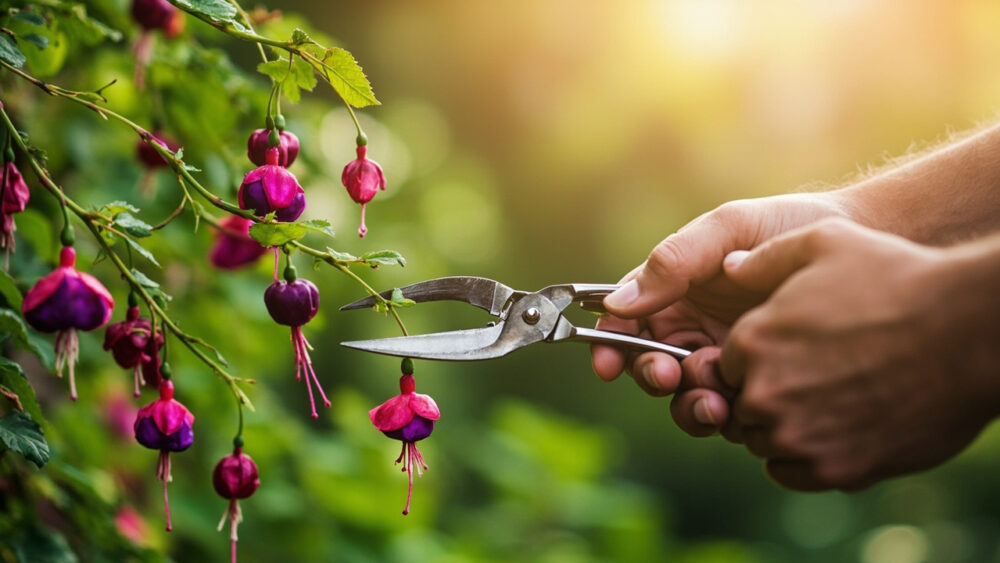
You need sharp bypass pruners for anything pencil-thick or smaller, and loppers for old, woody hardy stems thicker than that. Dull blades crush stems instead of slicing them, and crushed tissue is where rot gets started.
Wipe your blades with rubbing alcohol before you start, and again between plants if you are working on more than one fuchsia. Fuchsias are prone to a handful of fungal and viral issues that spread easily on pruning tools, and this thirty-second step is the difference between a clean cut and an infected one.
Skip disinfecting and you can carry a problem from a sick plant straight into a healthy one without ever noticing until weeks later.
How to Prune a Fuchsia, Step by Step
Step 1: Assess the framework
Look at the plant’s structure before you cut anything. On a hardy fuchsia, find where live wood starts, usually where you see green just under the bark when you scratch it lightly with a thumbnail.
Step 2: Cut hardy types down hard
Cut all stems back to 4 to 6 inches above the soil line, just above a pair of visible buds. This feels brutal the first time. It is exactly right, and it is what produces a fuller, better-flowering plant by midsummer.
Step 3: Shape tender and basket fuchsias more gently
For tender types you are keeping, cut back by about one third to one half, removing the oldest and weakest stems first and shortening the rest to just above a leaf node or bud pair.
Step 4: Pinch young growth through late spring
Once new shoots reach 3 to 4 inches, pinch out the growing tip. This forces branching and roughly doubles the number of flowering shoots you get by summer.
Step 5: Deadhead all season
Snip spent flowers, including the small seed pod that forms behind each one, back to the first leaf joint. Left on, those pods tell the plant to stop making new flowers.
Cutting hard in spring is only half the job, the deadheading habit is what keeps blooms coming through fall.
What to Expect After the Cut
A hardy fuchsia cut back to 4 to 6 inches will look bare and a little alarming for two to four weeks. New shoots then come fast once soil temperatures sit consistently above roughly 55°F, and by six to eight weeks you should have a bushy plant noticeably fuller than last year’s growth.
If you pinched the new shoots in step 4, you will see the plant branch into a rounder shape instead of shooting up a few long stems.
First flowers on hardy types typically show up 8 to 12 weeks after the spring cutback, depending on variety and climate. Tender types that only got a light shaping bloom sooner, often within 4 to 6 weeks.
Patience here matters more than people expect, and that patience is exactly where the next mistake usually creeps in.
The Mistakes That Cost You a Season of Flowers
- Pruning too early: a warm spell in late winter fools people into cutting weeks before the last frost, and a late freeze then kills the fresh growth that follows, setting the plant back hard.
- Being too timid with hardy types: a light trim instead of the hard cutback leaves old, unproductive wood in charge, and flowers stay sparse and confined to stem tips all summer.
- Letting seed pods form: skipping deadheading redirects the plant’s energy into seed production instead of new buds, and bloom count drops noticeably by midsummer.
- Pruning in fall: this removes the plant’s natural winter insulation and can trigger tender new growth right before the cold kills it.
- Using dirty or dull tools: crushed stems and unclean cuts invite rot and can spread disease between plants in the same bed or bench.
Fix these five and a fuchsia becomes one of the most reliably floriferous plants you can grow.
Fuchsias at a Glance
- When to prune hardy types: early spring, after the last hard frost, once buds are visible low on the stems.
- When to prune tender or basket types: late winter to early spring, before moving them back outdoors.
- How much to cut: hardy types down to 4 to 6 inches from the soil, tender types back by one third to one half.
- Where to cut: just above a healthy bud pair or leaf node, using clean, sharp bypass pruners.
- Never prune in: fall, since it strips winter protection and invites frost-killed new growth.
- Ongoing care: pinch young shoots at 3 to 4 inches, and deadhead spent flowers plus seed pods all season.
- Time to first bloom after a hard cutback: roughly 8 to 12 weeks, depending on variety and climate.
Cut hardy fuchsias harder than feels comfortable, and cut them at the right moment, not the first warm day.
Everything else, the pinching, the deadheading, the clean tools, just protects the flowers that hard spring cut sets in motion.