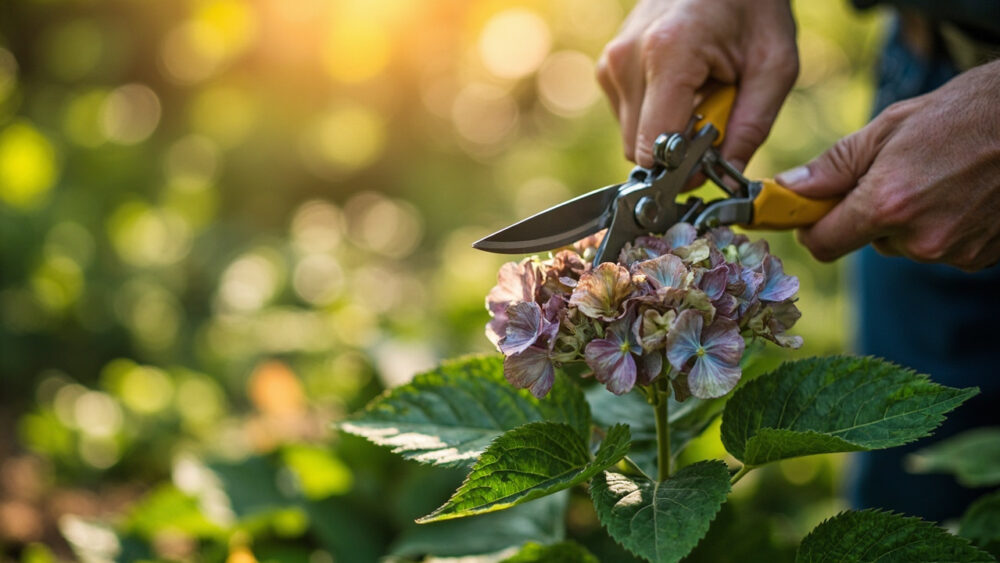
How to deadhead hydrangeas comes down to this: snip the spent bloom off just below the flower head, cutting at the first set of healthy leaves, any time from when the flower fades in late summer through late winter, depending on your variety. Cut too deep into the stem on the wrong type of hydrangea and you remove next year’s flowers along with this year’s dead ones. That single mix-up is responsible for more “my hydrangea won’t bloom” complaints than winter cold or bad soil combined.
Most people assume deadheading a hydrangea works like deadheading a rose or a coneflower. It does not, not exactly, and the reason has to do with where each type stores its flower buds for next year.
Stick around for the part almost nobody tells you about timing on bigleaf hydrangeas, the one cut height that separates a full bush of blooms from a season of green leaves and no flowers, and the save-able Hydrangeas at a Glance card at the very bottom of this page.
When to Deadhead, and When to Just Walk Away
Timing depends entirely on which hydrangea you have. Panicle hydrangeas (Hydrangea paniculata) and smooth hydrangeas (Hydrangea arborescens, including Annabelle types) bloom on new wood each year, so you can deadhead them any time from late summer through late winter without risking next year’s flowers.
Bigleaf hydrangeas (Hydrangea macrophylla) and oakleaf hydrangeas set next year’s buds on old wood starting in mid to late summer, often just weeks after this year’s flowers fade. Deadhead those too late in the season and you cut off flower buds that already formed.
The safe window for bigleaf and oakleaf types is right after the bloom browns, typically mid to late summer, and definitely before the first hard frost forces the plant into dormancy.
Once winter sets in, leave any remaining dead blooms on bigleaf hydrangeas alone until spring.
The One Prep Step That Matters More Than the Tool
You do not need fancy equipment. A clean pair of bypass pruners or even sharp scissors handles most hydrangea stems fine.
The step people skip is identifying the variety before they cut anything. Look at the base of the plant or check the tag if you still have it, because old wood versus new wood bloomers get treated completely differently.
Wipe your blades with rubbing alcohol before you start, especially if you have been pruning other plants that day. Hydrangeas are not especially disease prone, but a dirty blade can spread fungal problems from a sick plant to a healthy one.
Knowing your variety is the whole ballgame, so get that settled before the first cut.
How to Deadhead a Hydrangea, Step by Step
The mechanics are simple once you know where to stop.
Step 1: Find the spent bloom
A finished hydrangea flower turns papery, tan, or a faded dusty pink or green, depending on variety. It stops feeling fresh and starts feeling brittle.
Step 2: Follow the stem down to the first full set of leaves
Do not cut right at the base of the flower head. Trace the stem down 4 to 8 inches until you hit a healthy pair or set of leaves.
Step 3: Cut just above that leaf set, at a slight angle
This is the cut. On old-wood bloomers (bigleaf, oakleaf), stop here. Going lower risks cutting into the buds already forming for next year.
Step 4: On new-wood types only, you can cut lower if shaping
Panicle and smooth hydrangeas tolerate a harder cut back to a main branch junction if you also want to control size, since their flowers come from wood that grows this coming season.
Get the cut height right and the rest of the season takes care of itself.
What to Expect in the Weeks After
If you assumed deadheading triggers a fresh round of blooms right away, that guess is usually wrong for hydrangeas. Unlike reblooming roses, most hydrangeas do not push out a quick second flush from deadheading alone.
What you will see instead is a tidier plant that puts its energy into root and stem development rather than holding onto dead flower heads. Some reblooming bigleaf varieties, bred specifically to flower on both old and new wood, may throw a modest second round of blooms in late summer, but this is the variety doing its job, not a direct result of your pruning cut.
New leaf growth just below your cut is the sign you did it right. If that spot stays bare for several weeks going into fall, it is not necessarily a problem, just a slower plant.
The real payoff from deadheading shows up next spring, not next week.
The Mistakes That Cost You a Season of Flowers
Most hydrangea disappointment traces back to one of these.
- Deadheading bigleaf or oakleaf types too late: cutting into old wood in fall or winter removes buds already set for next year.
- Cutting too far down the stem: going past the first healthy leaf set on old-wood bloomers takes flower buds along with the dead bloom.
- Confusing deadheading with hard pruning: a light deadheading cut is not the same job as a rejuvenation cut, and doing the second when you meant to do the first can set a plant back a year or two.
- Removing winter blooms too early on old-wood types: those tan, dried flower heads actually help insulate the buds beneath them through freezing weather. Wait until the buds swell in spring to clear them off.
- Not identifying the variety first: treating every hydrangea the same way is the root cause behind nearly every mistake on this list.
Skip these five mistakes and your hydrangea does the rest of the work on its own.
Hydrangeas at a Glance
- When to deadhead old-wood types (bigleaf, oakleaf): right after blooms fade in mid to late summer, never in fall or winter.
- When to deadhead new-wood types (panicle, smooth): any time from late summer through late winter, before new growth starts.
- Where to cut: just above the first healthy leaf set below the spent flower, roughly 4 to 8 inches down the stem.
- Tools needed: clean bypass pruners or sharp scissors, wiped with rubbing alcohol between plants.
- Sign a bloom is ready to remove: papery, brittle texture and faded, tan or dusty color instead of fresh, full petals.
- What not to touch in winter: dried flower heads on bigleaf and oakleaf hydrangeas, which help protect the buds underneath from cold.
- Biggest mistake to avoid: cutting old-wood types too late or too low, which removes next year’s flower buds along with this year’s dead ones.
When in doubt about your hydrangea’s type, deadhead lightly and only just below the flower head.
Get the variety right and the timing right, and this becomes one of the easiest pruning jobs in the whole garden.