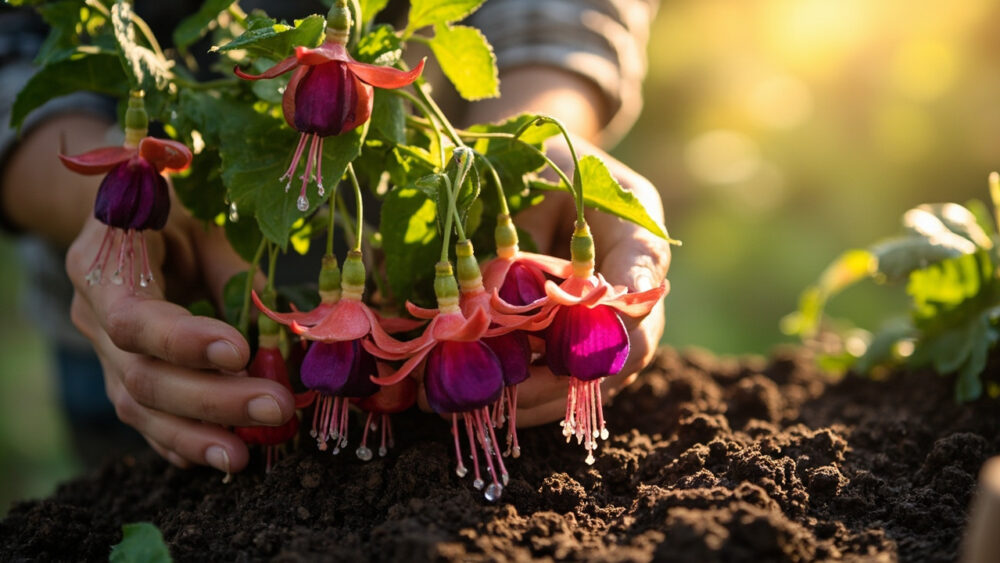
Learning how to grow fuchsias comes down to three things: cool roots, shade from hot afternoon sun, and steady moisture that never quite dries out and never sits soggy. Get those right and a fuchsia will bloom nonstop from late spring until frost, dripping with those lantern-shaped flowers hummingbirds cannot leave alone. Get them wrong and you get a plant that drops buds before they open, which is the single most common fuchsia complaint gardeners bring me.
Most of the frustration traces back to one mistake: treating fuchsias like a sun-loving annual because they’re sold next to petunias every spring. They are not sun lovers. There’s also a sign almost everyone misreads, a fuchsia that suddenly drops all its flower buds at once, and it is not the disaster it looks like.
Stick with me through the planting and care steps below and I will get to that bud-drop mystery, plus the honest answer to whether fuchsias come back next year. Save the Fuchsias at a Glance card at the very bottom for your phone, it has every number in one place.
When to Plant Fuchsias
Wait until night temperatures reliably stay above 45 to 50 Fwhich usually lands two to three weeks after your last spring frost. Fuchsias are tender in most of the country and will sulk or die back in a cold snap. In USDA zones 6 and colder, treat them as annuals or bring them indoors for winter; in zones 9 through 11, many types survive outdoors year-round and can go in the ground earlier, as soon as soil has warmed and nights hold above 50 F.
If you started with a hanging basket from a nursery, harden it off over four or five days, giving it a bit more outdoor time each day before it lives outside full-time.
Timing is only half the job, though, because where you put it matters just as much.
Choosing the Spot and Prepping the Soil
Fuchsias want morning sun and afternoon shadeor dappled light all day under high tree canopy. In hot-summer regions, more shade is safer; in cool coastal climates, they’ll take more direct sun without complaint.
They need soil that drains but does not dry out fast, which is a narrower target than it sounds. Work two to three inches of compost into the top 8 to 10 inches of native soil, and if your soil is heavy clay, raise the bed or plant in containers instead of fighting it.
Containers are actually the easier route for most gardeners. A pot gives you total control over drainage and lets you chase shade around the yard as the sun moves through the season.
Once the site is picked, the planting itself is fast.
Planting Step by Step
- Depth: set the root ball so its top sits level with the surrounding soil or pot rim, no deeper. Burying the crown invites stem rot.
- Spacing: upright bush types need 18 to 24 inches between plants. Trailing basket types need only one plant per 10 to 12 inch hanging basket.
- Technique: loosen the root ball gently with your fingers before it goes in, backfill, then water in slowly until it runs from the drainage holes or pools and sinks at ground level.
- Mulch: lay 2 inches of mulch around ground-planted fuchsias, keeping it an inch clear of the stem, to hold the even soil moisture they demand.
The plant is in the ground, but keeping it blooming is where most people either win or lose the season.
Watering and Feeding Through the Season
Check the top inch of soil daily in hot weather. Fuchsias in containers often need water every day once temperatures climb past 80 F, since their fibrous roots dry out fast in a pot. Ground-planted fuchsias usually need a deep soak two to three times a week instead.
Never let the root zone go bone dry, that’s the fastest way to trigger bud drop and crispy leaf edges.
Feed every one to two weeks through the growing season with a balanced liquid fertilizer at half the labeled strength, or use a slow-release granular at planting time and top it off midsummer. Fuchsias are heavy bloomers and hungry feeders, plain water alone will not keep the flowers coming.
Pinch the growing tips of young plants once or twice early in the season, this forces branching and roughly doubles your eventual flower count.
Feed and water right and the plant mostly takes care of itself, but a few problems still find every fuchsia eventually.
The Problems Most Likely to Strike
If you assumed that sudden bud drop means the plant is dying, that guess is wrong and it fools almost everyone. Fuchsias drop flower buds as a stress response to heat spikes, a move to a new location, or an inconsistent watering stretch. The plant is not dying, it is just resetting. Keep up steady care and new buds form within a couple of weeks.
Fuchsia gall mite is the harder problem, causing thickened, distorted, reddish growth at the stem tips. There is no reliable cure once it’s established, and badly affected plants usually need to be removed and replaced, since the mites overwinter in the tissue and spread to neighboring fuchsias.
Whitefly and aphids show up as sticky residue and curled new growth. Treat with insecticidal soap or a horticultural oil, following the product label exactly, and catch it early before populations build.
Botrytis (gray mold) and root rot both trace back to the same root cause: soil staying wet with poor air movement. Space plants for airflow and let excess water drain freely rather than pooling around the crown.
None of this is toxicity-related for people, but fuchsia berries and foliage are not something to feed pets or livestock as a matter of course, and any pet that seems ill after chewing on ornamental plants should see a veterinarian rather than being watched at home.
Head off moisture stress and you’ve dodged most of what actually kills fuchsias, which brings us to the flowers themselves.
When and How the Blooms Mature
Most fuchsias start blooming 8 to 12 weeks after planting and then keep flowering in waves straight through to the first fall frost, as long as you deadhead spent blooms and keep feeding. There’s no single harvest date, this is a cut-and-enjoy-as-you-go flower, not a fruit crop, though some types do form small edible berries after the flower drops.
Snip spent flowers off just behind the swelling seed pod to redirect the plant’s energy into new buds instead of seed production. Left alone, a fuchsia will still bloom, just less generously as the season goes on.
Here’s the honest follow-up answer: yes, fuchsias can come back next year, but only in mild climates or with help. In zones 9 to 11, many survive outdoors through winter with a hard pruning back to 6 to 8 inches in late fall. Everywhere colder, dig up the root ball before a hard freeze, cut the plant back, and overwinter it in a cool, dim spot around 40 to 50 F with just enough water to keep the roots from fully drying out.
That’s the whole cycle from planting to next year’s comeback, and here’s everything worth pinning to your phone before you walk away.
Fuchsias at a Glance
- When to plant: two to three weeks after last frost, once nights stay above 45 to 50 F.
- Light: morning sun with afternoon shade, or dappled light all day in hot climates.
- Spacing and depth: 18 to 24 inches apart for bush types, root ball top level with the soil surface, never buried deeper.
- Watering: keep soil evenly moist, daily checks in containers during hot weather, never let it dry out completely.
- Feeding: balanced liquid fertilizer every one to two weeks at half strength through the growing season.
- Bloom window: starts 8 to 12 weeks after planting, continues until first fall frost with regular deadheading.
- Winter care: hardy outdoors only in zones 9 to 11 with a hard pruning. Elsewhere, dig, cut back, and store cool and dim around 40 to 50 F.
Consistent moisture and afternoon shade solve more fuchsia problems than any fertilizer or spray ever will.
Get those two right and everything else on this list is just maintenance.