Learning how to grow delphiniums comes down to three non-negotiables: cool roots, rich soil that never turns to swamp, and a stake in the ground before the plant needs it. Get those right and you get spires four to six feet tall in blues no camera captures accurately. Get them wrong and you get a plant that flops over in June or rots out by August.
Most people who fail with delphiniums make the same mistake, and it is not underwatering or overwatering exactly. It is planting them somewhere with wet feet in winter and dry heat in summer, the one combination delphiniums cannot forgive.
There is also a staking question nobody answers honestly until the plant is already on the ground, and a bloom-timing truth that surprises first-timers who expect one big show and get something different. Stick around for the Delphiniums at a Glance card at the bottom, it is built to save to your phone before you head back out to the bed.
When to Plant Delphiniums
Plant delphiniums in spring once the soil is workable and nighttime temperatures are reliably staying above the mid 30s, roughly two to four weeks before your last frost date for potted nursery plants, since they tolerate light frost once established. In warmer zones, 3 to 7, fall planting also works well and often produces stronger first-year roots because the plant settles in cool weather instead of racing into summer heat.
Delphiniums are hardy in zones 3 through 7, sometimes 8 with real afternoon shade and a cooler microclimate. If you garden in zone 8 or hotter, treat them as a short-lived perennial or even an annual, because summer heat is what actually kills most delphiniums, not winter cold.
Soil temperature matters more than the calendar. If you can work the soil without it clumping into mud, and a handful crumbles rather than smears, it is ready.
Timing gets the roots started right, but the spot you choose decides whether they survive their first real summer.
Choosing the Spot and Prepping the Soil
Delphiniums want full sun in cool climatessix or more hours, but in hot summer regions they do better with morning sun and afternoon shade. Full blazing sun from noon on is what cooks the crown in July.
The soil has to drain well and hold fertility at the same time, which is a real trick. Work in two to three inches of compost or aged manure to a depth of 10 to 12 inches before planting. If your soil is heavy clay, raise the bed four to six inches, because standing water at the crown over winter is the single most common way delphiniums die that nobody blames on the actual cause.
Aim for a soil pH close to neutral, around 6.5 to 7.0. Delphiniums sulk in acidic soil, and a bag of garden lime worked in ahead of planting fixes that if a soil test shows you are much below 6.5.
Good soil prep buys you a plant that stands up straight without a fight, but the planting technique itself still has to be right.
Planting Delphiniums Step by Step
1. Space them properly
Set plants 18 to 24 inches apart. Crowding is a shortcut to powdery mildew because it kills the airflow delphiniums depend on.
2. Dig a wide, shallow hole
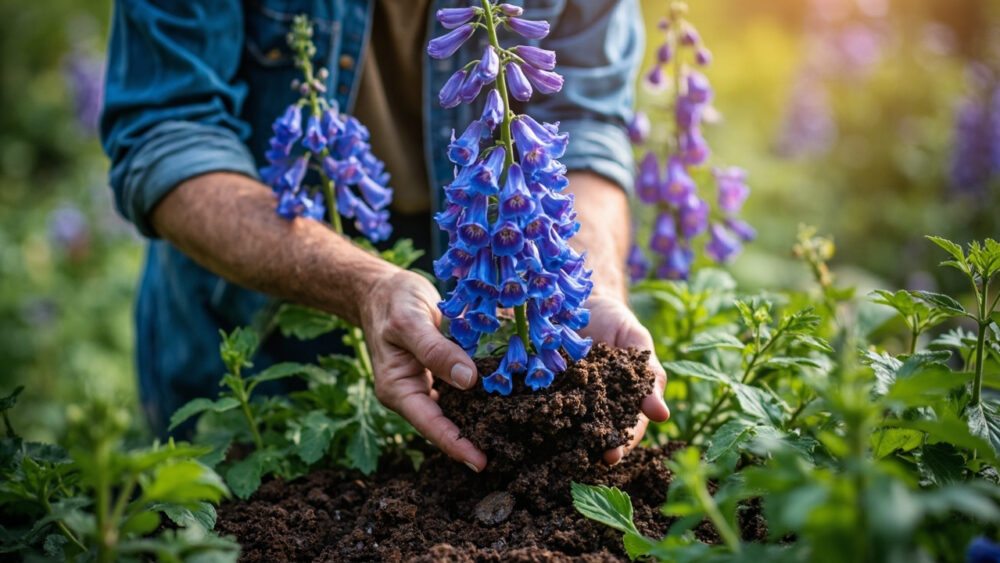
Dig the hole just as deep as the root ball and about twice as wide. Delphinium crowns rot if buried too deep, so the crown should sit right at soil level, not below it.
3. Set and backfill
Loosen the roots gently, set the plant, and backfill with the amended soil. Firm it down with your hands, not your boot, to avoid compacting the loose structure you just built.
4. Water in immediately
Give each new plant a slow soak right after planting to settle soil around the roots and knock out air pockets.
5. Stake now, not later
Tall varieties, especially the Pacific Giant types that hit five to six feet, need a stake or a peony ring installed at planting time. Waiting until the stalk is already leaning means driving a stake through roots you cannot see, and a stem you cannot straighten.
Staking early feels unnecessary on a six-inch seedling, which is exactly why most people skip it and regret it in June.
Watering and Feeding Through the Season
Delphiniums want consistent moistureabout an inch of water a week from rain or irrigation, more during hot dry stretches. Check the soil two inches down; if it is dry there, water. If it is still damp, wait.
If you assumed wilting leaves always mean the plant needs more water, that guess is what drowns half the delphiniums that die of root rot. Wilting in heavy, saturated soil is the crown suffocating, not thirst. Feel the soil before you reach for the hose.
Feed with a balanced fertilizer, or one slightly higher in phosphorus and potassium, at planting and again when new growth is 6 to 8 inches tall. A light second feeding after the first flush of bloom supports a possible rebloom later in the season.
Mulch two to three inches around the base, keeping it an inch away from the actual crown, to hold moisture and keep roots cool.
Feeding gets you height and color, but it is also what draws in the pests that go straight for that soft new growth.
Problems That Actually Take Delphiniums Down
Powdery mildew shows up as a white, dusty coating on leaves during humid stretches with poor airflow. Space plants properly and water at the soil line, not overhead, and treat early outbreaks with a fungicide labeled for powdery mildew, following the product label exactly.
Slugs and snails shred young leaves overnight, leaving ragged holes and slime trails. Bait or traps set early in spring, before the foliage is tall, head off most of the damage.
Crown rot is the quiet killer, caused almost entirely by wet, poorly drained soil over winter. There is no cure once it sets in; prevention through drainage and raised beds is the only real fix.
Delphinium worm and cyclamen mites distort new growth and stunt flower spikes. Remove and destroy affected shoots promptly rather than hoping the plant grows out of it.
One more honest note: delphiniums are toxic to humans and pets if ingested, with signs that can include drooling, vomiting, or worse depending on the amount eaten. If you suspect a pet or child has eaten any part of the plant, call a veterinarian or poison control right away rather than waiting to see what happens.
Head off these problems early and the plant rewards you with the bloom you actually planted it for.
When and How Delphiniums Bloom and Rebloom
Most delphiniums bloom in early to mid summer, roughly 12 to 16 weeks after spring planting for first-year plants, with established clumps blooming earlier each year as the crown matures. If you expected one long continuous flower show, the honest answer is that delphiniums bloom in a flush, not a season.
Once the main spike finishes, cut it back to the base rather than deadheading just the top flowers. This often triggers a second, smaller flush of bloom in late summer or early fall, especially in cooler climates.
Cut flowers for arrangements in the cool of morning, when about a third to half the florets on the spike are open. Cutting too early means the buds never finish opening in the vase. Too late and the lower florets are already fading by the time you cut.
Divide crowded clumps every three to four years in early spring or fall to keep the plant vigorous, since old, congested crowns bloom less and rot more easily.
Everything above works best as a quick reference, which is exactly what is waiting for you below.
Delphiniums at a Glance
- When to plant: spring after soil is workable and frost risk is easing, or fall in zones 3 through 7 for stronger root establishment.
- Where they thrive: zones 3 through 7, full sun in cool climates, morning sun with afternoon shade where summers run hot.
- Spacing and depth: 18 to 24 inches apart, crown planted at soil level, never buried deep.
- Watering: about an inch a week, checked two inches down, avoiding soggy soil at the crown.
- Feeding: balanced fertilizer at planting, again at 6 to 8 inches of growth, and lightly after the first bloom flush.
- Support: stake tall varieties at planting time, not after they lean.
- Bloom time: early to mid summer, 12 to 16 weeks from spring planting, with a possible second flush if cut back after the first.
Delphiniums are not a difficult plant, they are a picky one, and pickiness has a fix for every single item on that list.
Get the drainage and the staking right early, and the rest of the season takes care of itself.