The short answer: prune jasmine right after it finishes flowering, cutting spent flowering stems back by about a third and thinning out a portion of the oldest, woodiest growth to keep the plant productive. For most jasmines, that means late spring to midsummer, never in fall or winter when next year’s flower buds are already forming on the wood you’d be removing. Get the timing wrong and you won’t kill the plant, but you will cut off a whole season of bloom, which is the mistake that trips up more people than any pest or disease ever does.
There’s a second mistake almost as common: pruning by the calendar instead of by what the plant is actually doing. Jasmine doesn’t care what month it is. It cares whether it just finished blooming or is about to start.
Below I’ll walk through exactly where to cut, how much is too much, the honest truth about what happens if you prune at the wrong time, and the recovery signs that tell you whether you helped the plant or set it back. Save-and-screenshot the “Jasmine at a Glance” card at the very bottom before you head out to the plant.
When to Prune Jasmine (and When to Leave It Alone)
The rule that matters most: prune within a few weeks of the last flowers dropping, not before. Most jasmines set next year’s flower buds on the new growth that follows this pruning, so the window is narrower than people expect.
For spring-and-summer bloomers like common white jasmine (Jasminum officinale) or star jasmine (which isn’t a true jasmine botanically but gets treated the same), that window lands anywhere from late spring into midsummer depending on your climate. Winter jasmine (Jasminum nudiflorum) blooms on bare stems in late winter, so its pruning window shifts to right after those flowers fade, in early spring.
Never prune in fall or winter on a spring bloomer. You’ll be cutting off flower buds that are already set, and there’s no fixing that until the following year.
Timing is the whole game, but it only pays off if your cuts land in the right place.
Tools and the One Prep Step That Matters
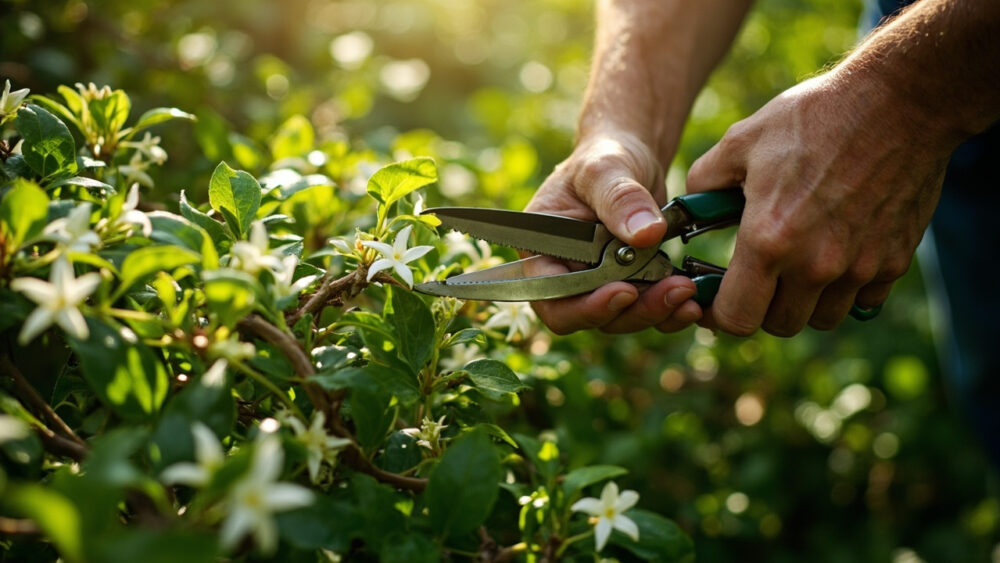
You need a clean pair of bypass pruners for anything pencil-thick or smaller, and loppers for older woody stems on mature vines. That’s really it for tools.
The prep step everyone skips: wipe your blades with rubbing alcohol before you start, especially if you’ve pruned anything else that day. Jasmine is generally tough, but dirty blades spread fungal and bacterial issues from plant to plant, and a stressed, freshly cut jasmine is an easy target.
Take five minutes before you cut anything to actually look at the plant. Find the oldest, thickest, grayest stems versus the newer green growth. You’re about to decide what stays and what goes, and that decision is easier standing back than it is mid-cut.
Once you know what you’re looking at, the cuts themselves are straightforward.
How to Prune Jasmine Step by Step
Step 1: Remove the dead, damaged, and crossing wood first
Cut out anything obviously dead, brittle, or blackened at the base, where it meets a healthy stem. Also remove any stems rubbing against each other, since that friction wound is an easy entry point for disease.
This first pass alone often opens up 10 to 20 percent of the plant’s mass and costs you zero flowers, because dead wood was never going to bloom again anyway.
Step 2: Cut back the stems that just flowered
On each stem that carried blooms, cut back by about a third of its length, making the cut just above a healthy leaf node or side shoot. This tells the plant to push new growth from that point, and that new growth is where next season’s flowers will form.
Don’t cut into bare, leafless old wood expecting it to sprout. Some jasmines will surprise you, but the reliable regrowth comes from cutting just above visible green.
Step 3: Thin out roughly a quarter of the oldest growth
Pick out the thickest, grayest, most tangled stems, the ones that look more like a rat’s nest than a vine, and remove them at the base or back to a strong lower junction. Aim for about a quarter of the oldest wood in a given year, not all of it at once.
This is the step that keeps a mature jasmine from turning into a woody, flower-sparse tangle after a few years of neglect. Skip it for too long and you end up needing a much harder renovation cut later.
Step 4: Shape and control size last
Once the plant is opened up, step back and trim for shape and size, cutting wayward long shoots back to a main stem or support. This is also when you remove anything growing where you don’t want it, like shoots heading into gutters or under siding.
As a ceiling, don’t remove more than about a third of the plant’s total growth in a single season unless you’re doing a genuine hard renovation on an overgrown, leggy vine, and even then, spread a full renovation over two seasons rather than one brutal cut.
Once the cuts are made, the waiting game starts, and what happens next tells you a lot.
What to Expect After Pruning
Within one to three weeks in active growing weather, you should see new green shoots emerging from just below your cuts. That’s the plant doing exactly what you wanted.
If you assumed a hard prune means a slow, sulky plant that takes all season to recover, that’s usually not what happens with jasmine. It’s a vigorous grower and typically responds fast, often putting out more new shoots than you removed stems.
What you won’t see, and shouldn’t expect, is flowers again that same season if you pruned right after the main bloom. The new growth is next year’s flowering wood, not an instant repeat performance.
Water and feed lightly after a hard prune, since pushing out that much new growth costs the plant real energy. A balanced, diluted feed once or twice over the following month is plenty; heavy feeding right after cutting encourages soft, weak growth that’s more prone to aphids and powdery mildew.
Recovery is usually the easy part. The mistakes happen before you ever make the first cut.
The Mistakes That Cost You a Season of Flowers
The single biggest mistake is pruning in fall or winter out of tidiness rather than necessity. A vine that looks a little wild in November is not a problem; a vine you’ve stripped of next year’s flower buds is.
Here are the others that show up again and again:
- Cutting hard every single year: jasmine doesn’t need an annual scalping. Light maintenance most years, with a heavier renovation only every few years, keeps it blooming reliably.
- Shearing it like a hedge: box-cutting the outer surface leaves a green shell with a dead, tangled interior and fewer flowers overall. Always cut individual stems back to a node, not a flat plane.
- Ignoring the support structure: jasmine climbs by twining, and if you don’t periodically untangle and retrain stems onto their trellis or wire, you’ll end up cutting good growth just to get at a mess.
- Pruning a stressed plant hard: a jasmine that’s drought-stressed, recently transplanted, or fighting a pest problem should get a light touch, not a heavy renovation, until it’s back on its feet.
Avoid these five things and honestly, jasmine forgives almost everything else.
Jasmine at a Glance
- When to prune: right after flowering finishes, generally late spring to midsummer for common jasmine, early spring for winter jasmine.
- When to avoid pruning: fall and winter on spring bloomers, since flower buds are already set on that wood.
- How much to remove: cut flowered stems back by about a third, thin roughly a quarter of the oldest wood, cap total removal near a third of the plant in one season.
- Where to cut: just above a healthy leaf node or side shoot, never into bare leafless old wood.
- Tools needed: bypass pruners for thin growth, loppers for old woody stems, blades wiped with rubbing alcohol before starting.
- Recovery time: new shoots typically appear within one to three weeks in active growing weather.
- After-care: water consistently and feed lightly once or twice over the following month, skip heavy fertilizing.
Prune by the flower cycle, not the calendar, and jasmine will forgive almost any cut you make.
When in doubt, cut less and wait for the plant to tell you what it needs next.