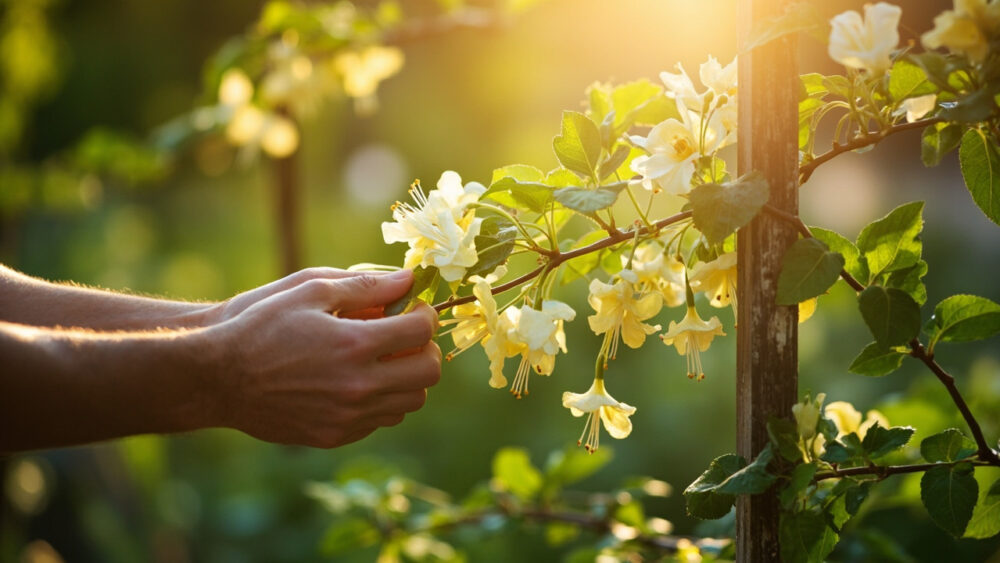
Growing honeysuckle starts with planting a container vine or bare-root plant in spring or fall, giving it a sturdy support and full sun to part shade, and staying patient for the first year while roots establish before the vine takes off. Once it’s settled, most varieties need almost nothing from you but a trellis and an annual haircut. That’s the whole job, but there’s a stretch between planting and that easy payoff where most people either plant the wrong species or starve the vine of light, and it never becomes the thing they pictured.
Here’s what trips people up: the honeysuckle you plant matters as much as how you plant it, because one common type is a thug that strangles trees and another is a well-mannered native that hummingbirds actually visit. There’s also a bloom mistake almost everyone makes in year one that has nothing to do with soil or water. And if you’ve got kids or pets circling that vine, you’re going to want the honest answer on the berries before anything else.
Stick with me through the planting steps, the feeding schedule, and the pest watch list, and I’ll give you a save-able Honeysuckle at a Glance card at the very bottom with every number on one screen.
When to Plant Honeysuckle
Plant in early spring after the soil has thawed and softened, or in early fall about six weeks before your first hard frost. Both windows give roots time to establish before they face summer heat or winter cold head-on. Spring planting is more forgiving for beginners because you’re not racing the calendar.
Soil temperature matters more than the date on the calendar. Honeysuckle roots start growing once soil hits about 50°F, so if you can work the ground without it clumping into mud, you’re in the window. Most honeysuckle vines are hardy in USDA zones 4 through 9, though the exact range depends on the species, so check the tag if you bought a named cultivar.
Container plants are far more forgiving of timing than bare-root ones, since bare-root stock needs to go in the ground while still dormant.
Get the timing right and the next decision, where you actually put it, decides whether this vine thrives or sulks for years.
Choosing the Spot and Prepping the Soil
Honeysuckle wants at least four to six hours of direct sun for strong bloom, though it will survive in more shade with fewer flowers. Vining types need something to climb: a trellis, arbor, chain-link fence, or sturdy post at least 6 to 8 feet tall. Give it distance from small trees and shrubs, because twining honeysuckle will wrap around and eventually choke a young trunk if left unmanaged.
Soil should drain well but hold some moisture, a loose loam is ideal. Honeysuckle isn’t fussy about pH, tolerating a range from mildly acidic to mildly alkaline. Work a few inches of compost into the top 8 to 10 inches of soil before planting, especially if you’re dealing with heavy clay or fast-draining sand.
If your yard has a fence line that gets baked all afternoon, that’s usually the spot, honeysuckle handles heat better than it handles deep shade.
Once you’ve picked the site, the actual planting takes ten minutes and matters more than people expect.
Planting Honeysuckle Step by Step
1. Dig the hole right
Dig a hole twice as wide as the root ball and just as deep, so the crown sits at the same soil level it was growing at in the container. Planting too deep is a common way to stall a new vine for a full season.
2. Space for the mature spread
Space plants 3 to 6 feet apart if you’re planting more than one, since a mature honeysuckle vine can spread 10 to 15 feet along a support. If you’re training it up a narrow trellis, one plant per structure is usually enough.
3. Set and backfill
Loosen the root ball gently, set it in the hole, and backfill with your amended soil. Firm it down with your hands, don’t stomp it, then water deeply to settle air pockets.
4. Anchor it to its support early
Tie the young stems loosely to the trellis or fence with soft garden twine right away. Honeysuckle twines on its own once it gets going, but a nudge in the first few weeks points it in the right direction instead of letting it flop and tangle.
With the vine in the ground and tied in, the next few months are about water and food, and this is where the year-one mistake shows up.
Watering and Feeding Through the Season
Water new plantings two to three times a week for the first month, enough to keep the top 4 to 6 inches of soil moist but not soggy. Once established, most honeysuckle is drought-tolerant and needs supplemental water only during extended dry spells, an inch of water a week is plenty.
If you assumed no blooms in year one means something’s wrong, that guess sends a lot of people out to buy fertilizer they don’t need. The real answer is simpler: honeysuckle often spends its first season building roots and canopy before it commits energy to flowers, and heavy nitrogen feeding actually delays bloom by pushing leafy growth instead.
Feed lightly in early spring with a balanced, slow-release fertilizer or a topdressing of compost, that’s enough for the whole year. Skip the high-nitrogen lawn-type feeds entirely.
Get the vine through its first patient season and you’re mostly in maintenance mode, but a few problems still show up if you’re not watching.
Problems That Actually Show Up
Powdery mildew is the most common issue, a gray-white coating on leaves that shows up in humid weather with poor air circulation. Prune out crowded interior growth to let air move through, and remove badly affected leaves. If it’s severe, a fungicide labeled for powdery mildew can help, follow the product label exactly.
Aphids cluster on new growth and buds, curling leaves and leaving a sticky residue. A strong blast of water knocks most of them off, and insecticidal soap handles the rest, again following the label.
Watch for these signs:
- Yellowing lower leaves with fine webbing: spider mites, usually in hot, dry conditions
- Sudden vine collapse with chewed bark near the base: vine borers, more common on stressed or older plants
- Sparse bloom despite healthy leaves: too much shade or overfeeding with nitrogen
One more thing worth naming plainly: Japanese honeysuckle (Lonicera japonica) is aggressive and invasive across much of North America, escaping gardens and smothering trees. If you want a well-behaved plant, look for native trumpet honeysuckle (Lonicera sempervirens) or coral honeysuckle instead, they climb politely and feed hummingbirds without taking over the fence line next door.
Handle the mildew, watch the base of the stem, and choose the right species, and this vine mostly takes care of itself from here on out.
When Honeysuckle Blooms and What to Do With It
Most honeysuckle varieties bloom from late spring into summer, with some reblooming into fall if you deadhead spent flowers. First-year plants may show few or no blooms, full flowering typically shows up in year two or three once the root system is established.
There’s no harvest in the food-crop sense, honeysuckle isn’t grown for eating. Some gardeners do cut flowering stems for indoor arrangements, they hold for several days in water and carry real fragrance into a room.
About the berries: many honeysuckle species produce red or blue-black berries after bloom, and these are considered toxic to humans and pets, particularly in quantity. If a child or pet eats them, don’t wait to see what happens, call a doctor, poison control, or your veterinarian and describe what and how much was eaten.
Prune right after the main bloom flush to shape the vine and encourage a second round of flowers, cutting back no more than a third of the growth at once.
That’s the full cycle from bare ground to blooming vine, and here’s everything worth saving before you close this tab.
Honeysuckle at a Glance
- When to plant: early spring once soil hits about 50°F, or early fall roughly six weeks before your first hard frost.
- Where: full sun to part shade, four to six hours of direct sun for best bloom, with a trellis, fence, or arbor at least 6 to 8 feet tall.
- Spacing and depth: plant at the same depth it grew in the container, space multiple plants 3 to 6 feet apart.
- Watering: two to three times weekly for the first month, then about an inch a week once established, more only in extended drought.
- Feeding: one light application of balanced, slow-release fertilizer or compost in early spring, skip high-nitrogen feeds.
- Bloom timing: late spring through summer, often sparse in year one, fuller by year two or three.
- Watch for: powdery mildew in humid weather, aphids on new growth, and invasive Japanese honeysuckle if choosing a species, go native (trumpet or coral honeysuckle) when possible.
Give honeysuckle sun, a sturdy support, and one patient season, and it rewards you for years with almost no fuss.
Just keep the berries away from curious hands and pets, and let the vine do the rest.