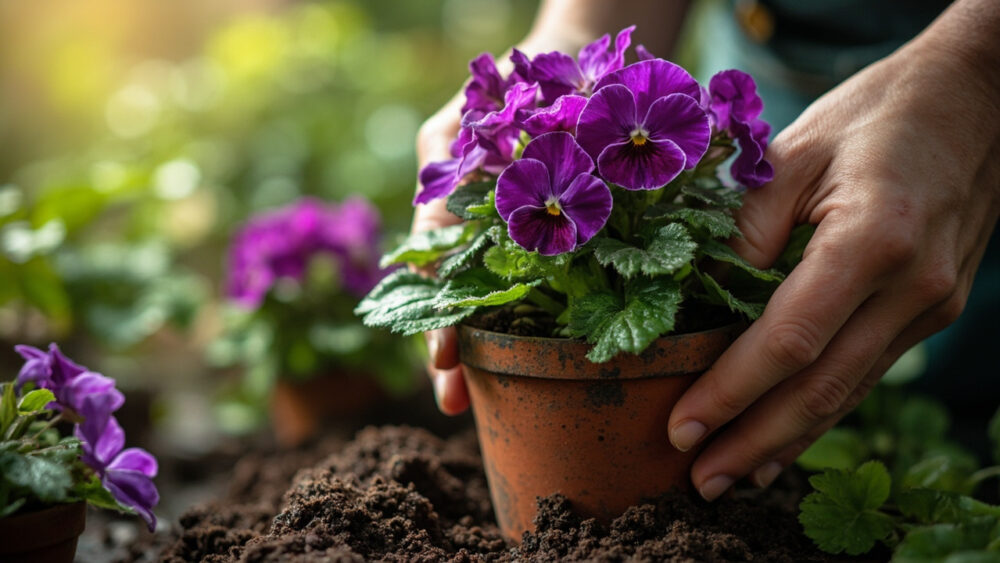
Here is how to grow african violet successfully: plant it in a shallow pot with a loose, peaty mix, give it bright indirect light with no direct sun, water from below or at the soil line so the crown stays dry, and feed lightly every time you water using a diluted violet-specific fertilizer. Do that consistently and you will get rounds of bloom nearly year-round, not just a one-time flush.
Most people who fail with this plant aren’t failing at the exotic stuff. They’re failing at the one mistake that kills more violets than any pest or disease ever will, and it involves water touching a place it should never touch.
There’s also a sign everyone misreads as “not enough light” when it’s usually the opposite, and an honest answer to the question you’re probably about to ask next: no, your violet does not need a special window or a greenhouse. Stick with this, and the full African Violet at a Glance card is waiting at the bottom, saveable in ten seconds once you’re done reading.
When to Start (and Why Timing Barely Matters Indoors)
African violets are tropical houseplants, so frost dates and outdoor soil temperature are irrelevant to them. You can start one any month of the year.
That said, spring and early summer give a newly potted or newly divided violet the longest run of strong natural light before winter’s low-light stretch, so a plant started in March or April tends to establish faster and bloom sooner than one started in November.
If you just bought one from a nursery or grocery store, don’t repot immediately. Let it adjust to your home’s light and humidity for two to three weeks first.
Once it settles in, the real work is about the spot you choose, not the calendar.
Choosing the Spot and Preparing the Soil
African violets want bright, indirect light for 10 to 12 hours a day. An east-facing window is close to ideal.
South or west windows work too, but only a few feet back from the glass, or filtered through a sheer curtain. Direct summer sun through unfiltered glass will scorch the leaves in a single afternoon, leaving bleached or brown patches you cannot undo.
For soil, skip regular potting mix. It holds too much water around the crown and compacts fast.
Use a mix labeled for African violets, or build your own with roughly equal parts peat moss or coco coir, perlite, and vermiculite. It should feel light and airy in your hand, almost fluffy, and drain within seconds when you pour water through it.
Pot choice matters here too, and it’s smaller than you’d think.
Planting an African Violet Step by Step
African violets actively dislike being overpotted. A plant with a 6 to 8 inch leaf spread is happy in a 4 to 5 inch pot, not a 10 inch one.
1. Pick a shallow pot with drainage
Violet roots stay shallow and wide, not deep. A squat pot with a drainage hole, roughly one-third the diameter of the leaf rosette, is the right proportion.
2. Set the crown at soil level, never below
The crown is where the leaves meet the roots. Plant it exactly level with the soil surface. Bury it even slightly and it rots within weeks.
3. Firm gently, don’t pack tight
Press the mix around the roots just enough to hold the plant upright. Compacted soil suffocates violet roots fast.
4. Space multiple plants 8 to 10 inches apart
If you’re growing several on one windowsill or tray, give each plant’s full leaf spread room to spread without leaves overlapping and trapping moisture.
5. Water once, lightly, then let it be
Settle the mix with a light watering right after planting. Then don’t touch it again until the top inch of soil feels dry.
Getting a violet in the ground correctly is half the battle. Keeping it alive week to week is the other half, and it’s where the one big mistake lives.
Watering and Feeding Through the Season
Here’s the mistake that ends most attempts: water touching the crown or sitting on the fuzzy leaves. Cold water splashed on those leaves leaves permanent yellow-white rings, and water pooling in the crown rots the whole plant from the center out, often within a week or two, with no way back.
Water from the bottom instead. Set the pot in a saucer of room-temperature water for 15 to 20 minutes, let it wick up through the drainage hole, then remove it. Or water carefully at the soil surface with a narrow spout, avoiding the leaves entirely.
Check the soil by feel, not by schedule. Water again when the top inch feels dry, which is usually every 7 to 10 days, faster in a dry, heated room.
Feed lightly and often rather than heavily and rare. A fertilizer formulated for African violets, diluted to about a quarter strength, applied every time you water, keeps bloom steady without the leaf burn that comes from occasional full-strength feeding.
Get the water and food rhythm right, and the next thing that trips people up is a plant that looks sick when it isn’t.
Problems Most Likely to Strike, and the Sign Everyone Misreads
If you assumed pale, faded-looking leaves mean the plant needs more light, that guess is backward more often than not. Pale, washed-out leaves with long stems reaching sideways usually mean too much direct sun, not too little. Genuine low light shows up differently, as dark green leaves on long, stretched stems with few or no blooms.
Crown rot and root rot come from overwatering or water sitting in the crown, exactly as covered above. Soft, mushy, discolored crown tissue means the plant likely can’t be saved; take healthy leaf cuttings instead and start over.
- Cottony white fuzz on leaves or stems: mealybugs, treat by wiping with a damp cloth and following the label directions on an insecticidal soap.
- Fine webbing and stippled leaves: spider mites, often from air that’s too dry; raise humidity and isolate the plant.
- Powdery gray-white patches: powdery mildew, improve air circulation and treat per a fungicide label if it persists.
- Leaves collapsing overnight, crown soft: crown rot, remove the plant, sanitize the pot, start fresh from cuttings.
African violets aren’t toxic to cats, dogs, or people, so an accidental nibble is a non-event, though heavy ingestion of soil or fertilizer residue is still worth a quick call to your vet if your pet seems off afterward.
Handle the light and water correctly and most of these problems never show up, which brings us to the payoff every violet grower is actually chasing: the blooms.
When and How Your African Violet “Matures” Into Bloom
A healthy, correctly potted African violet typically produces its first blooms 6 to 9 months after planting or dividing, sooner if it started as an already-mature nursery plant. Unlike a vegetable, there’s no single harvest moment. It blooms in waves, rests for a few weeks, then blooms again, often continuing this cycle for years.
The honest answer to “why won’t mine bloom” is almost always light. Ten-plus hours of bright indirect light daily is the single biggest driver of bloom frequency, more than fertilizer, more than pot size, more than variety.
To keep the cycle going, remove spent flower stalks at the base once blooms fade, and pinch off any lower leaves that yellow or touch the pot rim. This keeps the crown open and airy, which cuts down on rot and pushes energy into the next round of buds.
Every fact you need to keep this cycle running lives in the card below, saved and ready for your phone.
African Violet at a Glance
- When to plant: any time of year indoors, though spring and early summer give the fastest establishment thanks to stronger natural light.
- Light needs: bright, indirect light for 10 to 12 hours daily, an east window is ideal, filter or set back from south and west windows.
- Soil and pot: a light, fast-draining African violet mix in a shallow pot roughly one-third the diameter of the leaf spread.
- Planting depth: crown level with the soil surface, never buried.
- Watering: bottom-water or water at the soil line only, whenever the top inch of soil feels dry, roughly every 7 to 10 days.
- Feeding: a violet-specific fertilizer diluted to quarter strength, applied at most waterings.
- Bloom timeline: first flowers in 6 to 9 months from planting, then repeating bloom cycles for years with steady light and grooming.
Get the light right and keep water off the crown, and this plant forgives almost everything else. That single habit is the difference between a violet that sulks and one that blooms for years.