Water your monstera every 7 to 10 days in spring and summer, and every 2 to 3 weeks in fall and winter, but only after you’ve confirmed the soil is actually dry, not just because the calendar says it’s time. That calendar number is a starting point, not a rule. The real schedule depends on your light, pot size, and the season, which is exactly why so many monsteras end up drooping despite an owner who was “watering right on schedule.”
Here’s the loop worth opening right away: the most common monstera death isn’t underwatering. It’s the well-meaning schedule-follower who waters every Sunday no matter what, and slowly drowns the roots without ever seeing it coming until the leaves are already yellow.
There’s also a sign almost everyone misreads, a droopy, sad-looking monstera that gets more water when it actually needed less, and the plant just keeps sliding. Stick with this, because the bottom of this guide has a save-able Monstera at a Glance card with the numbers, so you don’t have to memorize any of it.
The Honest Schedule, and What Actually Changes It
In bright, indirect light and average room temperature, most monsteras want water roughly once a week to every 10 days during active growth. In lower light or a cooler room, stretch that to every 2 weeks even in summer. Come fall and winter, growth slows hard and most monsteras are fine on a 2 to 3 week interval, sometimes longer.
Pot size and material matter more than people expect. A monstera in a 6 inch plastic nursery pot dries out much faster than the same plant in a 12 inch terracotta pot, because terracotta wicks moisture out through its walls and larger soil volumes hold water longer. Unglazed clay pots need more frequent checks than glazed ceramic or plastic.
Root-bound plants also dry out faster, since there’s more root and less actual soil to hold moisture.
None of that matters, though, until you know how to check the soil instead of guessing.
Stop Guessing: The Checks That Actually Tell You
The finger test beats any schedule. Push your finger 2 to 3 inches into the soil, past the dry surface layer. If it feels dry at that depth, water. If it’s still cool and damp, wait a few more days and check again.
Pot weight is the trick experienced growers use once they know their plant. Lift the pot right after a thorough watering and feel how heavy it is. Lift it again in a few days. Once you’ve felt both ends of that range a couple times, you can judge moisture by heft alone, no finger required.
Leaves give you cues too, but they lag behind the soil, so treat them as a backup, not your primary signal. A monstera that’s genuinely thirsty gets slightly softer, less glossy leaves and can droop a bit at the tips before it curls.
That drooping leaf is exactly the sign most people misread, and it’s worth unpacking on its own.
The Droop Everyone Gets Wrong
If you assumed a droopy monstera always wants more water, that guess is what kills most of them. Both overwatering and underwatering cause drooping, and the leaves look nearly identical either way. The soil is what tells you the truth, not the leaf.
Underwatered leaves droop and feel thin, almost papery, and the soil is bone dry even a few inches down. The pot feels noticeably light. New growth may stall, but leaves usually don’t yellow, they just look tired and slightly curled at the edges.
- Overwatered: soil stays wet days after watering, leaves yellow starting at the base or edges, sometimes with brown mushy patches, and the pot feels heavy with no drainage improvement.
- Underwatered: soil is dry well below the surface, leaves droop but stay green or just slightly dull, pot feels notably light, and perking up happens within hours of a good soak.
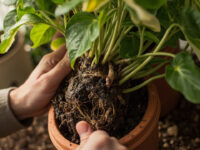
Root rot from chronic overwatering is the harder problem to reverse, sometimes requiring you to unpot the plant, trim mushy black roots, and repot in fresh, dry soil. Underwatering almost always fixes itself with one thorough watering and no drama.
Knowing which one you’ve got only matters if you then water correctly, which is its own skill.
How to Actually Water It, Not Just When
Shallow little sips from a cup train roots to stay near the surface and leave the center of the root ball dry. That’s a mistake that costs people a whole season of weak growth without them ever realizing why.
Water thoroughly instead. Pour slowly until water runs freely from the drainage holes, then let it drain completely for 10 to 15 minutes before it sits back in its saucer or cache pot. That flush pushes water through the entire root zone and rinses out built-up mineral salts from tap water and fertilizer.
A monstera with no drainage hole is fighting you before you’ve even started. If you’re stuck with a decorative pot, use it as a cache pot and keep the actual plant in a nursery pot with drainage, then pull it out to water and drain in a sink.
Room-temperature water is fine, ice-cold water straight from the tap can shock roots slightly and isn’t worth the risk.
Get the watering right and the next question answers itself: what changes once the seasons turn.
Adjusting Through the Year
Spring and summer are when monstera pushes new leaves and fresh aerial roots, and that growth burns through soil moisture fast. This is when the 7 to 10 day interval applies, and in very bright light or a dry, heated room, some plants want water every 5 to 6 days.
Fall brings the biggest adjustment most people forget to make. As daylight drops, growth slows dramatically even if your home stays warm. Keep watering on the summer schedule into fall and you’re the schedule-follower from the intro, quietly overwatering a plant that no longer needs it.
Winter is the slow season. Stretch to every 2 to 3 weeks, check the soil before every single watering, and expect the plant to sit still rather than push new leaves. That’s normal, not a sign of decline.
Once spring light returns and you see a new leaf unfurling, that’s your cue to gradually shorten the interval again.
Monstera at a Glance
- Spring and summer watering: every 7 to 10 days in bright indirect light, checking soil first rather than watering on autopilot.
- Fall and winter watering: every 2 to 3 weeks as growth slows, sometimes longer in cool or low light rooms.
- How to check: push a finger 2 to 3 inches into the soil, water only when that depth feels dry, not just the surface.
- How to water: pour slowly until it runs from the drainage holes, let it drain fully for 10 to 15 minutes, never let the pot sit in standing water.
- Underwatered signs: dry soil well below the surface, light pot, thin papery droop, perks up within hours of a soak.
- Overwatered signs: soil wet days later, heavy pot, yellowing at leaf base or edges, possible mushy brown patches.
- Pot and light factors: terracotta and small pots dry faster, low light and cool rooms mean longer intervals between waterings.
The finger test beats every calendar you’ll ever set. Check first, water second, and your monstera will forgive almost anything else you get wrong.