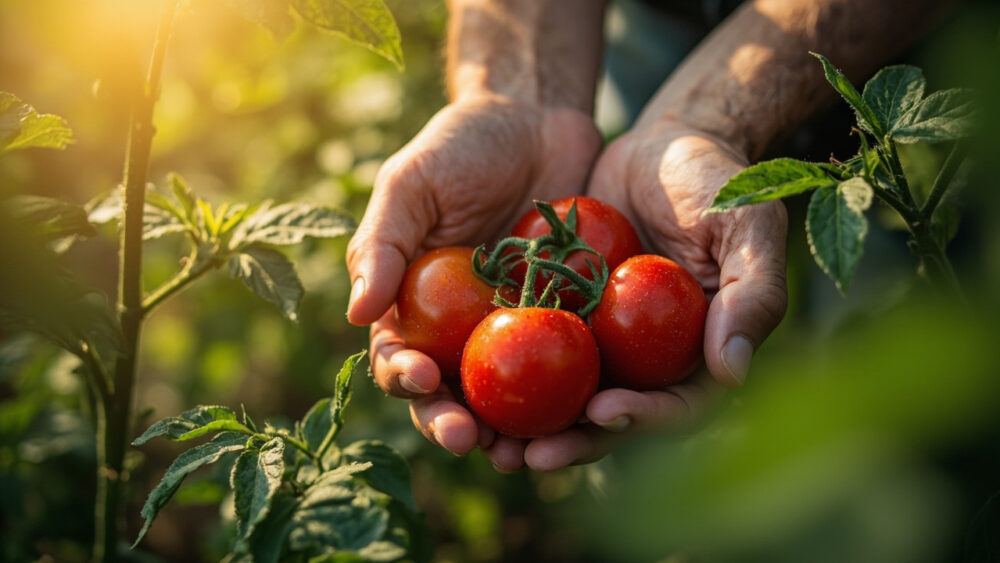
When to harvest tomatoes comes down to color and give, not the calendar. Most tomatoes are ready when they’ve reached full color for their variety and yield to gentle pressure without feeling mushy, which for a standard slicer usually runs 60 to 85 days after transplanting, depending on the variety. But that simple rule hides a few honest complications, and getting them wrong is how people end up with a bumper crop of mealy, flavorless fruit or a plant full of tomatoes killed by an early frost.
Here’s what most people get backwards: waiting for a tomato to feel rock hard before picking, or assuming deep red is always the finish line. Neither is reliable, and I’ll show you why in a minute.
There’s also a harvest-window trick worth knowing before your first frost ever gets close, plus the exact hand motion that keeps you from snapping next year’s flower clusters off by accident. Stick around, because the save-able Tomatoes at a Glance card at the bottom has the timing, spacing, and storage numbers all in one place for your phone.
The Real Ready Signs
Color is the first tell, but it lies to you on certain varieties. A ripe Cherokee Purple looks dusty pink-brown, not red, and a ripe yellow tomato can look underripe to eyes trained on Roma tomatoes.
Color
Look for the fruit to reach the full, even color listed for that variety, whether that’s deep red, orange, yellow, or streaked purple. Uneven color, with green shoulders still showing, means it needs more time on the vine.
Feel
Give the tomato a gentle squeeze. It should yield slightly, like a firm peach, not feel like a baseball and not feel soft or give way under light pressure.
The stem test
A ripe tomato usually separates from the vine with a light tug and a slight twist, the stem staying on the fruit rather than snapping off in your hand. If it fights you, it’s not ready yet.
Those three signs together beat any single one alone, and that combination is exactly what the next section is about to complicate.
If You Assumed Riper Is Always Better, Read This
Most people think the longer a tomato hangs on the vine, the better it tastes. That’s true up to a point, then it reverses fast.
A tomato left too long past peak ripeness turns mealy inside, splits after rain, and becomes an open invitation to birds, squirrels, and rot. Overripe fruit also stops the plant from putting energy into the tomatoes still coming behind it.
The honest fix is picking at “breaker” stage during specific conditions: heavy rain forecast, a heat wave that will cook fruit on the vine, or the first real frost threat in fall. A tomato showing just a blush of color will finish ripening indoors at room temperature with almost no loss in flavor, as long as it was allowed to develop full size and at least some color first.
Pick too early, before any color break at all, and you get bland, watery fruit that never develops proper sugar. That’s the real trade-off, not “riper equals better” but “ripened on the vine when possible, pulled early only when conditions force your hand.”
Next up is the part almost nobody thinks about until it’s too late in the season.
The Timing Window Nobody Warns You About
Tomatoes stop ripening reliably once nighttime temperatures drop into the upper 40s Fahrenheit for several nights running, well before your first hard frost actually hits. That’s the real deadline, not the frost date itself.
As frost approaches, here’s the honest math: green tomatoes with any hint of white or pale color at the blossom end will usually ripen indoors over one to three weeks. Fully green, hard, dark green tomatoes rarely ripen well and are better used for frying or pickling.
Going early on the whole crop, panic-picking everything green well before any real cold threat, throws away flavor and yield you didn’t need to lose. Going late, leaving fruit out through an actual frost, turns it to mush overnight since frost ruptures the cell walls.
The window that actually matters is the two to three weeks before your average first frost date, when you should shift from waiting for full vine-ripening to pulling anything showing color and letting it finish inside.
Now that you know when, let’s get the actual picking technique right.
How to Pick a Tomato Without Wrecking the Plant
The plant-damage mistake almost everyone makes is yanking straight down or sideways, which can tear the stem and split the branch it’s growing from. Here’s the move that avoids it:
- Cup the tomato in your palm, supporting its full weight.
- Find the stem just above the fruit, where it connects to the branch.
- Bend and twist gently rather than pulling straight out, letting the natural break point do the work.
- If it resists more than a light twist, it’s not ready, so stop and try again in a day or two.
- For fruit clusters, pick one at a time rather than tugging the whole truss loose.
Use both hands on heavy beefsteak varieties so the branch doesn’t bend or snap under the weight as the fruit comes free.
Once it’s in your hand, what you do in the next hour matters almost as much as the picking itself.
What to Do Right After You Pick
Skip the fridge. Cold storage below about 55 F kills flavor and turns the texture mealy, which is the single most common mistake people make with a fresh harvest.
Set ripe tomatoes stem-side down on a counter out of direct sun, where they’ll hold well for three to seven days depending on the variety and how ripe they were at picking. Check daily and use the softest ones first.
For tomatoes still finishing indoors, spread them in a single layer, not touching, in a spot around 65 to 70 F out of direct sunlight. A paper bag with a ripe banana inside speeds things up if you’re in a hurry, since the banana gives off ethylene gas.
Wash tomatoes only right before you eat or cook them, never before storing, since extra moisture invites rot.
That handles today’s harvest, but the real win is keeping more coming behind it.
Keeping the Harvest Coming All Season
Picking regularly is itself a productivity trick. A tomato plant with ripe fruit sitting on it slows down setting new flowers, so harvesting every two to three days during peak season pushes the plant to keep producing.
Consistent watering, roughly 1 to 2 inches a week, keeps fruit from cracking and cuts down on blossom-end rot, which shows up as a dark, sunken patch on the fruit’s bottom. Mulch helps hold that moisture steady between waterings.
If frost is still weeks off but production is slowing, pinch off new flowers about a month before your first expected frost. That redirects the plant’s energy into ripening the fruit already on the vine instead of starting more that won’t have time to mature.
Whatever you don’t eat fresh can be frozen whole for sauce later, or halved and dehydrated, both of which hold flavor far better than the fridge does.
All of that is worth pinning down in one place, so here’s the card to save.
Tomatoes at a Glance
- Ready signs: full, even color for the variety, slight give under gentle pressure, stem releases with a light twist.
- Days to maturity: roughly 60 to 85 days from transplant depending on variety, longer for big beefsteaks, shorter for cherry types.
- Best picking time: morning, once dew has dried, when fruit is firm and cool.
- Ripening indoors: pick at first color break before frost threat, ripen at 65 to 70 F out of direct sun, three days to three weeks depending on starting color.
- Never refrigerate ripe fruit: keep on the counter, stem-side down, out of direct sunlight, for best flavor and texture.
- Frost deadline: stops ripening reliably once nights run in the upper 40s F for several nights, before the actual frost hits.
- Keep production going: harvest every two to three days, water 1 to 2 inches weekly, pinch new flowers about a month before first frost.
Trust color and give over hardness, and pick a little early rather than a little late when frost or heavy rain is coming. That one habit saves more tomatoes than any other trick in the garden.