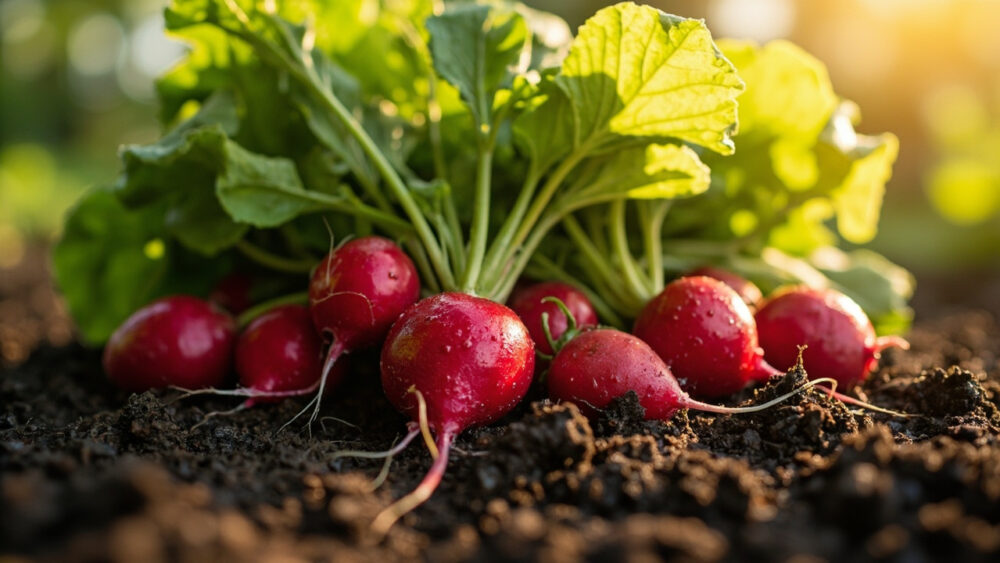
Most radishes go from seed to harvest in 21 to 35 days. That is the real answer, and it is one of the fastest turnarounds in the vegetable garden. But the exact number depends on which radish you planted, how warm your soil is, and honestly, how patient you are willing to be about that last week.
Some readers are going to pull radishes at day 22 and get something the size of a marble, then wonder what went wrong. Others planted the wrong variety for the season and are staring at a plant that seems stalled at day 40 with no root to speak of. Both of those situations are fixable once you know what is actually driving the clock.
Below I will walk through the honest range, what speeds it up or slows it down, what each week should look like, and how to tell a slow radish from a failed one. Save-able quick-reference card is at the bottom if you just want the numbers pinned down.
The Real Timeline, Variety by Variety
Standard round red radishes like Cherry Belle or Champion are the fast ones, typically 22 to 28 days from seed to harvest size. French Breakfast types run close behind at around 25 to 30 days.
Daikon and other winter radishes are a different animal entirely. Those take 45 to 70 days because you are growing a much bigger root, sometimes a foot long. If your seed packet says daikon, watermelon radish, or black Spanish radish, throw the 3-week expectation out the window.
Read your seed packet before you assume anything about timing.
What Actually Controls the Speed
Soil temperature runs this whole show. Radish seeds germinate fastest between 50 and 70°F, and growth stalls hard once soil temps push past 80°F.
That is why a radish planted in cool spring soil at 60°F might hit harvest size in 24 days, while the same variety sown in July heat can take closer to 35 days and still bolt to flower before the root fills out.
Consistent moisture matters almost as much. Radishes that dry out and then get soaked tend to crack or grow oddly shaped, and uneven watering slows root development even when the calendar says they should be ready.
Crowding is the other big one. Seeds sown too thick compete for space and never size up properly, no matter how many days pass.
Get the spacing and soil temperature right and the rest of the timeline mostly takes care of itself.
What Each Stage Actually Looks Like
Days 1 to 5: seeds germinate and you will see small rounded leaves poking through, assuming soil stays consistently moist.
Days 6 to 14: leafy top growth takes off. This is when the plant is building the engine, not the root, so do not judge progress by what is happening at soil level yet.
Days 15 to 21: the root actually starts swelling. You will often see the top of the radish shoulder push slightly above the soil surface, sometimes with a blush of color showing.
Days 22 to 35: the root fills out to harvest size. For standard varieties this is your window. Wait too long past this and roots can turn pithy, woody, or split.
Once you see that shoulder poking up and coloring, you are days away, not weeks.
How to Actually Speed This Up (and What Doesn’t Work)
The legitimate speed levers are soil temperature, spacing, and consistency. Direct-sow into loose, well-drained soil once it has warmed into that 50 to 70°F range, thin seedlings to about 1 inch apart early, and keep the bed evenly moist rather than letting it swing dry.
A quick-maturing variety genuinely shaves days off the calendar if speed is the whole point. Cherry Belle and similar 22-day types exist for exactly that reason.
Extra fertilizer does not speed radishes up, and it is one of the most common mistakes. High-nitrogen feeding pushes lush green tops at the expense of the root, which is the opposite of what you want. Radishes do fine in average soil with no feeding at all.
Skip the fertilizer, focus on spacing and temperature, and you have done everything that actually matters.
Is Your Slow Radish a Problem or Just Normal?
If your radish hits day 30 for a fast variety and the root is still pencil-thin, that is usually crowding, heat stress, or too much shade rather than a disease issue. Radishes want a good 6 hours of direct sun; less than that and top growth outpaces root growth every time.
If you assumed heat was speeding things up because the plant is growing fast, that guess has it backwards. Heat pushes leafy growth and often triggers bolting, where the plant sends up a flower stalk instead of finishing the root. A bolted radish is not going to size up further. Pull it, eat the greens if you want, and replant when temperatures cool.
A true problem looks different: seedlings that never emerge at all usually mean the soil crusted over or seeds rotted in soil that stayed too wet. That is worth restarting rather than waiting out.
Know which one you are looking at before you decide whether to wait another week or pull the row.
Radishes: Quick Reference
- Standard timeline: 21 to 35 days from seed to harvest for common round varieties like Cherry Belle and French Breakfast.
- Winter radishes: daikon and similar types need 45 to 70 days, not the standard 3 to 4 weeks.
- Ideal soil temperature: 50 to 70°F for both germination and steady root growth, growth stalls above 80°F.
- Spacing: thin to about 1 inch apart early, crowded roots stay small no matter how long you wait.
- Fertilizer: skip the extra nitrogen, it grows leaves instead of roots and does not speed harvest.
- Harvest cue: shoulder of the root pushes up through the soil surface and shows color, usually days before it is ready to pull.
- Bolting sign: a flower stalk shooting up means the root is done growing, harvest now or pull and replant.
Three to five weeks, sometimes longer for the big winter types. That is really all the patience radishes ask of you.