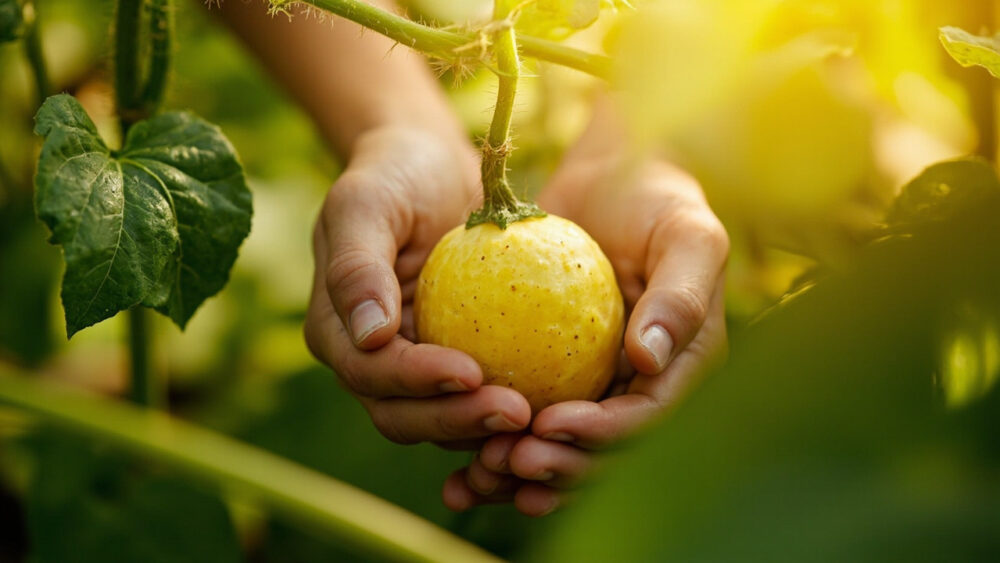
Lemon cucumbers grow the same way any vining cucumber does: you get them started after the soil warms past 65°F with no frost risk left, give the vines room to sprawl or something to climb, keep the water steady, and start picking the fruit when it’s still pale yellow and about the size of a tennis ball, not when it’s gone deep gold and puffy. That’s how to grow lemon cucumbers from seed to harvest in one sentence. But there’s a reason so many people end up with a vine full of bitter softball-sized fruit instead of the crisp, mild little globes they were expecting.
That reason is timing the harvest, and it trips up almost everyone the first year. There’s also a watering habit that causes more bitter, misshapen cucumbers than any pest ever will, and a pollination problem that looks like disease but isn’t. I’ll walk through all of it, plus the transplant shock mistake that sets a whole planting back by two weeks before it even gets going.
Stick around to the end and I’ll give you the Lemon Cucumbers at a Glance card, the short version you can save to your phone and check next time you’re standing in the garden wondering if today’s the day to pick.
When to Plant Lemon Cucumbers
Lemon cucumbers are frost-tender through and through, so timing hinges on two things: your last frost date and soil temperature. Wait until nighttime lows are reliably above 50°F and soil temperature has hit at least 65°F, usually two to three weeks after your last frost date.
Cold, wet soil is where most transplants stall out or rot at the stem before they ever take off. If you’re starting seed indoors, do it three to four weeks before your transplant date, not earlier. These vines grow fast and resent being root-bound in a small pot for long.
In zones 3 through 6, direct-sowing often means waiting until early to mid June. In zones 7 through 10 you can push earlier, sometimes late April into May, and get a second planting in for a fall crop.
Get the timing right and the next decision is where in the yard this vine actually gets to live.
Picking the Spot and Getting the Soil Ready
Lemon cucumbers want full sun, at least 6 to 8 hours a day, and they are not shy about how much space they’ll take if you let them sprawl on the ground. A trellis solves that and also cuts down on disease, since fruit and leaves get better airflow off the soil.
Soil should be loose, well-draining, and rich in organic matter. Work a few inches of compost into the bed before planting, aiming for a pH around 6.0 to 6.8.
Raised beds and mounded rows both work well because they warm up faster in spring and drain better after heavy rain. Heavy clay that stays soggy is the one condition that consistently produces weak, disease-prone vines.
Once the bed is ready, the actual planting takes about ten minutes and it’s easy to get wrong in a way that costs you two weeks.
Planting Step by Step
- Depth: sow seeds about 1 inch deep, or set transplants so the soil line matches the pot, no deeper.
- Spacing: space plants 12 to 18 inches apart along a trellis, or 3 to 4 feet apart if letting vines run on the ground.
- Grouping: plant in small hills of 2 to 3 seeds per spot rather than a single thin row, then thin to the strongest seedling.
- Transplant handling: cucumber roots hate disturbance, so slide the seedling out of its pot rather than shaking soil loose, and water it in immediately.
- Support setup: install the trellis or cage at planting time, not after the vines are already sprawling everywhere.
That transplant-handling step is the one almost everyone skips, and it’s why so many transplanted vines just sit there sulking for two weeks instead of growing.
Watering and Feeding Through the Season
If you assumed inconsistent watering just stresses the plant a little, that guess undersells the damage. Uneven watering is the single biggest cause of bitter, misshapen lemon cucumbers, more than any pest or soil problem. The plant needs about 1 to 1.5 inches of water a week, delivered consistently rather than in a flood-then-drought cycle.
Check soil moisture by feeling an inch down. If it’s dry there, water deeply at the base rather than misting the leaves, which just invites fungal problems.
Mulch heavily, 2 to 3 inches of straw or shredded leaves, to hold that moisture steady and keep soil temperature from swinging too hard in summer heat.
Feed with a balanced fertilizer at planting, then switch to something higher in phosphorus and potassium once flowering starts, roughly every 3 to 4 weeks. Too much nitrogen late in the season gives you a jungle of leaves and disappointing fruit.
Get the water rhythm right and most of the disease and pest pressure that follows becomes a lot easier to manage.
The Problems Most Likely to Hit Your Vines
Early on, you may see flowers drop off without ever forming fruit. That’s usually not disease, it’s a pollination gap, since cucumbers produce separate male and female flowers and need bees moving between them. Planting flowers nearby to draw in pollinators, or hand-pollinating with a small brush, fixes it fast.
Powdery mildew, a white dusty coating on leaves, shows up in humid weather with poor airflow. Trellising helps prevent it; if it appears, remove affected leaves and treat with a fungicide labeled for powdery mildew, following the product label exactly.
Cucumber beetles, small striped or spotted yellow beetles, chew on leaves and can spread bacterial wilt. Row covers early in the season keep them off young plants before flowering starts.
Bitter fruit traces back to water stress or heat stress far more often than genetics. Consistent moisture is the real fix, not the variety.
Manage those three and the vines usually sail through to the part everyone’s actually waiting for.
When and How to Harvest Lemon Cucumbers
Here’s the mistake that ruins most first attempts: waiting for the fruit to look like a ripe lemon. By the time it’s fully golden yellow, it’s overripe, seedy, and often bitter or tough-skinned. Pick lemon cucumbers when they’re still pale yellow to yellow-green, firm, and roughly 2 to 3 inches across, about the size of a tennis ball or a bit smaller.
Most varieties reach harvest size 55 to 65 days after planting. Once vines start producing, check them every day or two, since fruit can size up fast in warm weather and go from perfect to overripe within a couple of days.
Twist or snip the fruit off rather than yanking, which can damage the vine. Frequent picking is what keeps the plant producing, since letting fruit mature fully on the vine signals the plant to slow down.
Get the timing right here and you’ll have a crisp, mild cucumber with a texture nothing like the bitter version most people remember from a neglected vine.
Lemon Cucumbers at a Glance
- When to plant: two to three weeks after last frost, once soil hits at least 65°F.
- Spacing: 12 to 18 inches apart on a trellis, 3 to 4 feet apart if left to sprawl.
- Planting depth: 1 inch for seed, transplants set at the same depth as their pot.
- Water needs: 1 to 1.5 inches per week, kept consistent to prevent bitterness.
- Sun: full sun, at least 6 to 8 hours daily.
- Days to harvest: roughly 55 to 65 days from planting.
- Harvest cue: pick at pale yellow to yellow-green, tennis-ball size, before the skin turns deep gold.
The whole crop comes down to two habits: water on a steady schedule, and pick early rather than late.
Get those right and everything else about lemon cucumbers takes care of itself.