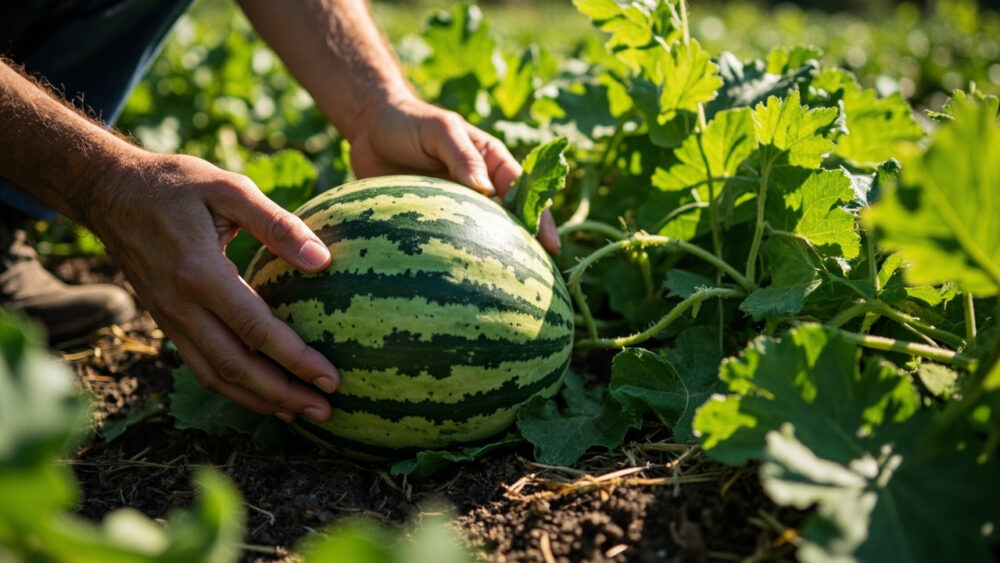
Caring for watermelon comes down to four things: full sun, warm soil above 70°F, deep but infrequent watering, and enough room for vines to run 6 to 12 feet. Get those right and the plant mostly grows itself. Get the watering wrong near harvest, though, and you can lose a whole season of work on the very last day.
Most people who fail with watermelon fail in one of two spots: they plant too early into cold soil and the plant just sits there sulking, or they keep watering right up until harvest and end up with a mushy, bland melon instead of a crisp one. There is also a sign almost everyone misreads when checking ripeness, and it is not the thump.
Stick with me through the sections below and I will cover light and placement, watering by feel instead of by schedule, feeding, the pruning and training tasks nobody tells you about, the pests and diseases actually worth worrying about, and the honest signs of a thriving vine. The save-able Watermelon at a Glance card is waiting at the very bottom, so keep scrolling once you get there.
Light, Placement, and Temperature
Watermelon wants full sun, a genuine 8 to 10 hours a day, with no shade from trees, fences, or taller crops. Less than 6 hours and vines get leggy with weak flowering.
Soil temperature matters more than air temperature. Do not plant until soil hits 70°F at a 2 to 4 inch depth, measured with a simple soil thermometer, which is usually 2 to 3 weeks after your last frost date. Cold soil stalls root growth even if the air feels warm enough for a T-shirt.
Give each plant 3 to 6 feet of space in-row and 6 to 8 feet between rows for standard vining types, or plan for a sturdy trellis and 2 to 3 feet of spacing if you are growing a bush or compact variety in a smaller bed.
Next comes the part that trips up even careful gardeners: how much water is actually enough.
Watering: How Much, How Often, and the Mistake That Ruins the Last Week
Young plants need consistent moisture, about 1 to 2 inches of water a week, keeping the top few inches of soil damp but never soggy. Check by pushing a finger 2 inches down; if it’s dry, water deeply at the base rather than misting the leaves.
Here’s the mistake that costs people their best melons: they keep watering on the same schedule right through ripening. Once melons reach full size and start to ripen, cut watering back significantly, almost to nothing if rain is absent. Excess water at this stage dilutes sugar and gives you a watery, less sweet melon.
If you assumed more water always makes a bigger, better melon, that assumption is exactly what waters down the flavor in the final two weeks.
Feeding follows a similar logic, and getting the timing backward causes its own kind of disappointment.
Soil and Feeding: Getting the Timing Right
Watermelon wants loose, well-draining soil rich in organic matter, with a pH between 6.0 and 6.8. Work in a few inches of compost before planting and mound rows slightly to improve drainage and warm the soil faster in spring.
Early on, feed with a balanced fertilizer or nitrogen-leaning compost to build vigorous vines and leaves. Once flowering starts, switch to something lower in nitrogen and higher in phosphorus and potassium, similar to a tomato or bloom fertilizer.
Too much nitrogen late in the season gives you huge, leafy vines and disappointing fruit, all leaf and no melon.
Follow the fertilizer label rates exactly rather than guessing, since watermelon is sensitive to over-feeding, particularly with nitrogen.
With soil and feeding sorted, the hands-on tasks are next, and this is where a lot of gardeners do too little or too much.
Pruning, Training, and the Routine Tasks
Watermelon does not need heavy pruning, but a little management pays off. Pinch the growing tip once a vine has set 2 to 3 fruits to redirect energy into ripening rather than producing more flowers you will just have to thin later.
Removing a few of the smallest, latest-set fruits on each vine, keeping 2 to 4 per plant, produces larger, sweeter melons than letting every fruit try to mature.
If you’re growing vertically on a trellis, slings made from soft cloth or netting support the fruit as it swells so the stem doesn’t tear. Rotate ground-grown melons gently every week or two so one side isn’t sitting in damp soil the whole season, which invites rot and flat spots.
Weed around the base regularly since watermelon roots are shallow and hate competition, but weed carefully by hand near the stem to avoid nicking roots.
Even a well-tended vine runs into trouble, so here’s what actually shows up and what to do about it.
Problems That Actually Strike, and Their Fixes
Powdery mildew, a white dusty coating on leaves, is the most common problem in humid climates. Improve airflow with wider spacing, water at the base instead of overhead, and treat early with a fungicide labeled for powdery mildew, following the product instructions exactly.
Cucumber beetles and squash bugs are the main insect threats, both chewing leaves and spreading bacterial wilt. Floating row covers early in the season keep them off young plants; remove covers once flowering starts so pollinators can reach the blossoms.
Blossom end rot, a sunken brown patch on the fruit’s bottom, comes from inconsistent watering disrupting calcium uptake, not usually a calcium deficiency in the soil itself. Even, regular watering solves it far more often than any additive does.
- Wilting despite moist soil: often bacterial wilt from cucumber beetles, and affected vines usually need to be removed since there’s no cure.
- Yellow leaves low on the vine: normal as the season progresses, not automatically a problem.
- Split fruit: usually a sudden heavy watering after a dry spell, so keep moisture consistent.
Once the vine gets past these hurdles, the bigger question becomes how to know it’s actually happy.
The Real Signs of a Thriving Watermelon Vine
A healthy vine has deep green leaves, vigorous new growth extending several inches a week during peak summer, and abundant yellow flowers followed by small fruit that swells visibly over days, not weeks.
Vines that just sit there with flowers dropping and no fruit forming are usually short on pollinators or hit a temperature stress spell above 95°F, which can cause temporary blossom drop.
Here’s the ripeness sign everyone gets wrong: thumping. A hollow sound is real but unreliable for most home gardeners since it takes experience to judge.
The better signs are the curly tendril nearest the fruit’s stem turning brown and dry, the underside where the melon touches soil turning from white to a creamy yellow, and the surface skin going slightly dull instead of glossy.
All three signs together are far more reliable than any single test, thump included.
Once you’ve got a feel for those cues, the rest is just repetition, and that’s exactly what the quick-reference card below is for.
Watermelon at a Glance
- When to plant: 2 to 3 weeks after last frost, once soil is consistently above 70°F at 2 to 4 inches deep.
- Spacing: 3 to 6 feet apart in-row for vining types, 2 to 3 feet for compact or trellised varieties, rows 6 to 8 feet apart.
- Light: full sun, 8 to 10 hours daily, no shade.
- Watering: 1 to 2 inches weekly while growing, cutting back sharply once fruit reaches full size and starts to ripen.
- Feeding: balanced fertilizer early for vine growth, then lower nitrogen, higher phosphorus and potassium once flowering begins.
- Ripeness signs: tendril nearest the fruit turns brown and dry, ground spot shifts from white to creamy yellow, skin turns slightly dull.
- Days to maturity: roughly 70 to 90 days from transplant depending on variety, so track your planting date.
Get the soil warm before you plant and ease off water in the final weeks, and most of the hard part is already handled.
Everything else is just patience and watching that tendril turn brown.