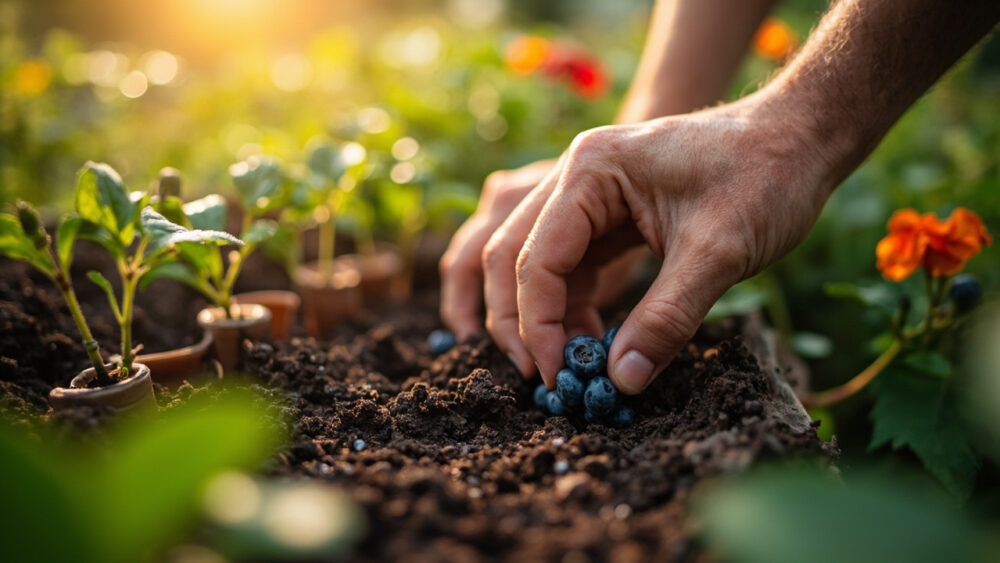
Growing blueberries from seed means starting indoors under lights 8 to 12 weeks before your last frost, sowing seed just barely covered on a moist, acidic, peat-based mix, and settling in for a wait: most seedlings take 2 to 4 years to fruit, sometimes longer. It works, but it is a slow, humbling project, not a shortcut to berries this summer. If you want a harvest fast, you buy a two-year potted plant. If you want the actual experience of growing blueberries from seed, this is the honest, full process.
Here is what trips people up before they even get a seedling: the seed needs a cold, damp stretch first or it may never sprout at all, and almost nobody tells you that part clearly. There is also a sign at week three that looks like failure but usually is not, and a soil mistake that quietly kills more blueberry seedlings than any pest or disease ever does.
Stick with me through each stage and I will flag every one of those, plus the honest timeline to fruit that most seed packets conveniently skip. Save-able Blueberries at a Glance card is at the very bottom once you have the full picture.
When to Start Blueberry Seeds
Blueberry seed needs a cold treatment before it will germinate reliably, so the real starting point is 10 to 14 weeks before your last frost, not the sowing date. You mix the seed into a slightly damp paper towel or moist sand, seal it in a bag, and refrigerate it at roughly 34 to 40°F for 8 to 12 weeks. This mimics winter and breaks dormancy.
Skip this step and you will still get some germination, just spotty and slow, with a lot of seed that never wakes up. After the cold stretch, you sow indoors under light 8 to 12 weeks before last frost, since blueberry seedlings are tiny and slow and need a long head start before they can handle outdoor conditions.
Direct sowing outside works only in climates with naturally cold, wet winters, scattered on the soil surface in fall and left to stratify on their own.
Next comes the part where soil choice makes or breaks the whole batch.
Sowing Blueberry Seed Step by Step
Blueberries are acid-lovers, and the seed-starting mix has to reflect that from day one. Regular potting soil is the mistake that quietly kills most attempts, since it is usually too alkaline and too heavy for the fine, shallow roots blueberry seedlings put out first.
Steps
- Medium: use moist peat moss, or a mix of peat and fine milled sphagnum, kept acidic and light. Avoid garden soil and standard potting mixes entirely.
- Depth: sow seeds on the surface and press in lightly, covering with no more than 1/8 inch of fine peat. Buried deep, they will not sprout.
- Containers: shallow flats or small cell trays with drainage work best, since you will be transplanting seedlings individually once they get their first true leaves.
- Temperature: keep the medium at 65 to 70°F. A seedling heat mat helps a lot if your indoor space runs cool.
- Light: blueberry seed needs light to germinate, so do not bury it, and set trays under grow lights for 12 to 16 hours a day once sown.
- Moisture: mist or bottom-water to keep the surface consistently damp, never soggy. A humidity dome or plastic wrap over the tray holds moisture until germination.
Get the medium and moisture right and the waiting game becomes the only hard part left.
Germination: What to Expect and When to Worry
Expect the first sprouts in 3 to 6 weeks under warm, humid conditions, though stragglers can show up out to 8 weeks. Germination is uneven by nature, with some seeds popping fast and others lagging far behind in the same tray.
If you assumed no green by week two means a failed batch, that guess is premature. Blueberry seed is famously slow and patchy, and a tray that looks bare at three weeks often fills in nicely by six.
What actually signals trouble is a moldy, sour smell or a fuzzy white or gray coating on the surface, which means the medium stayed too wet for too long. If that happens, increase airflow, ease off watering, and remove the humidity dome for part of the day.
True failure looks like nothing at all by week 8 to 10 with a consistently damp, warm, light-exposed tray, which usually traces back to skipped or too-short cold stratification.
Once you see a stand of tiny green threads with two seed leaves, the real growing begins.
Hardening Off and Transplanting Seedlings
Blueberry seedlings stay fragile far longer than tomatoes or peppers, so patience here matters more than usual. Let them grow indoors until they have several sets of true leaves and are at least 2 to 3 inches tall, which typically takes a few months from germination, before you even think about the transplant.
Move seedlings from the shared tray into individual small pots once they are large enough to handle, using the same acidic, peat-rich mix. Harden off over 7 to 10 days, starting with an hour or two of sheltered, dappled outdoor light and adding time daily, always avoiding harsh midday sun and wind at first.
Do not transplant into the garden until soil temperatures are reliably above 55 to 60°F and all frost danger has passed, generally the same window you’d use for other tender transplants.
Getting a seedling outside safely is only half the job, since what happens in the ground that first year decides whether it survives.
Caring for Blueberries Through the Season
Blueberries want full sun, at least 6 hours a day, and soil pH between 4.5 and 5.5, which is more acidic than almost anything else in a typical vegetable garden. Test your soil before planting, and if it runs high, work in an acidifying soil amendment made for blueberries or elemental sulfur well ahead of planting time, since pH shifts slowly.
Space plants 3 to 5 feet apart depending on the type, in loose, well-drained soil heavy on organic matter like peat or pine bark fines. Mulch 2 to 3 inches deep with pine straw or wood chips to hold moisture and keep roots cool, since blueberry roots are shallow and fibrous and dry out fast without it.
Water consistently, aiming for about 1 to 2 inches a week, more during fruit set and dry spells. Skip regular garden fertilizer, which is usually too alkaline, and instead feed lightly with an acid-forming, low-phosphorus fertilizer formulated for blueberries or azaleas, applied in early spring as growth resumes.
The honest hard part: seed-grown blueberries are unpredictable in fruit quality and quantity, since they are not clones of a named variety and can vary a lot from the parent plant. Some gardeners get decent berries, others get sparse or bland ones, and there is no way to know which you have until the plant fruits.
All that care is building toward one moment, and it takes longer to arrive than most people expect.
When Blueberries Bloom and Bear Fruit
Here is the follow-up question everyone has by this point: how long until actual berries? Seed-grown blueberry plants typically need 2 to 4 years of vegetative growth before they bloom at all, and many gardeners see their first real, worthwhile harvest closer to year 4 or 5.
Early blooms in year one or two are common and should usually be pinched off, since letting a young, small plant fruit too soon steals energy the roots and canes need to establish. Bushes bloom in mid to late spring with small white to pale pink bell-shaped flowers, and ripening runs mid to late summer depending on your climate and the plant’s genetics.
A ripe blueberry pulls off the stem with almost no resistance and has gone fully deep blue with a light dusty bloom, no red or purple blush left anywhere on the skin.
That timeline is the real trade you are making for growing from seed instead of buying a plant, and the card below is what to keep close while you wait it out.
Blueberries at a Glance
- When to start seed cold treatment: 10 to 14 weeks before your last frost, refrigerated moist for 8 to 12 weeks.
- When to sow indoors: 8 to 12 weeks before last frost, right after cold stratification finishes.
- Sowing depth and medium: surface-sown, barely covered with 1/8 inch of moist, acidic peat or peat-sphagnum mix, kept at 65 to 70°F under light.
- Germination window: 3 to 6 weeks typically, stragglers to 8 weeks, very uneven within a tray.
- Transplant timing: outdoors after soil hits 55 to 60°F and frost risk has passed, seedlings several inches tall with true leaves.
- Soil and spacing needs: pH 4.5 to 5.5, full sun, 3 to 5 feet apart, mulched 2 to 3 inches deep, watered 1 to 2 inches weekly.
- Time to first real harvest: 2 to 4 years to first bloom, closer to 4 to 5 years for a worthwhile crop.
Growing blueberries from seed is entirely doable, it just runs on the plant’s clock, not yours. Get the acidity and patience right, and the rest mostly takes care of itself.