Most watermelon varieties take 75 to 90 days from transplanting to harvest, or 85 to 100 days if you’re counting from seed sown directly in the ground. Icebox types like Sugar Baby run on the faster end, big classic slicers like Charleston Gray push toward the slower end, and seedless varieties usually need an extra week or two on top of that. So the honest answer to how long does it take to grow watermelon is: about three months of warm weather, minimum, and closer to three and a half if your summer runs cool or short.
That range is real, but it moves depending on a few things most guides skip. Your soil temperature at planting matters more than your calendar date. There’s also a specific way to tell, just by looking at the vine right now, roughly where your plant sits on that timeline without guessing.
Stick around for the stage-by-stage breakdown, the one mistake that adds weeks without anyone noticing, and a save-able quick-reference card at the bottom with the numbers side by side.
The Realistic Timeline, Start to Finish
From seed to harvest outdoors, budget 80 to 100 days depending on variety. From transplant to harvest, shave off about 10 to 14 days since you’re skipping the slow germination and early seedling stage.
Break it down further: 7 to 10 days to germinate in warm soil, 3 to 4 weeks of vine growth before flowering starts, another 1 to 2 weeks of male flowers only before female flowers (the ones with a tiny swollen bulge behind the bloom) show up, then 30 to 45 days from a successfully pollinated female flower to a ripe melon.
That last number, 30 to 45 days fruit-to-ripe, is the one worth writing on your calendar the day you spot a marble-sized melon forming.
What Actually Controls the Speed
If you assumed all watermelons grow at roughly the same pace, that guess is what leads people to pull melons early or let them rot waiting for a slicer-sized fruit that was never coming. Variety is the biggest lever. Icebox types mature in 65 to 75 days from transplant; large classic types need 85 to 100.
Heat is the second leverand it matters more than fertilizer or water. Watermelon vines barely grow below 65°F and stall out entirely in a cool, wet stretch. A string of 85 to 95°F days with warm nights can genuinely shave a week off the estimate; a cold, cloudy July adds one.
Soil temperature at planting decides whether you even get a fair start. Below 65°F at seed depth, germination drags or fails outright.
Next up: how to read your own vine so you know which stage you’re actually in.
Reading Your Own Plant: The Stage-by-Stage Cues
Skip the calendar math and check the vine itself. Each stage has a visual tell.
- Seedling stage: two seed leaves plus the first true leaf, rounded and fuzzy. This is week 1 to 2.
- Vining stage: the main vine stretches fast, often 6 inches or more a week once nights stay above 60°F.
- Male flowers only: lots of small yellow blooms on thin stems, no fruit forming yet. Normal, not a problem.
- Female flowers appear: look for the small swollen knob behind the bloom, that’s the ovary. This is your fruit-set window.
- Fruit sizing up: once pollinated, a marble becomes a softball in about 2 weeks and full size by week 4 to 5.
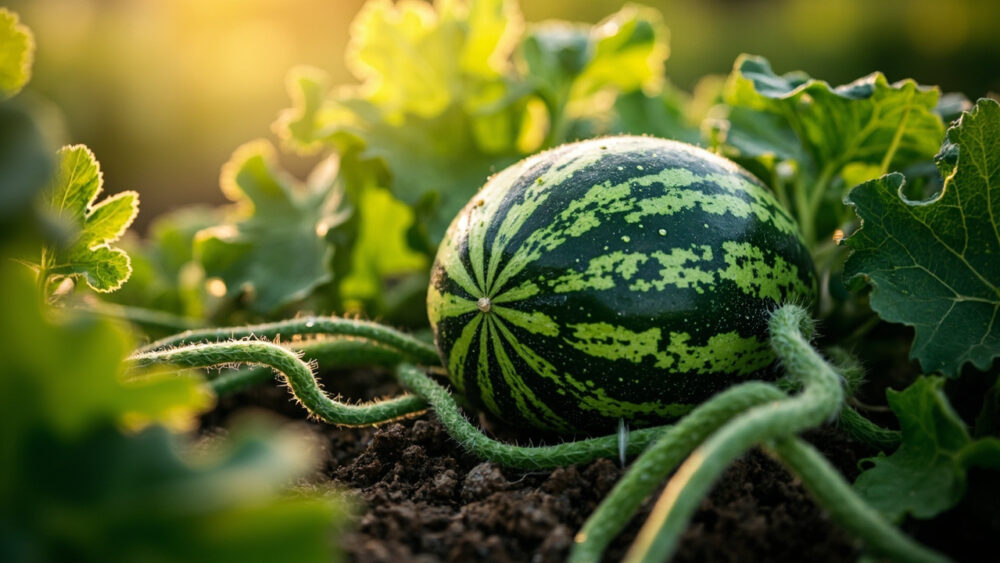
- Ripening: the color dulls slightly, the underside patch turns from white to creamy yellow, and the tendril nearest the fruit’s stem browns and dries.
The day that tendril goes brown and curls, you’re within a few days of harvest, not weeks.
How to Legitimately Speed It Up
Black plastic mulch warms the root zone several degrees and can pull the whole timeline forward by a week or more, especially in cooler climates. Starting seed indoors 2 to 3 weeks before your last frost and transplanting into warm soil does the same thing by skipping the slow outdoor germination window entirely.
Consistent water matters more than extra water. Watermelon roots run deep and wide. A deep soak once or twice a week beats a light daily sprinkle and keeps growth steady instead of stop-and-start.
What does not work: heavy nitrogen fertilizer late in the season. It pushes leafy growth at the expense of fruit and can actually delay ripening while making the vine look deceptively lush.
Handling pollination yourself, by moving pollen from a male to a female flower with a small brush early in the morning, won’t make fruit ripen faster, but it does prevent the wasted week of a flower dropping unpollinated.
Speeding up the front end only helps if you also know when a slow middle is actually trouble.
Slow Growth: Normal Patience vs. an Actual Problem
A vine that seems to sit still for the first 3 to 4 weeks after transplant is normal. Watermelon spends that time building roots before it visibly races.
Lots of male flowers with no females yet, even after a month, is also normal. Female flowers typically lag 1 to 2 weeks behind the first males and won’t show at all until the vine has enough leaf area to support fruit.
Real trouble looks different: pale yellow leaves across the whole plant, stunted growth with no vining at all after 5 to 6 weeks, or wilting vines with healthy soil moisture underneath. That pattern points to poor drainage, root damage, or a soil temperature that never got warm enough, not simple slowness.
If female flowers keep forming but every fruit shrivels and drops at golf-ball size, that’s usually a pollination gap, often from too few bees active during a cool or rainy bloom window, not a timeline problem at all.
Once you can tell patience from a real stall, the only thing left is knowing the numbers cold.
Watermelon: Quick Reference
- Seed to harvest: 80 to 100 days, variety dependent.
- Transplant to harvest: 65 to 90 days, variety dependent.
- Icebox types (Sugar Baby and similar): 65 to 75 days from transplant.
- Large slicing types (Charleston Gray and similar): 85 to 100 days from transplant.
- Seedless varieties: add 7 to 14 days beyond the seeded equivalent.
- Fruit-set to ripe: 30 to 45 days after a female flower is successfully pollinated.
- Minimum soil temp for planting: 65°F, with 70 to 95°F as the ideal growing range.
Write your fruit-set date on the calendar the day you see the first marble-sized melon.
Count 30 to 45 days forward and start checking that tendril for brown.