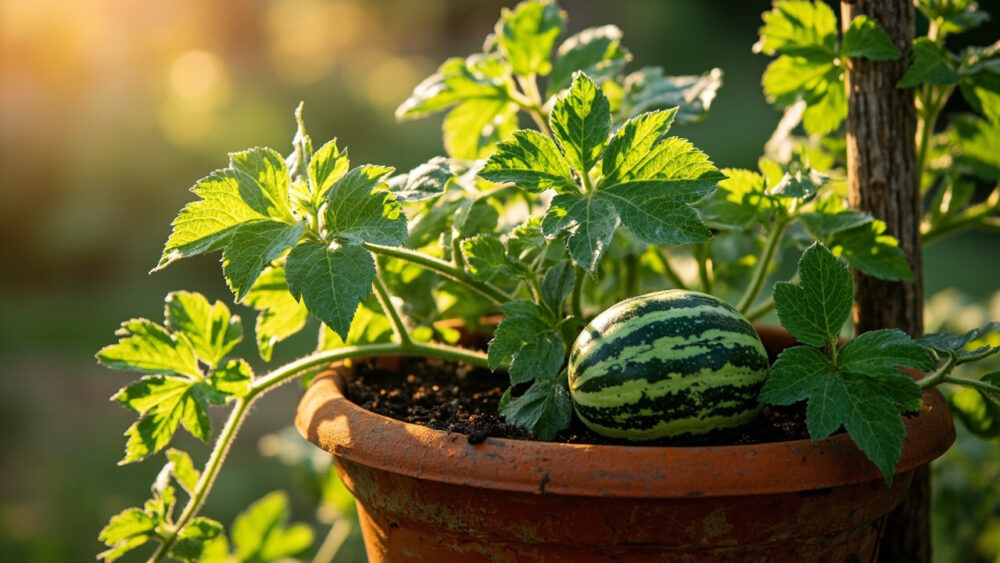
Yes, watermelon grows in containersbut you need a pot with genuine size, real heat, and the right variety, or you’ll get a lot of vine and no fruit. The short version: pick a bush-type or personal-size melon, use a container that holds at least 20 gallons of soil, and plant once your soil has warmed past 70°F. Get those three things right and the rest is mostly patience.
Here’s what trips people up. Most first-time container growers buy whatever watermelon seed is on the rack, the kind bred to sprawl 15 feet across a field, then wonder why their pot produces a jungle of leaves and one sad softball-sized melon in September.
There’s also a pollination problem almost nobody sees coming until their vines are covered in flowers and no fruit ever sets. And the moment of harvest, the actual sign a watermelon is ready, is one of the most misread cues in the whole vegetable garden. Stick around for the Watermelon at a Glance card at the bottom. It’s the version of this guide you’ll actually want pulled up on your phone while you’re standing over the pot wondering if today’s the day.
When to Plant Watermelon in Containers
Watermelon does not forgive cold soil. Wait until nighttime temperatures stay reliably above 55°F and soil temperature has hit at least 70°F, which is usually two to three weeks after your last frost date, not right on it.
In cooler zones (6 and below), start seed indoors three to four weeks before that window in biodegradable pots, since watermelon roots hate transplant disturbance. In zones 7 and warmer, direct-seed straight into the container once the soil’s warmed.
A pot’s soil warms faster than garden ground, which is actually an advantage here, but only if the pot sits somewhere it gets real sun to warm it in the first place.
That sun requirement is where most container setups quietly fail before a seed even goes in.
Choosing the Pot and Prepping the Soil
Watermelon roots run deep and wide even on “bush” varieties. You want a container at least 18 to 24 inches across and equally deep, holding roughly 20 to 25 gallons of soil. Anything smaller and the plant will stall out mid-season no matter how well you feed it.
Drainage matters more than fertility here. Use a loose, well-draining potting mix, not garden soil, which compacts in containers and suffocates roots. Mix in a couple handfuls of compost for a nutrient base.
Set the pot where it gets six to eight hours of direct sun. Watermelon is a heat-lover; a shaded patio corner will grow you leaves and disappointment.
Pick the variety before you pick the pot, actually, because that decision changes everything downstream.
Pick a Container-Friendly Variety
- Bush Sugar Baby: compact vines, 8 to 10 pound melons, matures in 75 to 80 days.
- Golden Midget: very short vines, small yellow-skinned melons, matures in about 70 days.
- Cal Sweet Bush: vines stay under 4 feet, larger 10 to 15 pound fruit.
Standard vining varieties like Crimson Sweet can technically be grown in a large pot with a trellis, but they demand far more space and support than most patios can offer.
Once you’ve matched the right melon to the right pot, the actual planting is the easy part.
Planting Step by Step
- Depth: sow seeds about 1 inch deep, or set transplants at the same soil level they were growing at previously.
- Spacing: plant two to three seeds per 20-gallon container and thin to the single strongest seedling once true leaves appear.
- Technique: water gently right after planting, keep soil consistently moist (not soggy) until germination, which takes 7 to 10 days in warm soil.
- Support: if you’re growing a vining type, install a trellis or cage at planting time, not later, so you don’t disturb established roots.
Germination is the easy win. Keeping that seedling alive through the first heat wave is where the season actually gets decided.
Watering and Feeding Through the Season
Container watermelon dries out fast, faster than gardeners expect, because that 20-gallon pot heats up in full sun just like the plant wants it to. Check soil moisture daily once temperatures climb; stick a finger 2 inches down and water whenever it comes out dry.
Feed every two weeks with a balanced fertilizer until flowering starts, then switch to something higher in phosphorus and potassium to push fruit instead of more leaf.
Here’s the guess that trips people up: if growth stalls, most gardeners assume the plant needs more nitrogen. It usually needs more consistent water instead, since erratic watering is what stunts container melons far more often than a lean feeding schedule.
Get the watering rhythm steady and you’ll see flowers within a few weeks, which brings up the part nobody warns you about.
The Pollination Problem Nobody Mentions
Watermelon plants produce separate male and female flowers, and only female flowers (look for a small round swelling at the base, like a tiny marble) turn into fruit. Bees have to move pollen from male to female flowers for that swelling to become a melon.
Container gardens on balconies or enclosed patios often get too few pollinators visiting. If you’re seeing flowers drop without any fruit forming, this is almost always why.
The fix is hand pollination: pick a freshly opened male flower in the morning, strip the petals, and dab the pollen-covered center directly onto the center of an open female flower.
Do this every couple of days once flowering starts, and you’ll see far more melons set than you would leaving it entirely to chance.
Problems That Actually Show Up in Pots
Powdery mildew is the big one, a white dusty coating on leaves that shows up in humid, still air. Space plants for airflow and water at the soil line, never overhead, to keep leaves dry.
Blossom end rota dark sunken patch on the bottom of developing fruit, comes from inconsistent watering disrupting calcium uptake, not a lack of calcium in the soil itself. Even watering fixes it faster than any additive will.
Aphids and squash bugs will find container plants too. Check the undersides of leaves weekly and treat with insecticidal soap at the first sign, following the product label exactly.
Handle these three and your plant will sail through to the part everyone’s actually waiting for.
When and How to Harvest
Most container varieties mature 70 to 85 days from planting, but the calendar is only a rough guide. The real signal is the tendril closest to the fruit’s stem: when it turns brown and dries out, the melon is ripe or very close to it.
If you assumed a hollow “thump” sound means it’s ready, that guess leaves a lot of gardeners cutting into pale, underripe fruit. The thump test is real but unreliable on its own. A ripe watermelon sounds deep and dull, an unripe one sounds sharp and hollow, and it takes experience to tell them apart confidently.
Better cues: the ground-contact spot underneath turns from white to a creamy yellow, and the skin surface dulls from glossy to matte.
When tendril, color, and sound all agree, you’re not guessing anymore, you’re just harvesting.
Watermelon at a Glance
- When to plant: two to three weeks after last frost, once soil hits at least 70°F.
- Pot size: at least 20 gallons, 18 to 24 inches wide and deep, with drainage holes.
- Best varieties: Bush Sugar Baby, Golden Midget, or Cal Sweet Bush for compact growth.
- Spacing and depth: one plant per 20-gallon pot, seeds sown 1 inch deep.
- Sun and water: six to eight hours of direct sun daily, soil checked and watered whenever the top 2 inches feel dry.
- Pollination: hand-pollinate female flowers if fruit isn’t setting after a couple weeks of blooming.
- Harvest signal: the tendril nearest the fruit turns brown and dry, ground spot turns creamy yellow.
Get the pot size and variety right at the start, and everything else is just steady watering and patience.
Watch that tendril, not the calendar, and you’ll know exactly when to cut.