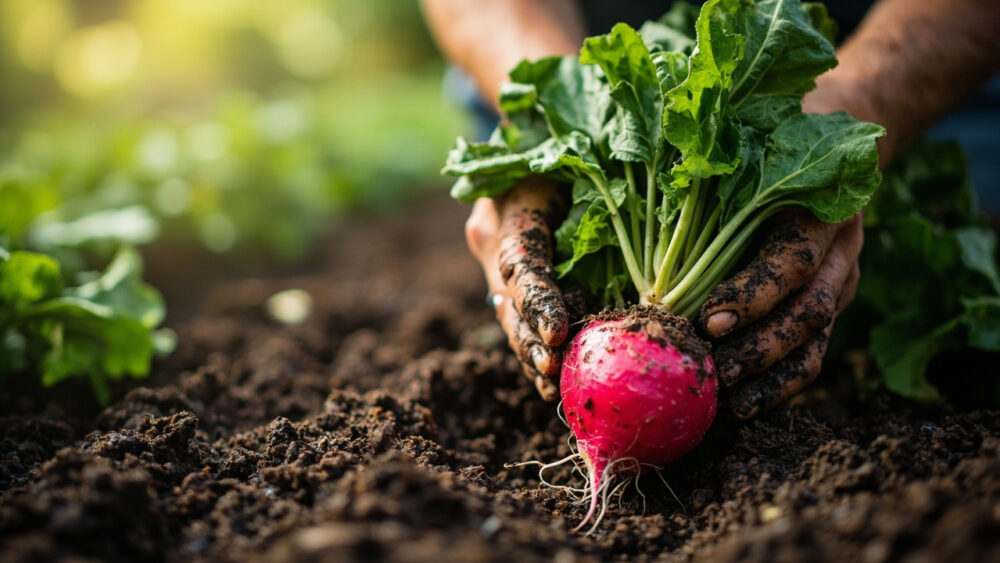
Most radishes are ready to pull 20 to 35 days after the seedlings emerge, once the shoulders poking up through the soil measure about half an inch to an inch across. That is the real answer to when to harvest radishes, and it has almost nothing to do with the calendar and everything to do with what you can see and feel at the top of the root. Spring varieties move fast, winter storage types take much longer, and the gap between “perfect” and “ruined” is shorter than most new gardeners expect.
Here is the part almost nobody tells you straight: the biggest reason radish harvests fail is not disease or pests, it is patience. Leaving them “just one more week to size up” is how you end up with a woody, cracked, hollow-centered root that tastes like a hot pepper crossed with cardboard.
Below I will walk through the exact signs to check, what happens if you pull too early or too late, how to get the root out of the ground without snapping it off, and what to do in the first five minutes after harvest so it stays crisp. Save-able specifics, including the timing window by radish type, are in the Radishes at a Glance card at the very bottom.
The Real Ready Signs, Not Just “It’s Been a Month”
Days-to-maturity numbers on the seed packet are a starting point, not a deadline. Soil temperature, sunlight, and spacing all speed radishes up or slow them down by a week or more in either direction.
The shoulder test beats the calendar every time. That is the visible top of the root breaking the soil surface.
The Shoulder Test
Brush back a little soil from the base of a leafy top and look at the root shoulder. Round spring types like Cherry Belle or French Breakfast are ready around 0.75 to 1.25 inches across. Daikon and other long winter radishes take much longer and are judged more by length than width, often 8 to 14 inches depending on variety.
If the shoulder is still pencil-thin, leave it alone.
The Leaf and Feel Clues
Healthy, upright, deep green tops usually mean the root below is still bulking up nicely. Tops that flop over or yellow at the edges, especially paired with a root shoulder that already feels firm and full through your fingers, mean it is time to check one and pull the rest soon after.
A root that feels rock hard rather than crisp-firm has likely already gone too long.
Once you know what to look for, the next question is exactly how much time you actually have before things go wrong.
The Timing Window, and What Early or Late Really Costs You
Spring radishes have a narrow window, often just 5 to 10 days between “perfect” and “past it,” once they hit mature size. That is the honest, slightly annoying truth about this crop.
Pull too early and you get flavor, but the roots are small, sometimes barely bigger than a marble, with skimpy flesh under a thin skin. Not a disaster, just a smaller harvest than you could have had with a few more days.
Pull too late and the damage is worse and cannot be undone. Overgrown radishes go pithy and hollow in the center, develop cracks along the shoulder, and turn sharp and bitter instead of peppery-crisp. Hot weather accelerates this badly, radishes that would hold a week longer in cool spring soil can blow past their prime in three or four days once summer heat arrives.
If you assumed a bigger radish is always a better radish, that guess is exactly what turns a crisp spring crop into compost. Size past the variety’s normal range is a warning sign, not a bonus.
Winter radishes like daikon are more forgiving, they can sit in cool soil for weeks past maturity without much quality loss, which is part of why they store so well.
Knowing the window is half the job, actually getting the root out cleanly is the other half.
How to Harvest Radishes Without Snapping Them Off
Grabbing the leafy top and yanking straight up is the move almost everyone tries first, and it is the move that leaves the root tip broken off in the soil more often than not, especially in clay or compacted ground.
Do this instead:
- Water first if the soil is dry and hard. A light watering an hour or two before harvest, or harvesting the morning after rain, loosens the ground enough that roots slide out clean.
- Loosen the soil around the root with a hand trowel or garden fork, sliding it in a couple inches away from the shoulder so you do not stab the root itself.
- Grip low on the leaves, close to where they meet the root, not the leaf tips, and pull straight up with steady pressure.
- Check as you go, pulling one or two test roots from each row section before committing to harvesting the whole bed.
Long daikon-type radishes need extra care, their roots can run 10 inches deep or more, and forcing a shallow pull will snap them mid-root every time.
Getting it out of the ground intact is only half the win, what you do in the next few minutes decides whether it stays crisp.
The First Five Minutes After Pulling
Radishes lose their crunch fast once separated from soil, and the leafy tops are the real culprit. Left attached, the greens keep pulling moisture out of the root even after harvest, going limp and starchy within a day or two.
Cut the tops off within minutes of pulling, leaving about half an inch of stem. If the greens are healthy, do not toss them, radish greens are edible and good sauteed like a mild mustard green.
Rinse the roots to knock off clinging soil, which also helps you spot any that are cracked or starting to soften.
Radishes handled this way stay crisp in the fridge for one to two weeks, but there is also a way to keep new ones coming instead of relying on one big harvest.
Succession Planting: The Honest Fix for “I Have Too Many at Once”
The follow-up problem almost everyone runs into is a glut, twenty radishes ready on the same day because they were all sown together. The fix is not a storage trick, it is changing how you plant.
Sow a short row every 7 to 10 days through cool weather instead of planting the whole packet at once. Spring radishes germinate in soil as cool as 45 to 50°F and grow best between roughly 50 and 65°F, so this staggered approach works well from early spring right up until heat sets in, and again once it cools in fall.
Hot weather above the mid 70s pushes radishes to bolt to flower and turns the roots hot and woody fast, so most gardeners get a strong spring run, skip the hottest stretch of summer, and plant again as days cool off.
Get the succession timing right and you will have a small, steady, crisp harvest all season instead of one overwhelming rush that half goes to waste.
Radishes at a Glance
- When to plant: direct sow as soon as soil can be worked in spring, once it hits about 45 to 50°F, and again in late summer for a fall crop.
- Days to harvest: spring types are ready in 20 to 35 days, winter and daikon types take 45 to 70 days or more.
- Spacing and depth: sow seeds a quarter to half inch deep, thin seedlings to 1 to 2 inches apart for round types and 4 to 6 inches for daikon.
- The ready sign: the root shoulder at the soil surface reaches about 0.75 to 1.25 inches across for round varieties, or the full expected length for long types.
- The harvest window: pull within 5 to 10 days of reaching full size, especially in warm weather, or expect pithy, cracked, hot-tasting roots.
- How to pull: loosen soil first, grip low on the leaves near the root, and pull straight up rather than yanking by the leaf tips.
- After harvest: cut tops off within minutes, rinse, and refrigerate for one to two weeks of good crisp texture.
Check the shoulder, not the calendar, and pull the moment it hits the size you want.
Everything else about growing good radishes is just patience management between now and then.