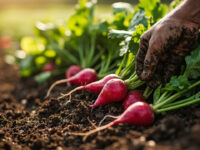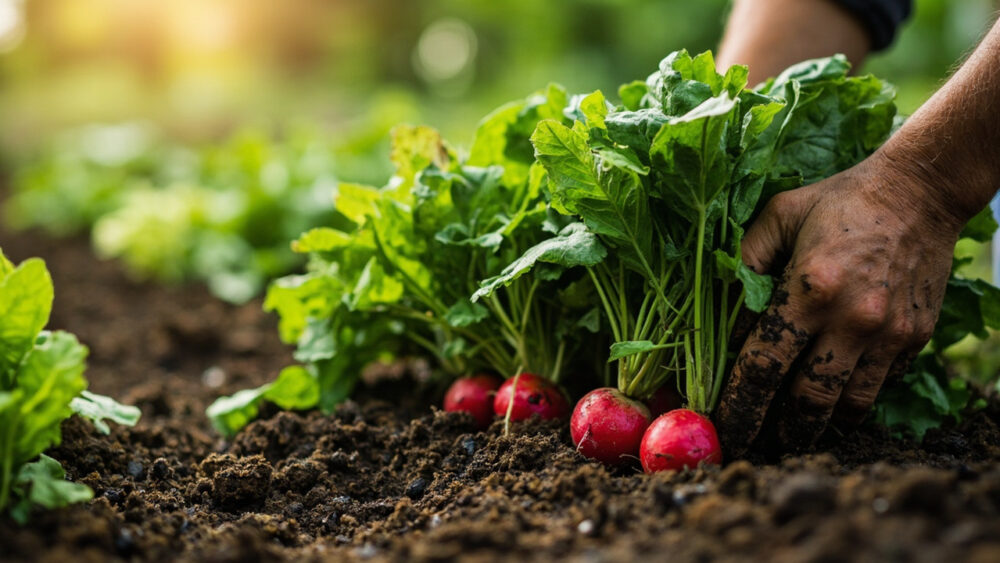
The best companion plants for radishes are ones that either pull pests away from your seedlings or make better use of space you’d otherwise waste, and the short list includes lettuce, spinach, carrots, cucumbers, beans, and peas, plus a few flowers like nasturtium that lure flea beetles somewhere else. Radishes grow so fast, usually 21 to 30 days from seed to harvest, that they’re less about who they team up with and more about who they can dodge trouble for while everybody else is still growing.
Most people get the mistake part backwards. They assume radishes need protecting, when really radishes are the ones doing the protecting, and planting them next to the wrong crop wastes that free labor entirely.
There’s also a sign almost everyone misreads once radishes are in the ground, a spacing myth that quietly ruins root size, and one popular pairing that sounds smart but actively works against you. All of it is below, and the quick-reference card at the very bottom is the one to screenshot before you go out to the bed this weekend.
Why Radishes Make Good Neighbors
Radishes germinate in 4 to 7 days and size up in about three to four weeks, which means they finish before slower crops even hit their stride. That speed is the whole trick.
Interplanted correctly, radishes act as a trap crop, sacrificing themselves to flea beetles and root maggots so nearby plants stay cleaner. They also mark rows of slow germinators like carrots and parsnips, so you know where to weed before those seeds even show themselves.
Here’s the part that trips people up: it’s not really about who radishes “like,” it’s about timing overlap and root depth.
Lettuce and Spinach
Both are shallow-rooted and shade-tolerant, so they don’t compete with radishes below ground. Radishes get pulled before lettuce needs the extra elbow room, freeing the space right when lettuce is starting to bulk up.
Next up is a taproot pairing that looks obvious but is actually the smartest one on this list.
Carrots and Parsnips
This is the pairing worth remembering. Carrot seed can take 14 to 21 days to germinate, and in that stretch it’s easy to lose the row to weeds or just forget where you planted. Mix in radish seed along the same row and the radishes pop first, marking the line and loosening soil with their quick root action. Pull radishes at three to four weeks, right as carrots are finally getting going, and you’ve used the same row twice with zero competition.
Beans and cucumbers work on a different principle entirely.
Beans, Peas, and Cucumbers
Legumes fix nitrogen in the soil, which radishes appreciate since they don’t want heavy nitrogen themselves, only steady phosphorus and potassium. Cucumbers and squash vines sprawl slowly at first, leaving open ground that radishes fill and vacate before the vines need it.
Cucumber beetles are also somewhat repelled by radish scent, though don’t expect it to replace real pest monitoring.
Flowers deserve their own mention, because one in particular is doing more work than people give it credit for.
Nasturtium and Marigold
Nasturtium is a legitimate flea beetle magnet, drawing them off your radish leaves and onto its own, which it tolerates better. Marigold’s pest-repelling reputation is overstated for most insects, but it does genuinely deter some nematodes in the soil over a full season, and it costs you nothing to tuck a few in at row ends.
Now for the plants that undo all of this good work.
What to Never Plant Next to Radishes
Hyssop is the one real exception on the herb side, and it’s often listed as a radish companion by mistake. It actually stunts radish growth and can make roots taste bitter and woody. Skip it near this crop specifically, even though it’s fine elsewhere in the garden.
The bigger, more common error is planting radishes next to other brassicas: broccoli, cabbage, cauliflower, kale, and turnips.
They all attract the same pests, cabbage worms, flea beetles, and root maggots, so instead of splitting the damage you concentrate it. A radish patch surrounded by cabbage family plants becomes one big buffet instead of a decoy.
The other quiet problem is hoary cress and other mustard-family weeds nearby, since they host the same root maggot cycle and reinfect your soil year after year if left alone.
Spacing mistakes cause just as much damage as bad neighbors, and that’s the next thing to fix.
Laying Out the Bed So It Actually Works
If you assumed tighter spacing means more radishes, that guess is exactly what produces skinny, misshapen roots. Radish seed should go about a half inch deep, with seedlings thinned to 1 to 2 inches apart once true leaves appear. Crowded radishes bolt to leafy tops with tiny, woody, or hollow roots underneath, and thinning after the fact doesn’t fully fix it.
Rows spaced 6 to 12 inches apart give you room to interplant carrots, lettuce, or beans right alongside without anyone shading anyone else out too early.
Soil temperature matters more than the calendar. Radishes germinate reliably once soil hits about 45 to 50°F, and they’re one of the few crops you can direct-seed two to three weeks before your last spring frost. A second planting in late summer, six to eight weeks before first fall frost, usually produces the sweetest roots of the year since cool nights slow bolting and concentrate flavor.
One more warning sign worth knowing before we get to the myths.
The Sign Everyone Misreads
Big, lush radish tops with no root swelling underneath gets blamed on “not enough water” almost every time. Usually it’s the opposite problem: too much nitrogen, often from planting too close to heavily fertilized crops like corn or fertilizing the whole bed for a hungrier neighbor.
Radishes want loose, well-drained soil with moderate fertility, not a rich feed. If your tops look great and the roots stay marble-sized after four weeks, back off nitrogen next round rather than watering more.
That leads straight into the pairing advice that sounds right but isn’t.
Companion Myths That Don’t Hold Up
Radishes next to squash are often recommended as a squash bug deterrent, and it’s mostly folklore. Squash bugs aren’t reliably repelled by radish scent, and the sprawling squash vines will shade out and crowd young radish tops long before either plant benefits.
- “Plant radishes everywhere as a universal pest deterrent”: they help specific brassica and cucurbit pests, not aphids, hornworms, or most beetles broadly.
- “Radishes and potatoes are a classic pairing”: potatoes are heavy feeders that shade out radish seedlings fast, and both can attract overlapping soil pests.
- “More companions always means better yield”: overcrowding a small bed with five companion species usually just means everyone competes for water.
Keep the pairings simple and purposeful, and the payoff card below is what to actually rely on.
Radishes at a Glance
- When to plant: direct-seed two to three weeks before last spring frost, once soil hits 45 to 50°F, with a second round six to eight weeks before first fall frost.
- Spacing and depth: seeds a half inch deep, thinned to 1 to 2 inches apart, rows 6 to 12 inches apart.
- Best companions: carrots, parsnips, lettuce, spinach, beans, peas, cucumbers, nasturtium.
- Never plant near: broccoli, cabbage, cauliflower, kale, turnips, and hyssop.
- Days to harvest: 21 to 30 days for most standard varieties.
- Feeding rule: skip heavy nitrogen, moderate fertility only, or you get big leafy tops with no root.
- Best trick: mix radish seed into slow-germinating carrot or parsnip rows to mark the line and loosen soil for free.
Pull radishes on time and pair them with something slower than they are, and they’ll earn their space twice over.
Get the neighbors wrong, and even perfect soil won’t save the roots.