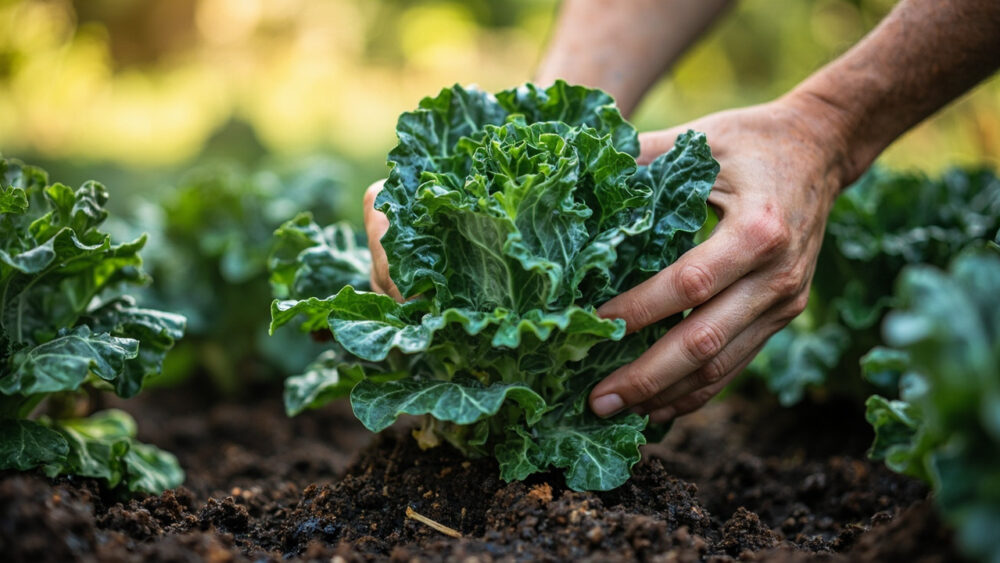
Kale wants 12 to 18 inches between plants and 18 to 24 inches between rows, planted a quarter to half inch deep for seed or set at the same depth it was growing in a nursery cell for transplants. Tighter spacing, down around 8 to 10 inches, works fine if you’re growing baby kale for cut-and-come-again harvests. But if you’re after full-size plants that keep producing all season, crowding them is the single most common reason kale disappoints people who know how far apart to plant kale on paper but eyeball it too optimistically at planting time.
Here’s what nobody tells you up front: the spacing mistake doesn’t show up for weeks. Your kale looks great at first, then stalls out right when it should be taking off.
There’s also a sign most people misread as disease when it’s actually just overcrowding, and an honest answer about whether you can fix it after the fact without starting over. Both are ahead, and the exact numbers, feel cues, and a save-able Kale at a Glance card are waiting at the bottom of this page.
The Exact Numbers and Why Kale Needs the Room
Kale isn’t a small plant once it matures. A single healthy plant spreads its outer leaves 18 to 24 inches wide and sends roots down 12 inches or more looking for water.
Give full-size kale 12 to 18 inches in every direction, closer if your soil is rich and you’ll harvest leaves regularly, wider if your soil is average and plants will grow untouched for a while. Rows want 18 to 24 inches between them so you can walk through to harvest without breaking leaves off.
Seeds go a quarter to half inch deep, no deeper. Kale seed is small and doesn’t have the stored energy to push up through much soil.
That depth number matters more than people expect.
Depth: The Part That Actually Trips People Up
If you assumed deeper planting means sturdier roots, that guess is backwards for kale. Plant seed too deep and it either never emerges or comes up so weak it never catches up to its neighbors.
A quarter inch is the sweet spot for most soils, half inch if your soil is light and sandy and dries out fast on the surface. Transplants are simpler: set them at the same depth they sat in their pot, maybe a half inch deeper to bury a slightly leggy stem, never more.
Burying a transplant’s lower leaves invites rot where they touch damp soil.
Depth handled, the next decision is how you lay out the whole bed.
Row Layout vs. Block Layout
Traditional rows work if you’re growing kale alongside other row crops or need clear walking paths. Space rows 18 to 24 inches apart, plants 12 to 18 inches apart within the row.
Block or grid planting fits more into a small bed. In a raised bed, stagger plants in a diamond pattern at 15 to 18 inches on center, which packs slightly more kale into the same square footage than straight rows while keeping every plant equally spaced from its neighbors.
- Small raised bed (4×4 feet): 6 to 9 plants staggered at 15 to 18 inches apart
- Traditional row garden: plants at 12 to 18 inches, rows at 18 to 24 inches
- Baby kale block for cutting: seeds or sets 6 to 10 inches apart, harvested young and often
The layout you pick changes your total yield, but crowding wrecks it no matter which one you choose.
What Overcrowded Kale Actually Looks Like
This is the sign everyone misreads. Pale, yellowing lower leaves on crowded kale look exactly like a nitrogen deficiency, so people run out and feed plants that don’t need feeding.
The real tell is airflow, not color. Pull two crowded plants apart and look at the stems: if leaves from neighboring plants are physically touching and shading each other’s lower growth, that yellowing is light starvation and poor air circulation, not hunger.
Crowded kale also bolts to flower earlier under stress, grows spindly and tall instead of filling out, and becomes a magnet for aphids that love the still, humid air trapped between packed leaves. Powdery mildew and other fungal issues show up faster too, since wet leaves stay wet longer with no airflow to dry them.
Plant too far apart, on the other hand, and you don’t get problems, you just get waste: bare soil growing weeds instead of kale, and fewer total pounds harvested per square foot than tighter spacing would have given you.
So which mistake are you actually looking at in your own bed right now.
Container Kale: Different Rules, Same Principle
One kale plant per 12-inch diameter pot is the honest minimum, with a container at least 8 to 10 inches deep since kale’s roots go down before they go wide. Go up to a 16 to 18-inch pot and you can fit two plants, but not three.
Bigger is genuinely better here. Container kale planted too tight dries out fast, competes hard for a limited root zone, and stalls out at a fraction of its potential size compared to the same variety in the ground.
If you’re growing baby greens in a shallow container instead, you can scatter seed much closer, an inch or two apart, since you’ll cut them small before crowding becomes a real problem.
Containers forgive a lot of mistakes, but not this one.
Can You Fix Kale You Already Planted Too Close
Yes, and this is the fix most people don’t realize is still available even a few weeks in. Thin the planting by harvesting, not by pulling.
Cut whole plants at soil level, choosing the smallest or weakest ones first, until survivors have that 12 to 18 inch breathing room. You lose nothing, since every plant you remove is a plant you eat.
If plants are still small, under 4 inches tall, you can also transplant the extras rather than cutting them. Water thoroughly first, lift with as much root ball as you can, and move them to open ground the same day.
Kale transplants surprisingly well even past the seedling stage, as long as you don’t let the roots dry out in transit.
Either way, do it now rather than waiting, because every week you wait is a week of stunted growth you can’t get back.
Kale at a Glance
- Spacing for full-size plants: 12 to 18 inches apart, rows 18 to 24 inches apart
- Spacing for baby greens: 6 to 10 inches apart, harvested young and repeatedly
- Planting depth for seed: a quarter to half inch, never deeper
- Transplant depth: same level as the nursery pot, up to a half inch deeper at most
- Container minimum: one plant per 12-inch pot, 8 to 10 inches deep
- Sign of overcrowding: yellowing lower leaves plus visibly touching neighbors, not a feeding problem
- Fix for crowded plants: thin by harvesting the smallest plants first, or transplant seedlings under 4 inches tall
Get the spacing right once and you’re mostly done, kale is forgiving about everything except room to grow.
When in doubt, give it the extra few inches. You’ll harvest more, not less.