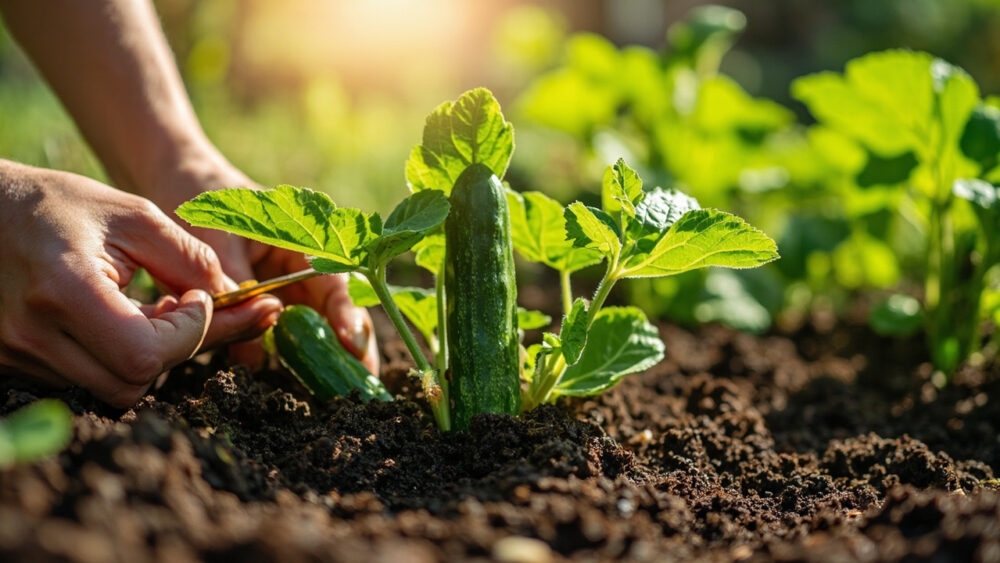
Plant cucumbers 12 to 18 inches apart within the row if you are trellising them, or 36 to 48 inches apart if you are letting them sprawl on the ground. Rows should sit 4 to 6 feet apart for sprawling vines, or 2 to 3 feet apart for trellised ones. Seeds go in about 1 inch deep in warm soil, or transplants go in at the same depth they were growing in the pot.
That’s the number. But knowing how far apart to plant cucumbers is only half the battle, because the spacing you choose today determines a problem you won’t see for another six weeks.
There’s a mistake almost everyone makes their first season, and it’s not planting too far apart. It’s the exact opposite, and by the time it’s obvious, it’s already cost you half your harvest. There’s also a sign of overcrowding that most gardeners misread as a disease. And if you’re growing in containers, the real answer isn’t a spacing number at all. Stick around, because the save-able Cucumbers at a Glance card is waiting at the bottom with every number in one place.
The Exact Spacing and Depth, and the Reasoning Behind It
Cucumber roots spread wide and shallow, and the vines need airflow to keep foliage dry. That’s the whole reason behind every number above.
Trellised plants can sit closer, 12 to 18 inches, because you’re training growth up instead of out, and vertical growth naturally improves air circulation even at tighter spacing.
Ground-sprawling plants need 3 to 4 feet because a single vine can run 6 feet or more, and crowded vines shade each other out and compete hard for water.
Seed depth is simple: 1 inch down in soil that’s already warmed to at least 60 to 65 F. Cucumbers planted in cold soil just sit there and often rot before they sprout.
Get the depth and spacing right and you’ve solved tomorrow’s problem before it starts.
Row and Bed Layout: Your Real Options
Straight rows aren’t your only choice, and for small gardens they’re often not the best one.
Hills work well for sprawling varieties: group 3 to 4 seeds in a mound, with hills spaced 4 to 6 feet apart in every direction. Thin to the strongest 2 plants per hill once they have true leaves.
Straight rows suit trellised cucumbers best, since a single fence line or cattle panel row lets you space plants tightly and still reach every fruit.
Raised beds favor vertical growing almost automatically, because floor space is limited and a trellis lets you fit 3 to 4 times more plants in the same footprint.
Your layout choice is really a trellis decision in disguise, and that decision changes everything else.
What Actually Goes Wrong When Plants Are Too Close
If you assumed the risk of crowding is just smaller cucumbers, that guess undersells the real damage. Overcrowded cucumbers don’t just produce less, they get sick more.
Powdery mildew is the classic result, showing up as a white, flour-like dusting on leaves. Most gardeners see it and think it’s a random disease that struck their garden. It isn’t random. It’s the direct, predictable result of leaves staying damp because there’s no airflow between crowded plants.
Crowded roots also compete hard for water and nitrogen, which is why crowded plantings often produce vines that look lush on top but set very few fruit. Pollinators struggle too. Bees have a harder time working dense, tangled foliage, and poor pollination shows up later as small, misshapen, or bitter fruit.
Once mildew sets in on a crowded planting, you’re managing a disease instead of growing a vegetable.
What Goes Wrong When Plants Are Too Far Apart
The opposite mistake is rarer, but it happens, usually from gardeners overcorrecting after a bad, crowded year.
Wasted space is the main cost. Cucumbers spaced at 6 feet in a row that only needed 3 just leaves bare soil that weeds happily fill in instead.
Wide spacing also means fewer plants per bed, which matters if you’re trying to get a real harvest from a small footprint. There’s no disease penalty for too much space, only a yield penalty from growing fewer plants than the bed could support.
Too far apart is a productivity problem, not a plant-health emergency, and that’s the easier problem to have.
Container Growing: Forget the Spacing Chart
Here’s the honest answer to the question you’re about to ask if you’re growing in pots: spacing numbers don’t really apply to containers.
One cucumber plant per container is the real rule, and the container needs to hold at least 5 gallons of soil, ideally closer to 10 for a vigorous vine. Two plants crammed into one pot will both underperform, no matter what the spacing chart says about inches.
If you’re running multiple containers, keep at least 12 to 18 inches between pots so leaves aren’t overlapping and trapping moisture. A small trellis or tomato cage in each pot lets even a compact bush variety climb instead of sprawl, which matters more in containers than anywhere else since floor space is exactly what you don’t have.
Get the container size right and the spacing question mostly answers itself.
How to Fix a Planting That’s Already Too Crowded
Thinning is the fix, and it works better than most people expect, even a few weeks in. Pick the strongest, most vigorous seedling or plant in each cluster and remove the rest at soil level with scissors rather than pulling, which avoids disturbing the roots of the plant you’re keeping.
If plants are past the seedling stage and vines are already tangled, you can still improve airflow by pruning back overlapping leaves and training vines onto a trellis or stake, even late. It won’t undo lost yield entirely, but it stops the mildew cycle from getting worse.
Don’t wait for perfect timing to fix overcrowding, because every week you wait is a week of worse airflow.
Cucumbers at a Glance
- When to plant: after all frost danger has passed, once soil has warmed to at least 60 to 65 F, usually 1 to 2 weeks after your last frost date.
- Seed depth: about 1 inch deep, planted directly in the garden since cucumbers dislike root disturbance.
- Spacing, trellised: 12 to 18 inches apart in the row, rows 2 to 3 feet apart.
- Spacing, sprawling: 3 to 4 feet apart in the row, or hills spaced 4 to 6 feet apart with 2 plants per hill.
- Containers: one plant per container of at least 5 gallons, containers spaced 12 to 18 inches apart.
- Signs of overcrowding: white powdery coating on leaves, lush vines with little fruit, small or misshapen cucumbers.
- Fix for crowding: thin to the strongest plant per cluster, or prune and trellis existing vines to restore airflow.
Get the spacing right at planting and you’re not fighting mildew all summer. Everything else about growing good cucumbers gets easier from there.