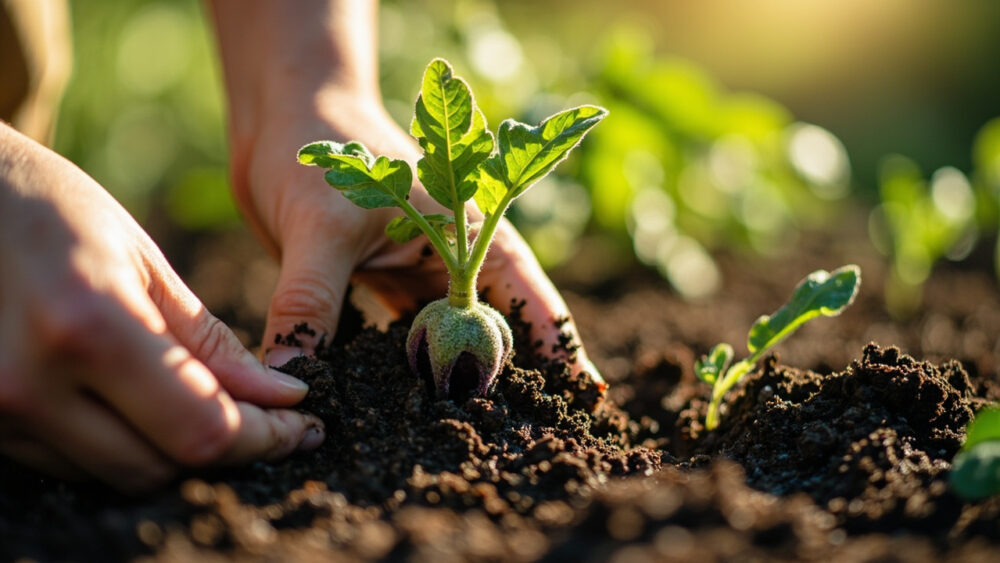
The right time to plant eggplant is two to three weeks after your last frost date, once nighttime temperatures are staying above 55°F and soil has warmed to at least 65°F. Not “after frost.” Not “when the garden center puts them out.” A solid two to three weeks past your last frost, when the ground has actually had time to bake in the sun.
That gap is where most eggplant seasons quietly fail before they even start. The plant goes in the ground looking fine, then just sits there, sulking, stunted, not dead but not growing either, for a month or more.
Here’s what nobody warns you about: cold soil damages eggplant in ways that don’t show up right away, and by the time you see the problem, you’ve already lost weeks you can’t get back. I’ll walk you through how to read your own yard instead of a calendar, the early-planting mistake that costs a whole season, and what actually happens if you wait too long instead. The full at-a-glance card, the one you’ll want to screenshot before you head out to the garden, is at the bottom.
The Real Planting Window, Anchored to Soil, Not the Calendar
Eggplant is a heat lover, more sensitive to cold than its cousins tomatoes and peppers. Air temperature isn’t the test that matters most, soil temperature is. You want soil at a sustained 65°F to 70°F at a 4-inch depth, not just a warm afternoon reading.
In practical terms, that means waiting until night temperatures hold above 55°F consistently, not just occasionally. A single warm week in a cold spring will fool you. Eggplant does not care that it was 78°F on Tuesday if it drops to 45°F Thursday night.
For most of the country, that lands two to three weeks after your last frost date. In the Deep South and low desert Southwest, that can mean an early spring planting followed by a second fall crop once the brutal midsummer heat breaks. In the Upper Midwest and Northeast, you’re often looking at late May into June before soil truly cooperates.
Knowing your average last frost date is only step one.
How to Find Your Actual Window, Not Just the Average One
Averages lie. Your yard has its own microclimate, and that’s what actually decides your window. A south-facing bed against a wall can run 5 to 10 degrees warmer than an open north-facing plot fifty feet away.
Buy a cheap soil thermometer and check it yourself, mid-morning, at a 4-inch depth, for several days running. One good reading means nothing. Three or four consistent days at 65°F or better means something.
No thermometer? Use your hand. Push it into the soil to the second knuckle. If it feels only mildly cool, comfortable to leave your hand there, you’re close. If it feels genuinely cold within a few seconds, the soil isn’t ready no matter what the calendar says.
Also watch your weeds and volunteer plants. When you see steady, active new growth on weeds and the ground has stopped looking soggy after rain, that’s a decent proxy that the soil has turned the corner into real warmth.
Once your own soil confirms it, the timing question is settled, but the temptation to jump the gun is where things go wrong next.
The Mistake That Ruins Most Eggplant Attempts
If you assumed the biggest risk is frost killing the plant outright, that’s the obvious guess, and it’s not the real danger. Most gardeners don’t lose eggplant to a hard freeze. They lose it to cold soil that never kills the plant, just cripples it.
Eggplant set into soil below 60°F essentially stalls. Root growth slows dramatically, the plant can’t take up nutrients well, and leaves may yellow or purple slightly from the stress even with no visible frost damage. That plant often never fully catches up, even once summer heat finally arrives. You’ll harvest weeks later than a plant set in properly warmed soil, sometimes with a noticeably smaller total yield.
The fix isn’t complicated, it’s just patience most people don’t have in April when the garden centers are stocked and tempting. Hold your transplants a little longer under grow lights or in a sunny window rather than rushing them outside.
Planting too early costs you the whole front half of the season, so it’s worth asking what the other direction costs.
What Happens If You Plant Too Late
Late planting is far more forgiving than early planting, but it’s not free. Eggplant needs 60 to 85 days to maturity depending on variety, plus real sustained heat to ripen fruit well.
Push planting too far into summer in a short-season climate and you risk fruit that’s still small and immature when fall’s cooling nights arrive and growth slows to a crawl. Eggplant flowers can also drop without setting fruit once nights consistently dip below 60°F in early fall, so a late-planted crop may flower generously and produce disappointingly little.
In hot-summer, long-season regions, though, late is genuinely fine, sometimes even smart. Gardeners in the Deep South or low desert often deliberately plant a second round in midsummer for a strong fall harvest once the worst heat breaks.
So the honest answer is that “late” only becomes a real problem when it collides with your first fall frost, which brings us to prep.
What to Do Before the Window Opens
The four to six weeks before your window matter more than people think. Start seed indoorsok, let me just make sure formatting is right, no stray tags.
What to Do Before the Window Opens
The four to six weeks before your window opens matter more than people think. Start seed indoors 8 to 10 weeks before your target transplant date, since eggplant germinates slowly, often taking 7 to 14 days even in warm conditions.
Warm the soil ahead of time with black plastic mulch or a low tunnel for a week or two before planting. This alone can push your window earlier by several days without any real risk.
Harden off transplants for 5 to 7 days before they go in the ground, gradually increasing outdoor exposure, since eggplant seedlings are noticeably tender and can scorch or stunt if moved outside abruptly.
Work in a couple inches of compost ahead of planting. Eggplant is a heavy feeder and appreciates rich, well-draining soil more than most garden vegetables.
With prep done and soil confirmed warm, actual planting is simple, spacing 18 to 24 inches apart in rows 24 to 36 inches apart, set at the same depth the seedling was growing in its pot.
Zone and Region Notes Worth Knowing
In USDA zones 3 to 6, your window is often tight, roughly late May into mid-June, so starting seed indoors early and warming soil with plastic mulch genuinely matters.
Zones 7 to 9 get a longer, more forgiving window, often April into June, with a possible second planting in July for zones on the warmer end.
Zones 10 and 11, along with the low desert Southwest, often skip the brutal middle of summer entirely, planting in early spring and again in late summer for a fall crop, since peak summer heat there can actually be too intense and stressful for fruit set.
Wherever you garden, the calendar date is a starting guess, your soil thermometer is the tiebreaker.
Eggplant at a Glance
- When to plant: two to three weeks after your last frost date, once soil is consistently 65°F to 70°F at 4 inches deep.
- Night temperature check: wait until nights hold above 55°F, not just an occasional warm evening.
- Spacing and depth: 18 to 24 inches apart in rows spaced 24 to 36 inches, planted at the same depth as the nursery pot.
- Start seed indoors: 8 to 10 weeks before your transplant date, since germination can take 7 to 14 days.
- Harden off: 5 to 7 days of gradually increasing outdoor exposure before transplanting.
- Days to maturity: 60 to 85 days depending on variety, so count backward from your first fall frost in shorter seasons.
- Warm-region bonus round: zones 9 to 11 can often plant again in midsummer for a fall harvest once peak heat passes.
If you remember one thing, let it be this: a soil thermometer beats a calendar every single time.
Give eggplant real warmth before it goes in the ground, and it will reward you with a much stronger, faster season.