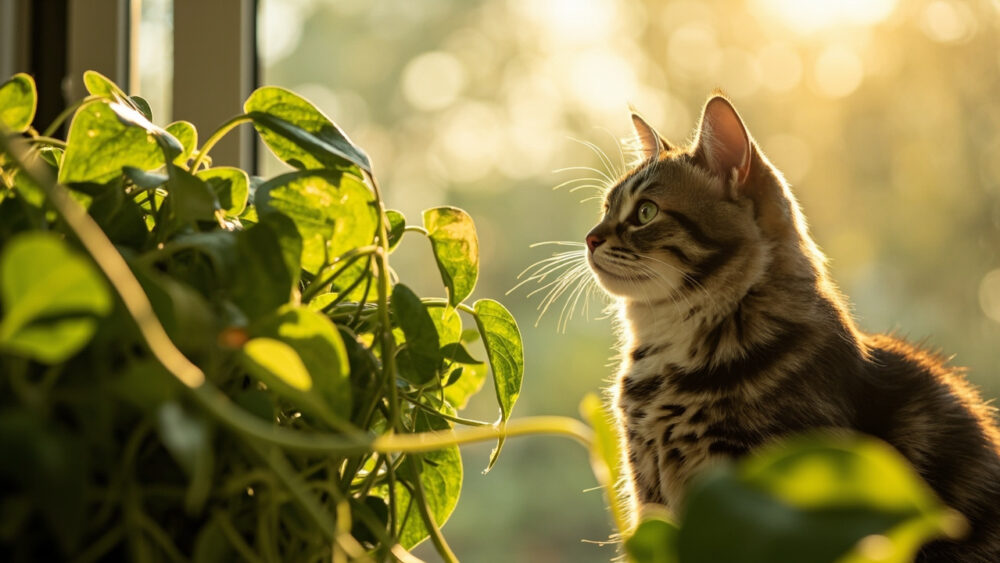
Yes, pothos is toxic to cats. Every part of the plant contains insoluble calcium oxalate crystals, and chewing into a leaf or stem releases them straight into your cat’s mouth and throat. It is rarely fatal, but it causes real pain and distress, and the severity depends entirely on how much your cat actually chewed versus just batted around.
That last part is the piece most owners get wrong. A cat who knocked a hanging pothos off its hook and scattered leaves across the floor is not the same case as a cat who sat there and methodically shredded three of them. I will show you how to tell the difference by looking at the plant and the mess, not just the cat.
Stick around for the signs to watch for, exactly what to do in the next ten minutes if you catch your cat chewing, and a handful of trailing, vining look-alikes that give you the same jungly hanging-basket look with none of the risk. There is also a save-able quick-reference card at the bottom of this page for exactly this reason, so you can pull it up fast next time.
The Plain Answer, No Hedging
Pothos (Epipremnum aureum) is classified as toxic to cats by the ASPCA, and that classification is not close or debatable. The plant is common in almost every plant-lover’s home precisely because it is nearly impossible to kill, which unfortunately also means it is nearly always within reach of a curious cat.
The good news is that pothos toxicity is a mouth-and-throat irritant reaction, not a systemic poison like lily toxicity is for cats. That distinction matters a lot for how worried you should be, and how urgently you need to act.
It does not, however, mean you can wait and see.
Which Parts, and How Much, Actually Matter
Every part of the pothos plant, leaves, stems, and the thick roots on cuttings rooting in water, contains the same calcium oxalate crystals. There is no “safe part” to let your cat nibble.
Exposure level is what changes the outcome. A single curious lick or a small nibble on one leaf tip usually causes mild, short-lived mouth irritation. A cat who bites down and chews releases far more crystals, and the reaction scales up fast from there.
Kittens and small cats are hit harder by the same amount of plant material than a large adult cat, simply because there is less body mass to dilute the irritation.
How much your cat got into is the single biggest factor in how bad this gets.
The Signs You’re Actually Looking For
Calcium oxalate crystals cause immediate, obvious mouth pain, so the signs usually show up within minutes, not hours.
- Drooling, sometimes heavy and sudden
- Pawing at the mouth or face
- Foaming at the mouth
- Difficulty swallowing or refusing food
- Vomiting
- Visible swelling or redness around the lips and tongue
If you assumed a toxic houseplant means lethargy and organ failure days later, that is a different category of plant entirely. Pothos hits fast and hits the mouth, which is honestly what makes it easier to catch early.
Catching it early is exactly what determines your next move.
What To Do If Your Cat Ate Pothos
Call your veterinarian or an animal poison control line right away, even if the symptoms look mild. Do this before you try anything else at home.
While you’re on the phone, have a few things ready: roughly how much of the plant is missing or chewed, when you noticed it, and what symptoms you’re seeing right now. If you can, bring a leaf or a photo of the plant with you to the vet visit so there is no guessing about the species.
Do not try to make your cat vomit, and do not give any home remedy, milk, oil, or over-the-counter medication on your own. Some of those can make oral irritation worse, and none of them are a substitute for a professional assessment of how much your cat actually ingested.
Rinsing your cat’s mouth gently with water, if they will tolerate it, can help while you’re getting them to care, but it is not a treatment on its own.
Your vet will tell you whether this is a phone-guided home recovery or a same-day visit, and that call is not optional.
Safer Plants That Give You the Same Look
You do not have to give up trailing greenery to keep a cat safe. Several vining houseplants have the same easy-care, cascading habit as pothos without the calcium oxalate problem.
- Spider plant (Chlorophytum comosum), non-toxic and just as forgiving
- Friendship plant (Pilea involucrata), non-toxic, more compact and bushy
- Watermelon peperomia (Peperomia argyreia), non-toxic, similar low-maintenance vibe
- Boston fern (Nephrolepis exaltata), non-toxic, wants more humidity than pothos
- Cat grass or wheatgrass, non-toxic and gives your cat something of their own to chew
Swapping is not a downgrade, and honestly some of these are less demanding about light than pothos ever was.
Whichever way you go, here is everything worth saving in one place.
Pothos: Quick Reference
- Toxic to cats: yes, confirmed toxic per the ASPCA, due to insoluble calcium oxalate crystals throughout the plant.
- Toxic parts: all of them, leaves, stems, and roots, with no safe part to allow chewing.
- Type of reaction: oral and gastrointestinal irritation, not systemic organ poisoning like lily toxicity.
- Severity depends on: how much plant material was actually chewed versus just touched or batted, and the size of the cat.
- Watch for: drooling, pawing at the mouth, foaming, swelling of the lips or tongue, vomiting, trouble swallowing.
- What to do: call your veterinarian or animal poison control immediately for any suspected ingestion, no home dosing or remedies.
- Safer swaps: spider plant, friendship plant, watermelon peperomia, Boston fern, cat grass.
Keep pothos up high, out of reach, or out of the house entirely if your cat is a determined climber.
Either way, that vet’s phone number is worth saving right next to this page.