Bush beans go 2 to 4 inches apart within the row, with rows spaced 18 to 24 inches apart. Pole beans need more room, 4 to 6 inches apart at the base of each support, with rows or hill centers 24 to 36 inches apart. Plant seeds 1 inch deep in most soils, or 1.5 inches deep in sandy soil that dries out fast, and that is how far apart to plant green beans in every situation you are likely to face this season.
That answer is the easy part. The part that actually determines whether you get a real harvest or a tangle of vines with nothing on them is what happens six weeks after planting, when the row looks thin and every instinct tells you to add more seed.
Most bean failures trace back to one of two mistakes, and they pull in opposite directions. One is crowding, which costs you yield without ever looking like a problem until the plants stop setting pods. The other is spacing too wide out of fear of crowding, which wastes bed space and invites weeds to fill the gap. Stick with me and I will also give you the fix if you already planted too thick, because that happens to almost everyone at least once. The full spacing card you can save to your phone is at the bottom.
The Exact Numbers, and Why Beans Care About Spacing at All
Bush beans want 2 to 4 inches between plants because their root systems are shallow and compact. Give them that room and each plant gets enough soil volume to pull the water and nitrogen it needs without fighting its neighbor.
Pole beans need more space per plant, 4 to 6 inches, because they are putting energy into climbing instead of bushing out, and a crowded base means poor airflow up a support that is already dense with leaves.
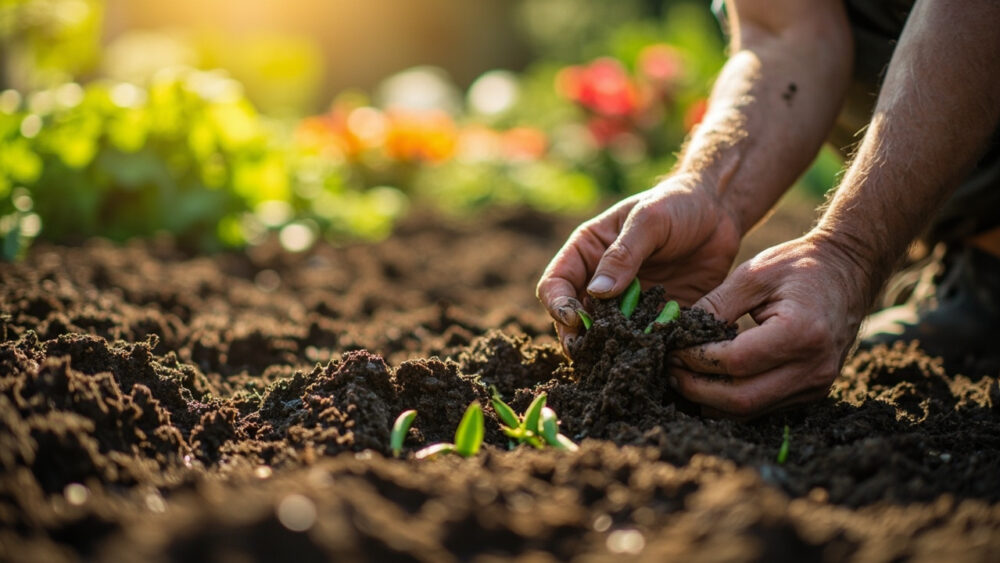
Depth matters just as much as spacing. Plant at 1 inch in average garden soil, going slightly deeper, up to 1.5 inches, in sandy or fast-draining soil so the seed does not dry out before it germinates.
Bean seeds planted too shallow dry out and never sprout, and that failure looks identical to bad seed even though it is not.
Row Layout vs. Hills vs. Blocks
Traditional rows work best for bush beans: space rows 18 to 24 inches apart so you can walk between them to harvest and weed, with seeds every 2 to 4 inches down the row.
Pole beans do well in hills of 4 to 6 seeds spaced 6 inches apart around a single pole or tepee, with hill centers 24 to 36 inches apart so mature vines are not shading each other out.
A wide-row or block planting, three or four staggered rows close together, works fine for bush beans as long as you keep at least 4 inches between plants in every direction. It raises yield per square foot but makes hand-weeding slower.
Whichever layout you pick, the spacing rule inside it does not change, and that consistency is what the next section depends on.
What Actually Goes Wrong When Beans Are Too Close
If you assumed crowded beans just grow a little smaller, that guess is too generous. What actually happens is more specific and more costly.
Airflow drops first. Dense foliage stays wet longer after rain or dew, and that damp, still air is exactly what fungal diseases like white mold and rust need to take hold. Bean plants packed tight are far more likely to show spotted or powdery leaves by midsummer.
Pod set drops next, and this is the part gardeners misread most. Crowded plants often still look green and healthy, so the grower assumes something else is wrong, like poor pollination or bad weather, when the real cause is root competition limiting how much energy the plant has left over to fill pods.
You also lose picking access. Beans hidden in a tangled, overcrowded row get missed, go tough and overripe, and signal the plant to slow down production since it thinks its job of setting mature seed is done.
Crowding is the quieter failure, but planting too far apart has its own cost, which is the one people don’t expect.
What Goes Wrong When Beans Are Too Far Apart
Wide spacing feels safe, but it is not free. Bare soil between plants heats up, dries out faster, and gives weeds an open invitation.
Weeds competing with young bean plants for water and nitrogen can stunt them just as effectively as crowding does, only slower and less visibly.
Wider spacing than the ranges above also just wastes bed space without any real gain in yield per plant, since bush beans do not get meaningfully bigger or more productive past about 4 inches of room.
The sweet spot is narrower than most people expect, which is exactly why overcrowding is the more common mistake.
Container Spacing That Actually Works
In containers, treat spacing the same way you would in the ground, just scaled to the pot. A 12-inch diameter pot fits 3 to 4 bush bean plants comfortably. An 18 to 24-inch container or a half whiskey barrel can hold 6 to 8.
Pole beans in containers need at least a 12-inch pot per plant, with 2 to 3 plants around a single tall support in a larger pot, because the roots need real depth, ideally 12 inches or more, to support that much vine.
Container soil dries out faster than garden soil, so plant depth stays the same at 1 inch, but expect to water more often once the canopy fills in.
Crowding shows up faster in containers than in open ground, which makes the fix below even more useful there.
How to Fix an Overcrowded Bean Planting
If your seedlings came up thicker than planned, and this happens to nearly every gardener at least once, thin them while they are still small, ideally before the second set of true leaves appears.
Snip, do not pull. Use scissors to cut unwanted seedlings at the soil line instead of yanking them, since pulling disturbs the roots of the plants you are keeping.
Thin bush beans down to one plant every 2 to 4 inches, and pole beans down to one every 4 to 6 inches at each support point.
If the row is already mature and pod-heavy with poor airflow, you cannot fix the spacing retroactively, but you can prune lower leaves touching the soil and pick ripe pods promptly, both of which reduce disease pressure and push the plant to keep producing.
- Seedlings under 3 inches tall: thin immediately to the correct spacing above.
- Established plants that are crowded: improve airflow with pruning and consistent harvest instead of transplanting, since bean roots resent disturbance.
- Next planting: sow slightly wider than you think you need, since beans rarely need thinning if you space carefully at seeding.
Get the spacing right at seeding and you will not be doing damage control in July.
Green Beans at a Glance
- When to plant: after soil warms to at least 60 to 65 degrees F, roughly one to two weeks after your last frost date.
- Bush bean spacing: 2 to 4 inches between plants, rows 18 to 24 inches apart.
- Pole bean spacing: 4 to 6 inches between plants at the base of the support, rows or hills 24 to 36 inches apart.
- Planting depth: 1 inch in average soil, 1.5 inches in sandy or fast-draining soil.
- Container spacing: 3 to 4 bush plants per 12-inch pot, 1 pole bean plant per 12-inch pot minimum.
- Thinning window: before the second set of true leaves, cut extras at the soil line rather than pulling.
- Days to harvest: roughly 50 to 60 days for bush beans, 60 to 70 days for pole beans from seed.
Get the spacing right once at planting and you skip almost every problem beans normally cause.
Everything else, disease, poor pods, weedy gaps, traces back to those first few inches you gave each seed.