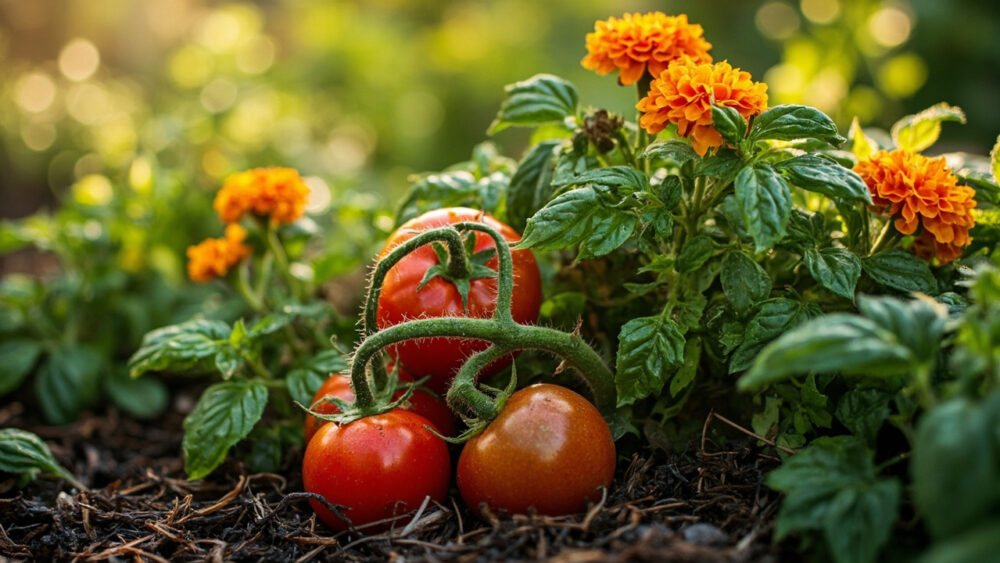
The best companion plants for tomatoes are basil, marigolds, borage, carrots, onions, and asparagus, each earning its spot by repelling a specific pest, luring in beneficial insects, or using soil space your tomatoes are not competing for. Skip anything in the brassica family, and never plant tomatoes near corn, fennel, or potatoes. Get those pairings backwards and you will not see the damage overnight, you will see it in August when everything looks tired and nobody can say why.
One mistake wrecks more companion-planting attempts than bad pairings do: cramming everything in tight because the seedlings look small in May. There is also a sign of pest trouble that most people misread as a nutrient problem, and it costs them two weeks of guessing. And the honest answer to “does companion planting actually work” is more complicated than the tidy lists suggest.
Stick with this to the end and you will find a save-able Tomatoes at a Glance card with the numbers you actually need this weekend.
The Companions Worth Planting
Basil
Basil is the classic pairing for good reason. It confuses thrips and whiteflies with its scent and, once it flowers, pulls in tiny predatory wasps that go after tomato hornworm eggs. Plant it 8 to 12 inches from the tomato stem so it is not shaded out once the vine fills in.
Basil also likes the same water and sun as tomatoes, so you are not fighting a mismatch in the same bed.
Marigolds
Marigolds, specifically French marigolds, release a compound from their roots that suppresses root-knot nematodes in the soil around them. That protection is real but local, it does not spread through the whole bed. Tuck them in a ring around the tomato’s root zone, not just at the bed’s edge as decoration.
They also draw hoverflies and lacewings, both of which eat aphids for a living.
Borage
Borage is underused and it should not be. It attracts bees in serious numbers, which improves pollination on tomato flowers even though tomatoes are mostly self-pollinating already, and it seems to boost vigor in nearby plants when used as a living mulch. Let it flop where it wants, borage does not compete hard for root space.
Carrots and Onions
Carrots grow low and use a different soil layer than tomato roots, so they are not stealing resources, just filling gaps. Onions and garlic in the allium family repel aphids and some root maggots with their sulfur compounds, and they take up almost no lateral space.
Now here is where most guides stop, but the placement details matter more than the plant list itself.
What to Never Plant Nearby
If you guessed potatoes might be a problem because they are both nightshades, you guessed right, but the reason is not the one people assume. It is not really about shared soil nutrients, it is about shared disease. Tomatoes and potatoes both host early blight and late blight, and planting them near each other lets spores jump between them fast, sometimes wiping out both crops in the same wet week.
Corn is a worse offender than most people expect. It attracts the corn earworm, which is the exact same insect as the tomato fruitworm. Plant them side by side and you have built a pest highway.
Fennel releases root compounds that stunt the growth of most nearby vegetables, tomatoes included. It is one of the few plants that is almost never safe to interplant with anything.
Brassicas, meaning cabbage, broccoli, kale, and their relatives, compete hard for the same nutrients tomatoes need heavily, particularly nitrogen and potassium during fruit set. Grow them in a separate bed or at least a full season apart in rotation.
Getting the bad pairings right is only half the job, the layout is where the good pairings either work or quietly fail.
Laying Out the Bed So Companions Actually Help
Space tomatoes 24 to 36 inches apart depending on whether you are staking or letting them sprawl in a cage, with rows 3 to 4 feet apart for airflow. That airflow is not optional, it is your main defense against fungal disease in humid weeks.
Plant companions in the outer 8 to 12 inches of that spacing, not directly under the canopy where they will be shaded out by July.
Set tomatoes into soil that has warmed to at least 60°F, generally two to three weeks after your last frost date, bury the stem up to the first set of true leaves for a stronger root system, and let companions go in around the same time or a week or two later once the tomato is established.
This is also where the misread pest sign shows up, and it is worth knowing before it costs you a plant.
The Sign Everyone Misreads
Yellowing lower leaves on a tomato get blamed on nitrogen deficiency almost automatically. Sometimes that is correct. But if the yellowing comes with fine stippling, tiny webs in the leaf joints, or a dusty look on the underside, you are looking at spider mites, not a feeding problem, and pouring on fertilizer does nothing but feed the mites’ next meal.
Check the underside of a yellowing leaf with a hand lens or your phone camera zoomed in before you reach for fertilizer. Marigolds and basil planted nearby will not eliminate an active mite outbreak, they are prevention, not treatment. For an active infestation, a insecticidal soap or horticultural oil applied per the product label is the standard cultural response.
Prevention only works if it started before the problem did, which brings up the myths worth killing off.
The Pairing Myths That Do Not Hold Up
Companion planting gets oversold constantly, and the honest answer to whether it works is: partially, and less dramatically than the charts imply. It will not replace crop rotation, disease-resistant varieties, or a fungicide when blight is already established.
Nasturtiums as a trap crop is a popular claim, the idea being aphids prefer them and leave your tomatoes alone. In practice they can work as a mild lure but they also attract aphids in numbers that then spread to nearby plants once the nasturtium is overwhelmed. Treat them as a bonus, not a defense plan.
The claim that any herb repels any pest near tomatoes is too broad to be true. Dill, for instance, attracts beneficial predatory wasps when young but can draw tomato hornworms as it matures and flowers, so timing and removal matter more than the herb itself.
Real results come from stacking two or three proven pairings and good spacing, not from planting a dozen “helper” plants and hoping.
Tomatoes at a Glance
- When to plant: two to three weeks after your last frost date, once soil hits at least 60°F.
- Spacing: 24 to 36 inches between plants, 3 to 4 feet between rows for airflow.
- Depth: bury the stem up to the first set of true leaves for stronger roots.
- Best companions: basil, marigolds, borage, carrots, onions and garlic, planted 8 to 12 inches from the stem, outside the canopy line.
- Never plant nearby: potatoes, corn, fennel, and any brassica like cabbage or broccoli.
- Watch for: yellowing lower leaves with stippling or webbing means spider mites, not a nitrogen problem, check leaf undersides before fertilizing.
- Reality check: companions help at the margins, they do not replace crop rotation or treating active disease.
Get the spacing and the bad neighbors right first, the companion plants are the finishing touch, not the foundation.
Everything else is just paying attention to what the leaves are actually telling you, all season long.