The fastest way to sort the types of christmas trees is by needle attachment: firs and spruces have needles that grow singly right off the branch, while pines grow theirs in bundles of two, three, or five. Learn that one trick and you can identify most trees on a lot in about ten seconds, no tag required. It also predicts a lot about how the tree will behave in your living room.
Some of the most popular choices get picked for the wrong reason entirely, usually because they smell like “Christmas” in the store and then drop needles by New Year’s Day. Meanwhile there is a quietly excellent species that experienced growers keep buying year after year, and most casual shoppers walk right past it because it looks a little floppy on the lot.
Number 13 on this list is the one almost everyone misjudges based on looks alone, and it costs people a dry, needle-shedding disappointment by mid-December. The last few entries plus a real method for choosing, based on your space, your climate, and how much mess you’re willing to deal with, are waiting at the bottom of this list.
The Firs: Soft Needles, Strong Branches, Best Needle Retention
Firs are the gold standard for a reason: soft to the touch, strong limbs for heavy ornaments, and needles that stay put for weeks if the tree gets water.
1. Fraser Fir
The needle grip on this tree is exceptionaland it holds on for six weeks or more even in a warm, dry room. Fraser fir has a narrow, pleasingly symmetrical shape and a strong piney scent, which is why it dominates cut-tree lots across the eastern half of the country.
2. Balsam Fir
This is the classic Christmas smell most people are actually picturing when they say they want a “real tree.” Balsam fir has dark green, flattened needles and a dense, slightly informal shape, and it’s the traditional choice throughout the Northeast and upper Midwest.
3. Noble Fir
Stiff, upturned branches make this the tree for heavy ornaments and thick strings of lights. Noble fir has a more open, tiered structure than a Fraser, so it shows off large or oversized decorations instead of hiding them, and it holds needles well past a month indoors.
4. Douglas Fir
Technically not a true fir, but sold as one everywhereDouglas fir has soft, bushy needles that radiate around the branch in every direction, giving it a fuller, rounder look than a Fraser or noble. It has a sweet, almost citrusy scent and is one of the most widely grown Christmas trees in the country because it grows fast and shapes well on the farm.
5. Concolor Fir (White Fir)
Longer, curved blue-green needles set this one apart at a glance, and crushing a needle releases a citrus smell that surprises people expecting straight pine scent. Concolor fir is less common on lots but worth seeking out if you want something that looks and smells different from every other tree on the block.
If firs are the safe, reliable choice, the pines below are where things get more particular about care.
The Pines: Full, Bushy, and a Little More Demanding
Pines carry their needles in bundles rather than singly, which gives them a softer, fuller silhouette but usually a shorter indoor life than a fir.
6. Scotch Pine (Scots Pine)
Stiff branches and needles that resist drying out make Scotch pine one of the most forgiving trees for people who forget to check the water reservoir. The needles come in twos, the color runs bright to dark green, and it holds its shape well even without much shearing.
7. White Pine
Soft, almost feathery needles in bundles of five give white pine a blue-green, wispy look unlike any fir on the lot. It has very little scent, which is actually a selling point for anyone in the house with fragrance sensitivities, but its thin branches mean lighter ornaments only.
8. Virginia Pine
A budget tree with real drawbacks worth knowing upfront: shorter needle retention, a stronger resinous smell, and branches that can feel sparse compared to a Fraser or noble. It’s still sold widely in the South because it grows well in warmer climates where true firs struggle.
Pines ask for a little more attention to water, and the spruces coming up ask for even more.
The Spruces: Classic Shape, Shortest Patience for Neglect
Spruces have single needles like firs, but they’re stiffer, sharper, and far less tolerant of a dry stand, which is the honest tradeoff for their picture-perfect shape.
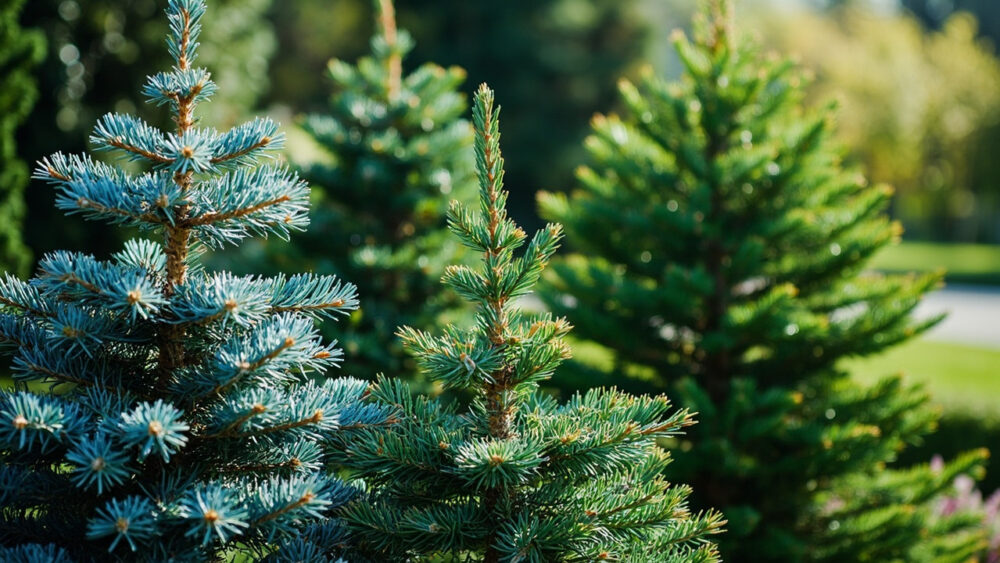
9. Blue Spruce (Colorado Spruce)
That striking silver-blue color is the whole appealand it comes with a classic, dense, pyramidal shape that looks great from every angle. The tradeoff is sharp, stiff needles that make decorating less comfortable and needle drop that starts sooner than on a fir if the water level slips.
10. White Spruce
A tighter, more compact grower with a strong but not unpleasant scent when the needles are crushed, white spruce holds its neat conical shape naturally with less shearing than most spruces need. It still drops needles faster indoors than a Fraser or noble, so it rewards checking the water daily rather than weekly.
11. Norway Spruce
The tree most likely to disappoint if left dry even brieflyNorway spruce has a graceful, drooping branch habit and a rich green color, but it sheds needles fastest of any tree on this list once it dries out. It’s a fine choice for a shorter display window, like putting the tree up closer to Christmas Day and taking it down soon after.
If you want a tree that forgives you for forgetting to water it, the next category is where to look.
Alternative and Live-Potted Options
Not every option is a cut tree from a farm, and this category covers the choices that solve a specific problem: allergies, small spaces, or wanting a tree you can plant outside come spring.
12. Norfolk Island Pine
A houseplant standing in as a tree, and a genuinely different kind of careNorfolk Island pine is not cold-hardy and can’t go outside in winter in most of the country. It’s often sold small and potted for tabletop display, wants bright indirect light and consistent moisture, and can live for years as a houseplant long after the holidays end.
13. Live, Balled-and-Burlapped Spruce or Fir
This is the tree people misjudge the mostbuying it expecting a normal cut-tree experience and getting something with entirely different rules. A live tree with its root ball intact can be planted outside after the holidays, but it can only tolerate the warm, dry indoor air for about a week to ten days before the shock of the temperature swing and lack of dormancy starts to hurt it; keep it in an unheated garage or porch beforehand and after to ease the transition, and know that the root ball is heavy, often 50 to 150 pounds depending on size, so plan for help moving it.
14. Leyland Cypress
The go-to choice across the Southeast where firs struggle with heatLeyland cypress has soft, feathery, scale-like foliage rather than true needles, giving it a texture unlike anything else on this list. It has very little scent, grows well in warm, humid climates, and holds up reasonably well indoors, though it’s less sturdy for heavy ornaments than a fir.
15. Eastern Red Cedar
A strong, distinctly spicy fragrance sets this one apart instantlyand its dense, scale-like foliage and narrow shape make it a traditional choice in parts of the South and Midwest where it grows wild. It’s prickly to handle without gloves, holds needles reasonably well, and gives a room a completely different smell than the sweeter, more familiar fir scent.
With all fifteen on the table, here’s the actual method for narrowing them down in your own living room.
How to Choose the Right One
- Measure your space first: know your ceiling height minus at least 12 inches for the stand and topper, and measure the width of the spot where it will stand, not just the room.
- Check what actually grows well near you: ask the lot or farm which species are locally grown, since a tree cut close to home and sold fresh will outlast a shipped tree of the same species almost every time.
- Decide how long it needs to look good: for a display going up right after Thanksgiving and coming down after New Year’s, choose a fir or Scotch pine; for a shorter window, a spruce is fine.
- Match the branch strength to your ornaments: heavy, breakable, or oversized ornaments want a noble fir or Douglas fir. Light or delicate ornaments suit a softer-branched white pine or Fraser.
- Be honest about your maintenance habits: if you know you’ll forget to check the water stand, pick a fir or Scotch pine over a spruce, and cut a fresh half inch off the trunk base before it goes in the stand no matter what you choose.
- Only go live and potted if you have a plan: a balled root ball needs a planting spot already picked out, a hole ready before the ground freezes hard, and a garage or porch to buffer the temperature swing on both ends.
Any tree on this list will do its job. The right one is just the one that matches your ceiling, your climate, and how often you’re actually going to fill that water stand.