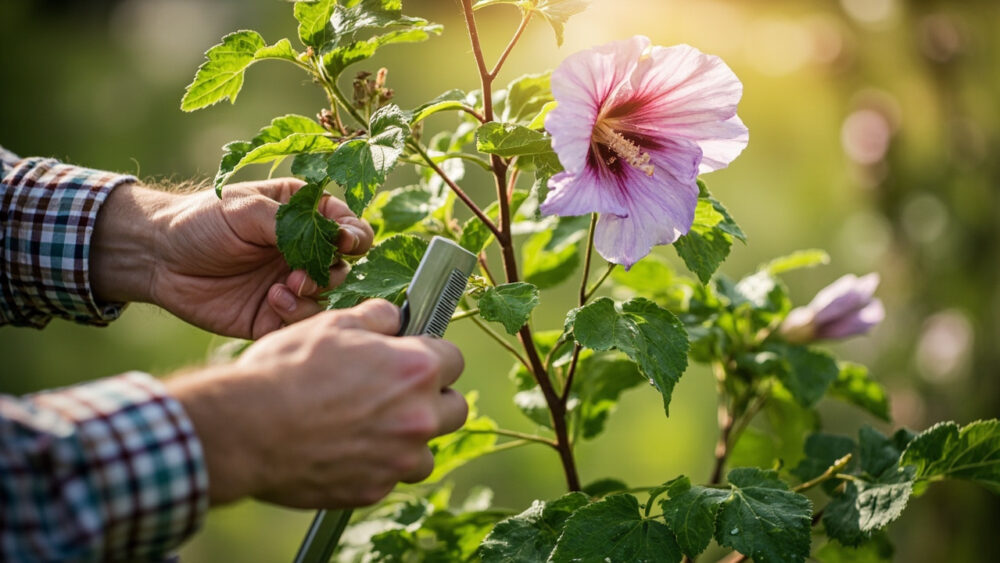
Rose of sharon grows about 1 to 2 feet per year once it’s established, reaching its mature size of 8 to 12 feet tall and 6 to 10 feet wide in roughly 5 to 8 years. Young plants from a nursery pot often look like they’re standing still for the first year, then take off once the roots catch up. That stall is normal, not failure.
How fast yours grows depends on things you can actually check today: how much sun it gets, whether the roots have room to run, and how old the plant already was when you bought it. A rose of sharon in full sun with decent soil can outpace one in part shade by a wide margin, same variety, same age.
Stick with this. Below is the stage-by-stage timeline, what actually speeds growth up versus what just wastes your money, and a saveable quick-reference card at the bottom with the numbers in one place.
The Honest Growth Timeline
Year one is mostly root establishment. Top growth might only be 6 to 12 inches, sometimes less, even though the plant is healthy. Roses of sharon spend their first season underground more than above it.
By year two or three, once roots are established, you’ll typically see 1 to 2 feet of new growth annually. This is the plant’s real growth rate, and it holds fairly steady for years.
Full mature size, 8 to 12 feet tall in most landscapes, arrives somewhere between year 5 and year 8. Some named cultivars stay smaller, more in the 4 to 6 foot range, so check the tag if you want to know your ceiling.
Next up: the variables that push your own plant toward the fast end or the slow end of that range.
What Actually Controls the Speed
Sun exposure matters more than almost anything else. Rose of sharon wants a minimum of 6 hours of direct sun. In shade it survives, blooms less, and grows noticeably slower.
Climate and zone play a real role too. Rose of sharon is hardy in USDA zones 5 through 9, and within that range, warmer zones with longer growing seasons simply pack more growth into each year than colder ones where the plant is dormant six months out of twelve.
Soil and watering come next. It tolerates average soil fine, but consistent moisture during the first two seasons builds a stronger root system, and a strong root system is what makes years three through eight fast.
Variety is the one people forget to check. Some cultivars are bred to stay compact and slower growing on purpose, so a “slow” rose of sharon might just be doing exactly what its tag promised.
If you assumed a fast-growing shrub means one that never slows down, rose of sharon actually plateaus once it hits maturity, and that’s the next thing worth understanding.
Stage by Stage: What to Expect
- Newly planted (year 1): focus is root growth, minimal visible height gain, may look stalled
- Establishing (year 2 to 3): 1 to 2 feet of new growth per year begins, first strong bloom seasons show up
- Active growth (year 3 to 6): steady 1 to 2 feet annually, shrub fills out width as much as height
- Maturity (year 5 to 8): reaches full size for its variety, growth rate slows to a few inches a year of upkeep growth
- Mature shrub (year 8+): height mostly holds, energy goes into denser branching and more blooms
That plateau at maturity is a feature, not a problem, and it’s exactly when this shrub starts blooming its heaviest.
How to Legitimately Speed It Up
Full sun placement is the single biggest lever you control. Moving a struggling shade plant isn’t always practical, but if you’re choosing a spot now, give it the sunniest one available.
Consistent watering for the first two growing seasons, about 1 inch a week including rainfall, builds roots faster than sporadic deep soaks or, worse, letting it dry out between waterings.
A balanced, slow-release fertilizer in spring can help a young plant push growth, applied per the product label. Skip heavy nitrogen feeds late in the season, they push soft growth that winter damages.
Mulch, 2 to 3 inches, keeps soil temperature and moisture steady, which matters more to root establishment than almost any product you could buy.
What doesn’t work: buying a bigger nursery plant to skip the wait. Larger transplants often experience more transplant shock and can stall out just as long as a smaller one, sometimes longer, while they rebuild root mass to match their top growth.
Pruning is the other lever people misuse, and that’s worth its own explanation.
Pruning: Helps Growth, Doesn’t Create It
Light pruning in late winter or early spring, before new growth starts, encourages bushier growth and more blooms, since rose of sharon flowers on new wood. It won’t make the plant grow taller faster, but it makes the growth it does produce more productive.
Hard pruning, cutting back by a third or more, can actually set a plant back a season while it recovers, so it’s a tool for shaping, not for speed.
Pruning shapes what growth happens, it doesn’t raise the ceiling on how much.
When Slow Growth Is Actually a Problem
Less than 6 inches of growth for two straight seasons on an established plant, especially paired with pale leaves or few blooms, points to a real issue: not enough sun, compacted or poor soil, or roots that never spread past the original planting hole.
Check the base of the plant. If it’s still loose or wobbly after its first full year, or if the soil around it stays soggy for days after rain, drainage or planting depth is likely the culprit rather than the variety or your patience.
Yellowing leaves with green veins often signal an iron deficiency tied to alkaline soil, common in rose of sharon growing in soil with a high pH. A simple soil test tells you for certain rather than guessing.
Most “slow” rose of sharon complaints turn out to be a shade or watering issue, not a sick plant, and both are fixable without starting over.
Rose of Sharon: Quick Reference
- Growth rate: about 1 to 2 feet per year once established
- Mature size: 8 to 12 feet tall and 6 to 10 feet wide, smaller for compact cultivars
- Time to maturity: roughly 5 to 8 years from a young nursery plant
- First year: minimal visible growth while roots establish, this is normal
- Hardiness: USDA zones 5 through 9
- Sun needs: at least 6 hours direct sun for best growth and bloom
- Best speed booster: full sun plus consistent watering the first two seasons
Patience gets you most of the way with this shrub, the rest is sun and water.
Give it both, and by year five you’ll wonder how it got so big so fast.