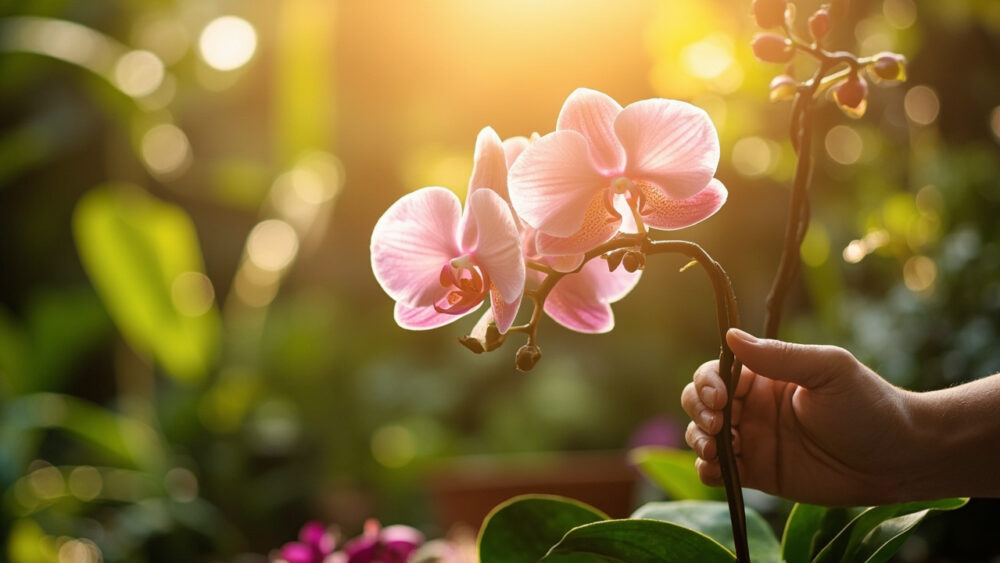
Phalaenopsis orchid light requirements come down to one simple target: bright, indirect light for 10 to 12 hours a day, roughly what you get sitting a few feet back from an east or lightly filtered south window. No direct sun beating on the leaves, but nowhere near a dim corner either. Too little light and the plant will refuse to rebloom no matter how well you water it. Too much and you get bleached, sunburned leaves that never recover.
Here is the part almost nobody gets right on the first try. Most people assume a north window or a shady spot on the counter is “gentle enough” for an orchid, and that guess is exactly what leads to a phalaenopsis that lives for years and never throws a single flower spike again.
There is also a sign of too much light that gets misread constantly, mistaken for something else entirely, and a seasonal shift that catches people every year once the light changes and nothing tells them to move the pot. Stick around, because the save-able Phalaenopsis Orchid at a Glance card at the bottom has the exact light levels, distances, and seasonal adjustments in one place.
The Plain Answer on Light Needs
Phalaenopsis orchids evolved growing on tree branches under a forest canopy, so they get filtered, dappled light, never open sun. In a home, that translates to bright indirect light, something in the range of 1,000 to 1,500 foot-candles, for most of the day.
An east-facing window is the easiest match, giving gentle morning sun without the harsh afternoon intensity. A south or west window works too, but only a few feet back or behind a sheer curtain.
If you can read a book comfortably by the window’s natural light without turning on a lamp, that is roughly the brightness a phalaenopsis wants.
Getting the number right matters less than getting the placement right, and that is where most people go wrong next.
What the Right Light Actually Looks Like in a Real Room
Forget foot-candles for a second and use your eyes. Set the plant near an east window where it catches direct sun only in the early morning, then shifts to bright shade the rest of the day.
In a south or west window, pull the pot back 3 to 6 feet from the glass, or hang a sheer curtain between the plant and the pane. The leaves should cast a soft, blurry shadow on a piece of paper held a few inches away, not a sharp, dark-edged one.
A sharp shadow means the light is too direct and too strong for the leaves to handle long term.
A north window is usually too dim on its own unless the room is otherwise very open and bright, which is the opposite of what most people assume about “safe” orchid light.
Once you know what good light looks like, you need to know what the plant looks like when the light is wrong in either direction.
Signs of Too Little Light
A phalaenopsis starved for light grows dark green, almost blackish-green leaves, thin and floppy instead of firm. It will survive for years like this, which is exactly the trap.
No flower spikes is the biggest tell. Phalaenopsis need a real light and temperature cue to bloom, and low light alone will keep it in permanent vegetative mode.
New leaves also come in noticeably smaller than the ones below them, a slow shrinking that is easy to miss if you are not comparing leaf size over time.
If your orchid has not bloomed in over a year and looks otherwise healthy, low light is the most common reason, not a lack of fertilizer like most people assume.
Signs of Too Much Light
Here is the sign everyone misreads. Leaves that turn a reddish or purplish blush along the edges get mistaken for a sign of health, even vigor, when it is actually mild sun stress starting to build.
A slight reddish tint on otherwise firm, healthy green leaves usually means the light is bright but still tolerable, and you can leave it as is if the plant looks otherwise good.
The real damage shows up as bleached yellow-white patches or papery brown, sunken spots, usually on the side of the leaf facing the window. That is permanent leaf burn, and it will not turn green again.
Move a sunburned plant back from the glass immediately, but understand the damaged tissue on that leaf is there to stay, the leaf will just need to be outgrown.
Light needs do not stay constant all year either, and that is the shift that quietly wrecks a lot of otherwise well-placed orchids.
Seasonal Changes That Catch People Off Guard
The sun’s angle drops in fall and winter, so a spot that was perfect in June can suddenly be too dim by December, especially in a south or west window where the summer sun was actually filtered by a high angle and roof overhang.
Winter light is weaker even when the window direction has not changed, so a plant sitting 5 feet back in July may need to move to 2 or 3 feet back, or right up near the glass, in January.
Summer brings the opposite problem. That same south or west window can turn brutal by midday once the sun climbs high and direct, especially through unshaded glass.
Check your orchid’s spot every season, not just once when you first bring it home.
Placement Fixes That Do Not Require a Greenhouse
You do not need a sunroom to get this right. A sheer curtain, a piece of frosted window film, or simply moving the pot a couple of feet across the room solves most light problems instantly.
Rotating the pot a quarter turn every week or two keeps growth even, since phalaenopsis will lean and grow lopsided toward a strong light source.
If every window in your home is either too dim or too harsh, a simple grow light on a timer for 12 to 14 hours a day is a reliable fix, kept 12 to 18 inches above the leaves depending on the light’s strength.
Bathrooms and kitchens with a bright window often work surprisingly well too, since the extra humidity is a bonus phalaenopsis genuinely appreciates.
Once the light is dialed in, the payoff is the part everyone actually clicked for, and it is right below.
Phalaenopsis Orchid at a Glance
- Ideal light: bright, indirect light for 10 to 12 hours a day, similar to reading light near a window without direct sun on the leaves.
- Best window: east-facing is easiest, or south or west positioned 3 to 6 feet back or behind a sheer curtain.
- Too little light looks like: dark, floppy, almost blackish-green leaves and no flower spikes for over a year.
- Too much light looks like: bleached yellow-white patches or brown papery spots on the leaf facing the window, permanent once they appear.
- Harmless warning sign: a slight reddish or purplish blush on the leaf edges means bright but tolerable light, no need to move the plant.
- Seasonal adjustment: move closer to the window in winter, farther back or behind a sheer curtain in summer.
- No good window option: use a grow light 12 to 18 inches above the leaves on a timer for 12 to 14 hours a day.
If your phalaenopsis has healthy leaves but refuses to bloom, light is the first thing to fix, not fertilizer.
Get the light right and the flower spikes tend to take care of themselves.