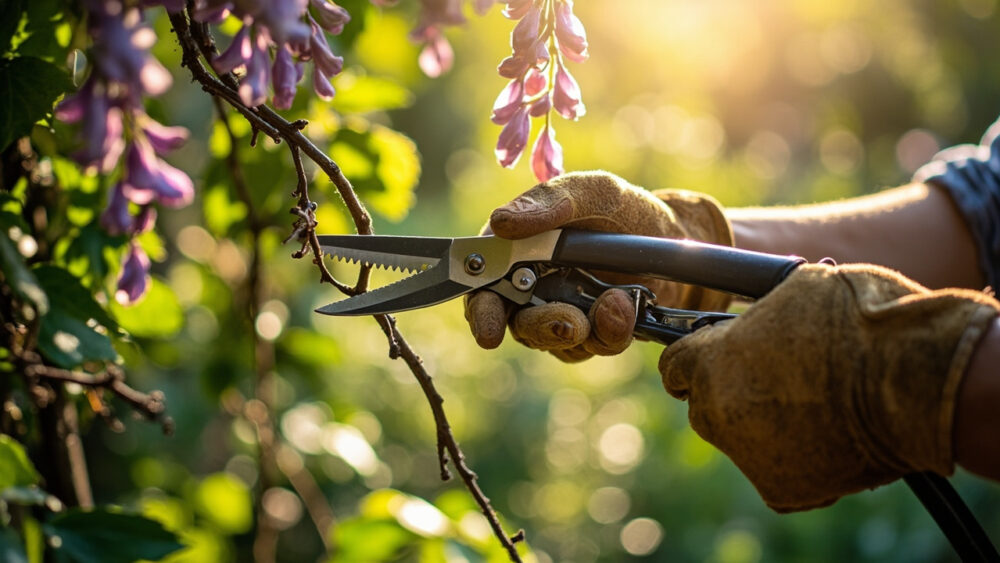
You prune wisteria twice a year: hard in late winter while it is bare, and lighter in summer right after the flush of blooms fades. The winter cut is the one that shapes the plant and sets up next year’s flowers, and it is also where most people either chicken out or go too far. Get the timing and the cut location right, and a tangled, non-blooming vine can turn into a flowering one within a year or two.
Here is the part nobody tells you before you climb the ladder with loppers: the mistake that ruins most wisteria isn’t cutting too much, it’s cutting in the wrong place, removing the very spurs that were about to flower. There’s also a sign most people misread completely, mistaking a bare, whippy shoot for dead wood when it’s actually the most productive growth on the plant. And if you’re standing there wondering why your wisteria has never bloomed despite years of vigorous growth, the pruning cut you’re about to make is very likely the answer.
Stick with this, because the full breakdown, including the printable Wisteria at a Glance card with every number you need, is waiting at the bottom of this page.
When to Prune Wisteria, and When to Leave It Alone
Do the main structural prune in late winter, while the vine is fully dormant and leafless, typically four to eight weeks before your last expected frost. You want the buds visible but still tight and not yet swelling. This is also when you can actually see the plant’s skeleton, which matters enormously for this particular vine.
The second prune happens in midsummer, four to eight weeks after flowering ends, once the long whip-like green shoots have grown a couple of feet past the flower clusters.
Do not prune wisteria hard in spring right as it is budding or blooming. You will cut off the flowers you waited a year for, and on young plants you can delay bloom by another season entirely.
Get the calendar wrong once and you’re waiting twelve months to fix it.
Tools and the One Prep Step That Actually Matters
You need bypass hand pruners for anything pencil-thick or thinner, loppers for the thicker woody stems, and a pruning saw for old, gnarled trunk wood on mature vines. Clean the blades with rubbing alcohol before you start, especially if you pruned anything diseased recently.
The prep step everyone skips is finding the main framework first. Before you cut anything, trace the permanent woody vines back to where they attach to their support and identify two or three main leaders you intend to keep long term. Everything else is either a flowering spur or a candidate for removal.
Skipping this step is why so many people end up hacking at random and losing structure they spent years building.
Once you know what stays, the actual cutting takes ten minutes.
How to Prune Wisteria Step by Step
Step 1: Remove the obvious problems first
Cut out anything dead, damaged, crossing, or growing straight into the support structure or a wall. Cut dead wood back to live tissue, which shows green or white when you nick the bark with a thumbnail.
Step 2: Cut the long whippy shoots back hard
These are the thin, fast-growing tendrils with few or no flower buds, usually the most vigorous growth on the plant. Cut them back to two or three buds from the main framework, leaving stubs about 4 to 6 inches long.
This looks brutal. It is exactly what you’re supposed to do.
Step 3: Leave the short, stubby spurs alone
Along the older woody framework you’ll see short, knobby, swollen-looking side shoots that barely extend an inch or two. These spurs are where next year’s flower clusters actually form.
If you assumed these stubby little nubs were dead or damaged growth worth cutting off, that guess is the single most common reason wisteria refuses to bloom. Leave every spur you can identify.
Step 4: Thin, don’t shear
Remove entire unwanted shoots back to their point of origin rather than shortening everything uniformly. Aim to open the canopy enough that light reaches the interior spurs, since shaded spurs flower poorly or not at all.
That’s the winter cut done, now here’s what the plant does in response.
What Happens After You Prune
Within a few weeks of the winter prune, dormant buds along the framework begin swelling, and by bloom time you should see flower clusters forming directly from those stubby spurs you left alone. New whippy growth will also explode outward once the weather warms, sometimes 3 to 5 feet in a single season.
That regrowth is normal and is exactly what the summer prune is for.
In midsummer, once flowering has finished, cut those new long shoots back again to about six leaves from the base, or roughly 12 to 18 inches. This second cut redirects the plant’s energy into forming flower buds for next year instead of growing more unproductive length.
Skip the summer prune and you’ll spend the following winter cutting away twice as much growth, with fewer spurs to show for it.
Now for the mistakes that actually cost people their flowers.
The Mistakes That Cost You Flowers
The biggest one, again, is cutting off the short flowering spurs because they look stubby and unimpressive next to the vigorous whips. Those spurs take a couple of years to build up flowering capacity, so removing them sets the plant back further than people expect.
Pruning too late in spring is the second big one. Once buds are swelling or the vine has leafed out, any structural cutting removes the flowers you were waiting for.
Third is skipping the summer prune entirely and letting the plant become a tangle of long shoots with no light reaching the interior. A wisteria grown this way can look lush and still barely flower.
Fourth, and this one is honest and a little deflating: young wisteria (especially from seed) can take five to ten years to flower regardless of how well you prune, so if your vine is still in that window, correct pruning sets it up for success but won’t force an early bloom. Grafted, named cultivars bought from a nursery typically flower much sooner, often within two to three years.
Fifth, cutting into old, thick trunk wood too aggressively in one season can stress older vines. If a plant badly needs rejuvenation, spread hard structural cuts over two winters rather than one.
Get these five right and next season’s bloom is mostly a matter of patience.
Wisteria at a Glance
- Main prune timing: late winter, four to eight weeks before your last frost, while fully dormant and bare.
- Secondary prune timing: midsummer, four to eight weeks after flowering, once new shoots extend past the flower clusters.
- What to cut hard: long whippy green shoots with few buds, back to two or three buds or about 4 to 6 inches from the framework.
- What to leave alone: short, stubby, knobby spurs along old wood, these are next year’s flowers.
- Summer cutback length: new shoots trimmed to roughly six leaves, or 12 to 18 inches, after bloom.
- Tools needed: bypass pruners, loppers for thick wood, a pruning saw for old trunks, blades cleaned with alcohol between plants.
- Time to first bloom: two to three years for grafted cultivars, five to ten years for seed-grown plants, pruning does not speed this up.
If you remember one thing, remember the spurs: stubby and unglamorous is exactly what you want to keep.
Prune the long whips hard, leave the short stubs alone, and do it twice a year, and the flowers take care of themselves.