The best time to prune honeysuckle is right after it finishes its main flush of flowers, which for most vining types is early to mid summer, and for shrub honeysuckles is right after bloom in late spring. Cut spent flower stems back by about a third, thin out crowded or crossing growth at the base, and never take more than a third of the whole plant in one session. That single rule, timing the cut to bloom rather than to the calendar, is the piece almost everyone gets backwards.
Here is what usually goes wrong. Someone prunes honeysuckle hard in early spring because that is when they prune everything else, and they wipe out a whole season of flowers without realizing the buds were already set on last year’s wood. Someone else lets a vine run wild for three or four years, then whacks it back to stubs all at once, and wonders why it sulks for the rest of the season instead of bouncing back.
There is also the question you are probably about to ask next: what do you do about a honeysuckle that is bare and woody at the bottom but still blooming like crazy up top. That has a real answer, and it is not just “cut it back and hope.” Stick with me through the how-to and the mistake list, and the save-able Honeysuckle at a Glance card at the bottom will give you the exact numbers to keep on your phone for next time.
When to Prune, and When to Leave It Alone
Honeysuckle sets next year’s flower buds on the growth it puts out after this year’s bloom. That means the safe pruning window is right after flowering finishes, not in early spring before growth starts.
For climbing types like trumpet honeysuckle and common woodbine, that is usually early to mid summer. For shrub honeysuckles, it is late spring, just after the flowers fade.
If you cut in early spring instead, you will remove the wood that was about to flower, and you will get a green, leafy plant with few or no blooms that year. That is not damage, exactly, it is just a wasted season.
The one exception is dead, damaged, or diseased wood. That comes out any time you see it, no waiting required.
One season lost to bad timing is recoverable, so do not panic if you already cut at the wrong time this year.
Next year’s flowers depend on what you do the rest of this season, and that starts with the right tools.
Tools and the One Prep Step That Actually Matters
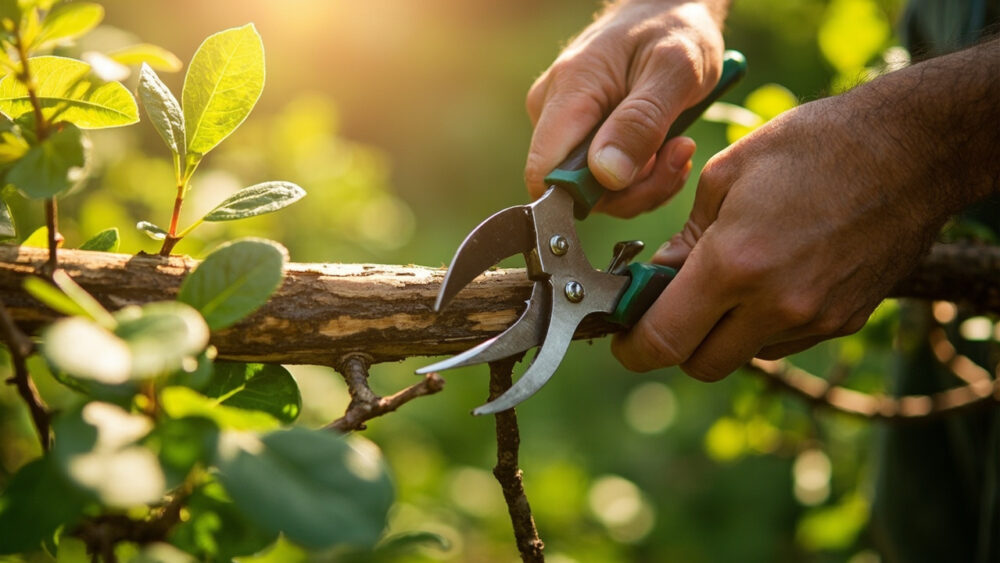
You need a clean pair of bypass pruners for anything pencil-thick or thinner, and loppers for older woody stems on established shrubs or overgrown vines. For a vine that has turned into a tangled mat, hand shears help you thin without hacking blindly.
The prep step nobody wants to do is tracing the stems before you cut. Honeysuckle vines twist around themselves and their support, and a stem that looks dead at the top is often still alive at the base, or the reverse.
Follow each stem from the ground up for a few feet before you commit to a cut. Five minutes of tracing saves you from cutting a stem that was actually feeding a healthy section higher up.
Wipe your blades with rubbing alcohol between plants, especially if you are working on a shrub honeysuckle that has shown any leaf spot or powdery mildew.
Once you know which stems are which, the actual cutting is straightforward.
Step 1: Remove the Dead, Damaged, and Crossing Wood First
Start every pruning session here, regardless of the season. Cut dead stems back to where you find live green tissue underneath the bark, or all the way to the base if the whole stem is dry and brittle.
Remove any stems that cross and rub against each other, choosing the healthier of the two to keep.
Step 2: Cut Back the Spent Flower Stems
On vining honeysuckle, cut flowering side shoots back by about a third to a half, making the cut just above a leaf node. On shrub types, shape the whole plant by trimming the outer growth back by roughly a third.
This is what triggers the fresh growth that will carry next year’s buds.
Step 3: Thin the Base to Let in Light and Air
Pick two or three of the oldest, thickest stems and cut them out entirely at ground level, even if they look otherwise healthy. This is renewal pruning, and it is what keeps an established honeysuckle from turning into a solid, airless tangle over the years.
Do this every year or two rather than all at once on an overgrown plant.
Step 4: Rein In Length on Vigorous Vines
If a vine has outgrown its trellis, arbor, or fence, cut the longest runners back to a strong side shoot or bud, rather than shearing the whole thing flat. This keeps the natural arching habit instead of leaving you with a stubbly wall of cut ends.
Do all four steps and you are done for the year, but what happens next depends on how hard you actually cut.
What to Expect in the Weeks After You Cut
A light, well-timed prune shows results fast. New shoots usually appear within two to three weeks, and those shoots are what will carry next year’s flowers.
If you had to do a harder renovation cut on a badly overgrown plant, expect a season of mostly foliage with fewer or no flowers. That is the honest tradeoff for fixing years of neglect in one go.
This is the answer to the bare-bottomed, top-heavy honeysuckle problem. If your vine or shrub is leggy and woody low down but still flowering up high, do the renewal cuts in Step 3 over two consecutive years rather than one. Removing a third of the oldest stems each year forces new growth from the base without sacrificing the whole season’s bloom at once.
Water and a light feed after a hard prune help the plant push new growth faster, but resist the urge to fertilize heavily. A rushed flush of soft new growth is more attractive to aphids than a slower recovery.
Most of the disappointing honeysuckle seasons trace back to one of a handful of avoidable mistakes.
The Mistakes That Cost You a Season of Flowers
- Pruning in early spring: this removes the wood that was about to bloom, the single most common reason for a flowerless summer.
- Shearing the whole plant to one height: this ruins the natural arching or climbing form and encourages a dense outer shell with a bare, tangled interior.
- Taking more than a third of the plant at once: a plant stripped this hard puts its energy into survival, not flowers, for at least a year.
- Never thinning the base: skipping renewal cuts for years in a row leaves you with a woody, hollow-centered plant that eventually stops flowering well anywhere.
- Ignoring the support structure: cutting vine growth without checking whether it is strangling its own trellis or a nearby shrub leads to girdled stems that die back on their own.
Every one of these is fixable, and the fix is almost always patience over the next full growing cycle.
Honeysuckle at a Glance
- Best time to prune: right after flowering, early to mid summer for vines, late spring for shrub types.
- Time to avoid: early spring, before new growth starts, since it removes the season’s flower buds.
- How much to remove: no more than a third of the plant in a single session, spread renovation work over two years if heavily overgrown.
- Where to cut: just above a leaf node on flowering side shoots, at the base for renewal cuts on old woody stems.
- Tools needed: bypass pruners for thin growth, loppers for thick old wood, blades wiped clean between cuts.
- Recovery time: new shoots in two to three weeks after a light prune, a full season of mostly foliage after a hard renovation cut.
- Renewal rhythm: remove two or three of the oldest stems at the base every year or two to keep the plant flowering well long term.
Get the timing right and honeysuckle forgives almost everything else you might do wrong.
When in doubt, prune less than you think you should and wait for next year’s flowers to tell you if you were right.