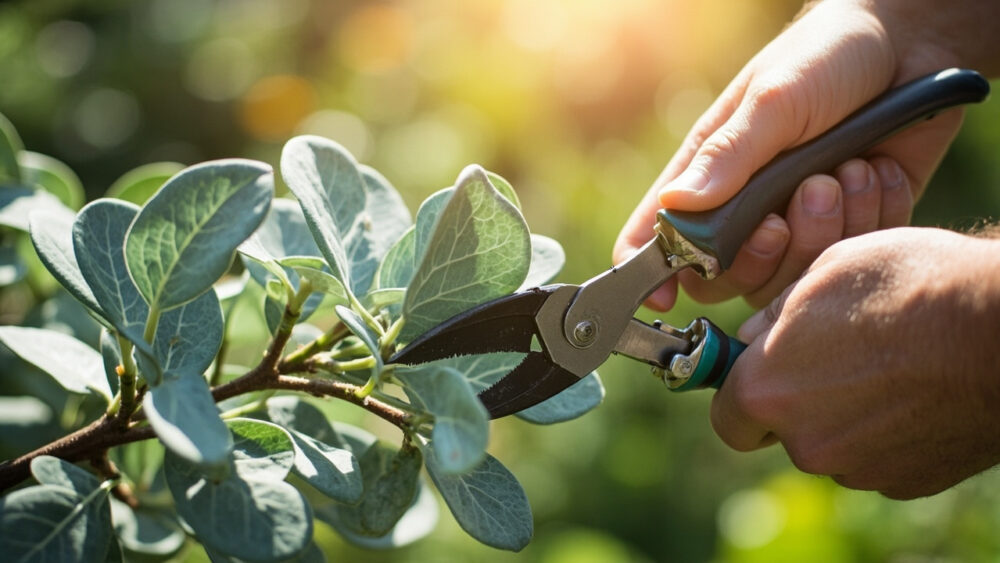
The short answer: prune eucalyptus in late spring to midsummer, once frost danger has fully passed and the tree is actively growing, never in late fall or winter when cuts sit open and vulnerable to cold damage. Take no more than 15 to 20 percent of the canopy in a single season on an established tree. Cut back to a healthy lateral branch or bud, never leaving a bare stub, and never take a hard hand to a young tree still building its root system.
That is the core of it, but eucalyptus punishes sloppy pruning harder than most trees people plant in their yard. There is one mistake that ruins the shape of a eucalyptus for years, and it is not the one most people worry about.
There is also a sign of stress that looks exactly like “the tree needs more water” and is actually the opposite problem entirely, plus a question you have not asked yet about why your eucalyptus keeps throwing up thin, floppy juvenile leaves no matter how much you prune it. Stick around for the Eucalyptus at a Glance card at the bottom, it is built to save to your phone before you walk back out to the tree.
When to Prune, and When to Absolutely Leave It Alone
Late spring through midsummer is the window, after new growth has hardened off a little and the tree has months of warm weather ahead to heal. Eucalyptus heals cuts through active growth, not through winter dormancy the way an apple tree does, so pruning it in fall or winter leaves wounds sitting open for months with nothing happening.
Skip pruning entirely in the first year or two after planting except to remove damage. A young eucalyptus is spending its energy on roots, and every cut you make asks it to redirect that energy into healing instead.
Also skip it during drought stress or right after a heat spell, even in season. A stressed tree responds to pruning with slower healing and sometimes with a flush of weak, whippy regrowth instead of solid branching.
Get the timing right and the next question is what you actually need in hand before you make a cut.
Tools and the One Prep Step Nobody Skips (But Should)
For anything under an inch thick, sharp bypass hand pruners do the job cleanly. For branches an inch to two and a half inches, use loppers. Anything bigger than that on a mature eucalyptus is a job for a pruning saw, and on trees over 15 to 20 feet with large limbs overhead, it is a job for a certified arborist, not a Saturday project.
The prep step that matters most is disinfecting your blades between cuts, especially if you are removing anything diseased or dead. Wipe blades with rubbing alcohol or a household disinfectant between trees at minimum, and between cuts if you see any sign of dieback, oozing, or discoloration in the wood.
Eucalyptus is not especially disease-prone, but a dirty blade is how you turn one sick branch into a sick tree. Dull blades are the other silent problem: a crushed cut heals slower than a clean one, every time.
Once your tools are ready, the cuts themselves follow a specific order.
How to Prune Eucalyptus, Step by Step
Step 1: Remove the dead, damaged, and crossing wood first
Before you shape anything, clear out what is already a problem. Dead branches are usually gray, brittle, and bark-shedding compared to the live wood around them.
Cut these back to where they meet healthy wood, or all the way to the trunk if the whole branch is gone. This alone often opens up 5 to 10 percent of the canopy without touching a single healthy limb.
Step 2: Cut back to a lateral branch or bud, never mid-air
This is where most people go wrong. Every cut needs to land just outside a lateral branch, a bud, or a node, at a slight angle, roughly a quarter inch beyond it.
Cutting into open space between nodes leaves a stub with nowhere to direct growth, and that stub usually dies back and rots inward.
Step 3: Thin from the inside out, not the outside in
Reach into the canopy and remove crowded, crossing, or inward-growing branches before you touch the outer silhouette. This keeps air moving through the tree and preserves its natural, slightly wild branching habit.
Shearing the outside into a ball or hedge shape is the fastest way to trigger a thicket of weak, whippy regrowth that needs cutting again next year.
Step 4: Stop at 15 to 20 percent
Stand back every few cuts and reassess. It is easy to keep going once you are in a rhythm, and eucalyptus does not forgive an over-thinned canopy the way a forgiving shrub might.
If you are unsure whether you have hit your limit, stop. You can always come back next season.
Once the cuts are made, the tree tells you fairly quickly whether you got it right.
What to Expect in the Weeks After Pruning
Expect a burst of new growth within 2 to 4 weeks during the active growing season, often clustered right around your cut points. This is normal and is the tree doing exactly what it should.
Here is the sign everyone misreads: if that new growth comes in as soft, rounded, silvery-blue juvenile leaves instead of the narrow, sickle-shaped adult leaves the tree had before, that is not distress and it is not the tree “reverting.” It is a completely normal response to hard pruning, especially on species like silver dollar eucalyptus that are grown commercially specifically for that juvenile foliage.
What is not normal is wilting, blackened leaf margins, or sap oozing from cut sites more than a week or two out. That combination points to a cut made in the wrong season, a dirty blade, or a stressed tree that was pruned when it should have been left alone.
Most of the time what you are looking at is healthy vigor, not a warning sign, but there is one more layer to check.
The Mistakes That Cost You Years, Not Just a Season
Topping the tree is the single biggest mistake, and it is the one most people assume is fine because it is common practice on other fast-growing trees. Eucalyptus responds to a topping cut by throwing dozens of weak, poorly attached shoots from just below the cut, and those shoots are prone to snapping in wind for years afterward. A topped eucalyptus never fully recovers its original structure.
- Pruning too young: heavy cuts on a tree under two years old slow root establishment and can stunt the whole tree.
- Pruning in cold weather: open wounds in fall or winter invite dieback that spreads well past the cut.
- Leaving stubs: any cut not made at a node or lateral branch rots inward instead of healing over.
- Removing too much canopy at once: beyond 20 percent, the tree often responds with a flush of weak regrowth rather than steady, useful branching.
- Shearing into a formal shape: it fights the tree’s natural growth habit and creates ongoing maintenance you did not sign up for.
Avoid these five and pruning eucalyptus becomes a once- or twice-a-season task instead of a recurring repair job.
Eucalyptus at a Glance
- When to prune: late spring through midsummer, once frost risk is gone and the tree is actively growing.
- When to avoid pruning: fall, winter, drought stress, heat stress, and the first one to two years after planting.
- How much to remove: no more than 15 to 20 percent of the canopy per season on an established tree.
- Where to cut: just outside a lateral branch or bud, at a slight angle, never mid-air leaving a stub.
- Tools: bypass hand pruners under 1 inch, loppers up to 2.5 inches, a pruning saw beyond that, disinfected between cuts on diseased wood.
- Normal aftermath: new growth in 2 to 4 weeks, sometimes soft silvery juvenile leaves instead of the usual adult foliage.
- Warning signs: wilting, blackened margins, or ongoing sap oozing past two weeks means the timing or technique was off.
Get the timing and the 20 percent rule right and eucalyptus is genuinely low-maintenance. Get either wrong and you are managing the consequences for years, not just one season.