A healthy river birch grows 1.5 to 2.5 feet per year once it’s established, which makes it one of the faster shade trees you can plant. That means a 6 to 8 foot sapling from the nursery can hit 30 to 40 feet in 15 to 20 years, with real shade arriving in year 5 to 7. That is the honest average, and your tree could easily beat it or lag behind it depending on a few things I’ll walk through.
Here’s the loop worth opening first: the first two years look nothing like the ten years after that, and a lot of new owners panic during the slow part thinking they bought a dud. There’s also a specific mistake, planting too deep or in poor drainage, that quietly stalls growth for years without ever killing the tree outright, so you never quite figure out why it’s sulking.
Stick with me through the stages and the speed controls, and I’ll show you how to read your own tree’s growth honestly. The save-able quick-reference card with the numbers you’ll want to check back against is waiting at the bottom.
The Realistic Growth Timeline
Year one and two are the establishment phase, and growth during that window is often disappointing, sometimes just 6 to 12 inches a year while the roots get sorted out. Don’t judge the tree by this stretch.
From year three onward, once roots are established, you’ll typically see 1.5 to 2.5 feet of vertical growth annually, sometimes pushing 3 feet in a great year with ample water and heat. By year 5 to 7 most river birches are 15 to 20 feet tall and starting to cast real shade. By year 15 to 20, a single-stem or clump form can reach 30 to 50 feet, with clump forms often appearing fuller sooner because you’re getting growth from three or more stems at once.
Next up: the variables that actually decide whether you land on the fast end or the slow end of that range.
What Actually Controls the Speed
Water availability is the single biggest factor. River birch is named for a reason, it evolved along streambanks and wants consistently moist soil. A tree with steady access to water, whether from natural site conditions or supplemental watering through its first 3 summers, will noticeably outpace a tree left to fend for itself in dry, compacted soil.
Climate and zone matter too. River birch thrives in USDA zones 4 through 9, but growth is faster and the tree is generally happier in the warmer half of that range with reliable summer rainfall, and slower and more stress-prone in hot, dry climates like the southern Plains or interior Southwest, where afternoon heat and low humidity punish it.
Sun exposure counts as well. Full sun, 6 or more hours a day, drives faster growth than a tree stuck in partial shade competing with other roots.
Soil and planting depth are the quiet variable most people never suspect.
The Mistake That Stalls Growth for Years
If you assumed a slow river birch just needs more fertilizer, that guess is usually wrong and can make things worse. The far more common culprit is planting depth or drainage.
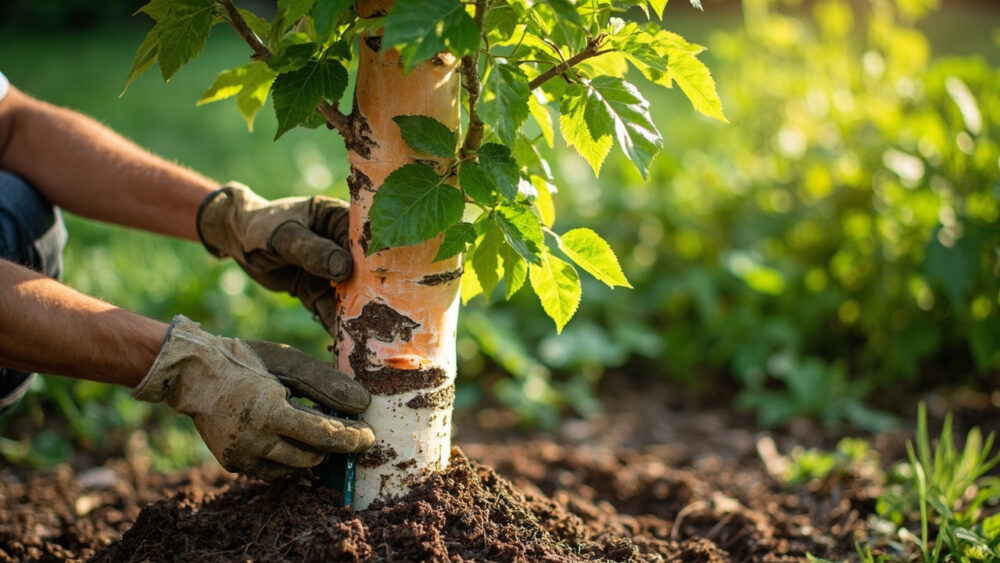
A river birch planted even 2 to 3 inches too deep, with the root flare buried instead of visible at soil level, will often survive for years while barely growing, because it’s essentially suffocating slowly instead of establishing normally. Heavy clay soil that holds water in a bathtub effect around the roots causes a similar quiet stall, though in the opposite direction of drought stress.
Check the base of your trunk right now. You should be able to see where the trunk widens into root flare at or just above soil level. If it disappears straight into the ground like a fence post, that’s very likely your growth problem, and it’s fixable by carefully excavating soil away from the flare rather than replanting the whole tree.
Once planting depth checks out, the next question is what you can do to legitimately speed things along.
How to Speed It Up, and What Doesn’t Work
Consistent water is the single best lever you have, especially during the first two establishment years and through any drought stretch after that. Aim for the equivalent of about 1 inch of water a week for a young tree, checking soil moisture a few inches down with your finger rather than going by the calendar.
A 2 to 3 inch layer of mulch, kept a few inches back from the trunk, holds that moisture and moderates soil temperature, which genuinely accelerates root growth. Light, timed fertilization in spring can help on poor soils but is not a shortcut on a tree that’s already getting adequate water and sun.
What doesn’t work: heavy annual pruning to “encourage growth,” which mostly just stresses the tree, and dumping high-nitrogen fertilizer on a stalled tree without first checking planting depth and drainage. That treats a symptom while ignoring the actual cause.
Even with everything right, some trees are simply slower than others, and that’s where the next section matters.
When Slow Growth Is Normal vs. a Real Problem
A river birch putting on less than 6 inches a year after its third season, especially paired with sparse leaves, early yellowing, or thin canopy, is genuinely underperforming and worth investigating. Check water, check planting depth, and check for root competition from nearby trees or turf.
But a tree that’s growing steadily even at 12 to 18 inches a year, with good leaf color and no dieback, is not a problem. It’s just not maxing out its genetic potential, often because of partial shade or a leaner site, and that’s a perfectly fine tree to have.
Bark peeling and flaking is not a symptom of anything, by the way. That’s just what river birch bark does as the tree matures, and it’s actually one of its best ornamental features, not a warning sign.
Now here’s the card worth saving before you head back out to look at your own tree.
River Birch: Quick Reference
- Average growth rate: 1.5 to 2.5 feet per year once established, sometimes up to 3 feet in ideal conditions.
- Establishment period: years 1 and 2 are slower, often just 6 to 12 inches annually while roots develop.
- Mature size and timeline: 30 to 50 feet tall in 15 to 20 years, with real shade by year 5 to 7.
- Best zones: USDA zones 4 through 9, with the warmer, wetter half of that range producing faster growth.
- Biggest speed factor: consistent moisture, roughly 1 inch of water per week for young trees.
- Most common hidden problem: planting too deep, check that the root flare is visible at soil level.
- Normal, not a symptom: peeling, curling bark is a natural feature of the species, not a health issue.
Give it consistent water, correct planting depth, and a few seasons of patience, and a river birch will reward you faster than almost any other shade tree you could plant.
That’s the honest timeline, now go check your root flare.